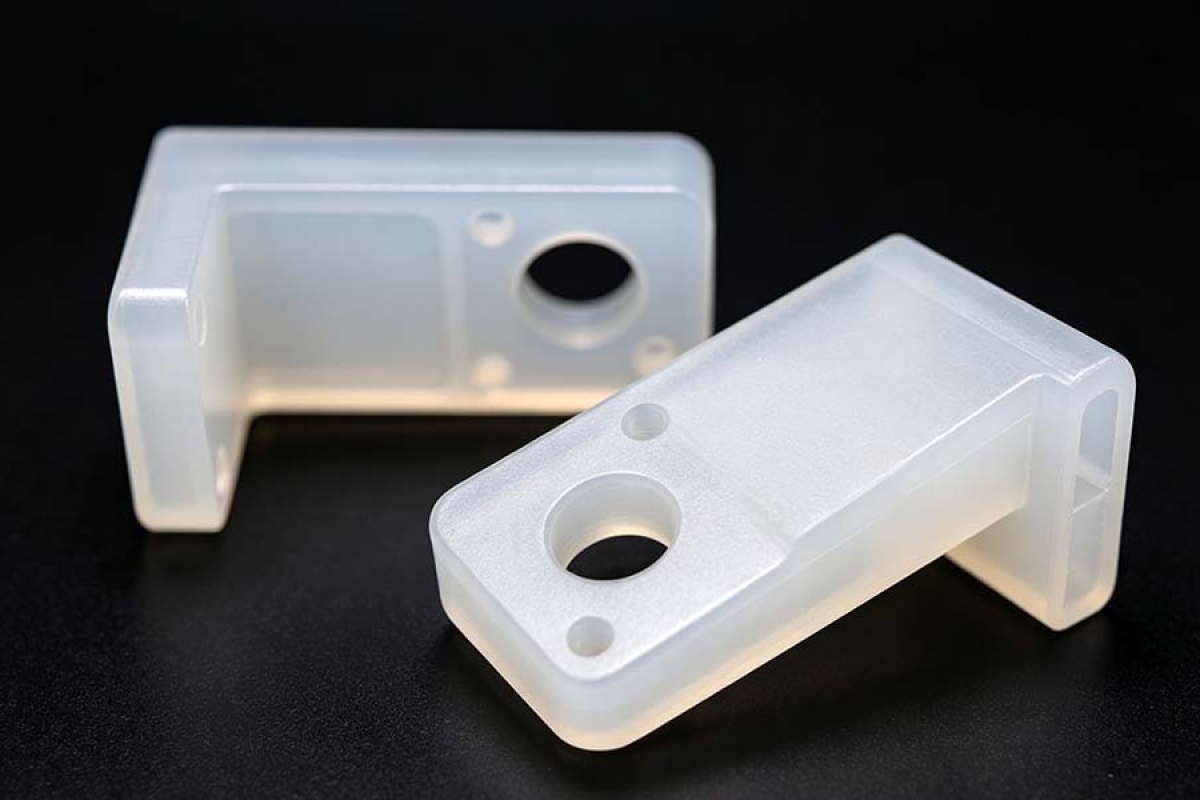
PET (Polyethylene Terephthalate) is a high-performance thermoplastic polyester widely used in industrial precision parts, electrical components, mechanical wear parts and equipment accessories. With excellent dimensional stability, ultra-low moisture absorption, good wear resistance and electrical insulation, PET has become a cost-effective choice for precision CNC machining. As a professional precision machining manufacturer, Evefab provides customized PET and PET-P CNC machining services for automation, electronic, food machinery and industrial equipment industries.
Different grades of PET materials (unfilled PET, engineering-grade PET-P, transparent PET-G, glass fiber reinforced PET) have huge differences in mechanical properties, thermal stability and machinability. Evefab selects matching material grades according to customer application scenarios to avoid material substitution errors and ensure part service performance and stability.
1. Basic Material Information
What Is PET?
PET is a classic thermoplastic polyester material. In the field of CNC precision machining, engineering-grade PET-P is the most mainstream application type, which is specially modified for mechanical processing and precision industrial parts. Compared with nylon and ordinary plastics, PET has outstanding dimensional stability and low friction characteristics, and can maintain high precision in variable humidity environments.
Common industrial PET series materials include general unfilled PET, machining-specific PET-P, transparent PET-G and reinforced PET. Their performance parameters are different and cannot be replaced arbitrarily. Evefab strictly distinguishes material grades in customized processing to meet diverse working condition requirements.
Standard Designations and Material Identification
Item | Typical designation |
Material | Polyethylene Terephthalate (PET) |
Abbreviation | PET |
Polymer family | Thermoplastic polyester |
Common engineering grade | PET-P |
Common transparent grade | PET-G |
ISO material designation | PET |
Common stock forms | Sheet, plate, rod, tube |
Typical applications | Bushings, rollers, guides, electrical components, wear parts |
Core Market Positioning
PET is a cost-effective engineering thermoplastic that balances precision, wear resistance and insulation performance. It is widely used in scenarios that do not require ultra-high temperature resistance of PEEK but require stable dimensional accuracy and low friction. Its core advantages processed by Evefab are as follows:
Excellent long-term dimensional stability
Far lower moisture absorption than nylon materials
Good wear resistance and low friction coefficient
Stable electrical insulation performance
Excellent chemical corrosion resistance
Superior CNC machinability with smooth finished surface
High rigidity among ordinary thermoplastics
Cost-effective, suitable for mass precision parts production
2. Physical Properties of PET
Property | Typical Value / Range |
Density | ~1.30–1.40 g/cm³ |
Tensile strength | ~50–80 MPa |
Tensile modulus | ~2.5–3.5 GPa |
Elongation at break | 10–50% (grade-dependent) |
Flexural modulus | ~2.5–3.5 GPa |
Water absorption | Very low |
Glass-transition temperature | ~70–80°C |
Melting temperature | ~245–260°C |
Thermal conductivity | ~0.2–0.3 W/m·K |
Continuous-use temperature | 100–120°C (grade-dependent) |
Electrical insulation | Good–Excellent |
Wear resistance | Good |
Dimensional Stability
PET's biggest advantage over nylon materials is ultra-low moisture absorption. It will not expand or deform due to environmental humidity changes, so it can maintain long-term dimensional stability. Evefab widely uses PET materials to process precision parts such as precision bushings, mechanical guides, instrument accessories and test fixtures, which are suitable for high-precision equipment working in variable humidity environments.
It should be noted that PET has a higher thermal expansion coefficient than metal materials. For high-precision parts, Evefab will control processing temperature and carry out constant-temperature inspection to avoid dimensional deviation caused by thermal expansion and contraction.
Mechanical Performance
PET has a balanced comprehensive mechanical performance, with moderate rigidity, structural strength, wear resistance and low friction characteristics. It is stiffer than most soft thermoplastics and can adapt to light-load sliding friction working conditions. It is the preferred material for ordinary industrial wear-resistant precision parts with cost control requirements.
Temperature Resistance
PET's high-temperature resistance is weaker than high-performance plastics such as PPS, PPSU and PEEK. Its continuous service temperature is affected by load, working time, material crystallinity and part structure. Evefab will strictly evaluate the temperature resistance of PET materials according to actual working conditions and recommend alternative high-temperature materials for high-temperature continuous working scenarios.
3. Chemical Properties of PET
Chemical Resistance
PET has excellent resistance to most conventional industrial media, including dilute acid, various greases, hydrocarbons, partial alcohols and daily cleaning agents. It is stable in conventional industrial environments.
However, strong alkali, high-concentration acid and special organic solvents will erode and hydrolyze PET materials, especially in high-temperature environments. Evefab will verify chemical compatibility one by one for parts contacting special media to ensure long-term service stability.
Hydrolysis Resistance
PET contains ester bond structure, and long-term exposure to high-temperature water or steam will cause hydrolysis and performance degradation. Therefore, PET is not suitable for continuous high-temperature water vapor working scenarios, and Evefab will recommend PPS and other hydrolysis-resistant materials for such working conditions.
Oxidation and Environmental Stability
Ordinary PET has good atmospheric stability, but long-term ultraviolet radiation will cause aging and performance attenuation. For outdoor application parts, Evefab recommends UV-stabilized PET grades or surface protective coating treatment to improve environmental adaptability.
Chemical Composition
PET is polymerized from ethylene glycol and terephthalic acid. Commercial engineering PET materials will be added with glass fiber, mineral fillers, lubricants, UV stabilizers and other additives according to different grades to meet wear resistance, reinforcement and anti-aging requirements.
Welding and Bonding
PET supports a variety of assembly methods, including mechanical fastening, ultrasonic welding, thermal welding and adhesive bonding. Evefab matches targeted surface pretreatment processes and high-performance adhesives according to assembly methods to ensure firm and stable part assembly.
4. CNC Machinability Analysis of PET
Machining Difficulty: Easy to Moderate
PET is one of the most machinable engineering thermoplastics. Compared with glass-filled plastics and high-performance plastics such as PEEK and PAI, PET has low processing difficulty, low tool loss and stable molding effect. With standardized processing technology,Evefab stably outputs high-precision and burr-free PET precision parts.
The key points of PET high-quality processing include: keeping tools sharp, smooth chip evacuation, controlling cutting heat, reasonable workpiece clamping and optimizing feeding parameters to avoid tool friction and material surface smearing.
Recommended CNC Cutting Tools
For conventional unfilled PET parts, sharp carbide tools are the first choice for batch production, with stable dimensional accuracy and long tool life; high-speed steel tools can be used for small-batch prototype processing. For glass fiber reinforced PET materials, Evefab is equipped with high-wear-resistant special carbide tools to reduce tool wear.
Tool Geometry Requirements
Tools with sharp cutting edges and positive rake angle can effectively reduce cutting heat, cutting resistance, burr generation and material surface smearing. Evefab adheres to the principle of replacing dull tools in time rather than adjusting parameters to compensate for tool wear, ensuring consistent processing quality.
5. General CNC Machining Parameters for PET
PET processing parameters need to be adjusted according to tool specification, equipment rigidity, part structure and material grade. The following is the standardized processing scheme adopted by Evefab for mass production:
Operation | Recommended Processing Approach |
Rough milling | Moderate cutting parameters, priority to ensure smooth chip removal |
Finish milling | Sharp carbide tool, small margin light finishing pass |
Drilling | Special sharp drill bit, stable low-speed feeding |
Deep-hole drilling | Peck drilling processing, intermittent chip evacuation |
Turning | Positive rake angle sharp carbide tool |
Reaming | Constant feeding speed, rigid workpiece clamping |
Tapping | Sharp tap, control cutting load to avoid tooth breakdown |
Due to the low thermal conductivity of PET, cutting heat is not easy to dissipate. Evefab always takes "sharp cutting + smooth chip removal + heat control" as the core processing principle to avoid thermal deformation of parts.
6. Common PET CNC Machining Problems & Solutions
1. Burr Formation
Burrs are easy to appear at hole exits, groove edges, cavity contours and thin-wall positions of PET parts.
Evefab Optimization Solutions: Equip brand-new sharp tools, optimize feeding speed, reduce tool deflection, add independent finishing procedures, and carry out precise secondary deburring to ensure smooth edges of parts.
2. Heat Accumulation
Long-term tool friction will cause heat accumulation, resulting in material surface smearing, edge deformation and dimensional deviation.
Evefab Optimization Solutions: Use sharp cutting tools, strengthen chip evacuation, match reasonable cutting speed and feed volume, control tool cutting depth, avoid friction heating, and realize cutting processing instead of friction processing.
3. Part Deflection
Thin-wall, long-strip and large flat PET parts are easy to deform under clamping force and cutting force.
Evefab Optimization Solutions: Add auxiliary support fixtures, reduce clamping pressure appropriately, reserve reasonable roughing allowance, adopt multiple small finishing passes, and process thin-wall features in the final procedure.
4. Edge Chipping
Sharp corners and unsupported tiny features of PET parts are prone to chipping during processing.
Evefab Optimization Solutions: Optimize design by adding inner fillets and chamfers, ensure sufficient feature wall thickness, and use special finishing tools to protect part edges.
5. Dimensional Drift
Dimensional errors are caused by thermal expansion, material residual stress, tool wear and clamping deformation.
Evefab Optimization Solutions: Monitor tool life in real time, optimize clamping scheme, process and inspect parts in constant-temperature environment, and eliminate residual stress interference.
7. PET CNC Machining Tolerances
With standardized processing technology and precision equipment of Evefab, conventional PET parts can stably achieve±0.05 mm precision tolerance. For rigid parts with regular structures, tighter precision control can be realized through process optimization, constant-temperature processing and precision detection.
Evefab recommends adopting GD&T geometric tolerance design for precision assembly parts, focusing on key assembly dimensional accuracy and avoiding unnecessary full-scale high-precision requirements to balance quality and cost.
8. PET Surface Finish
After professional finishing processing by Evefab, PET parts can achieve a smooth and burr-free surface with a surface roughness of Ra 1.6–3.2 μm. The surface quality is affected by tool geometry, cutting parameters, equipment rigidity and finishing technology. Independent fine finishing procedures can effectively improve surface flatness and appearance quality.
9. PET CNC Machining Processes
PET is suitable for 3-axis, 4-axis and 5-axis CNC milling processing. Evefab customizes various complex structural parts such as equipment brackets, protective covers, precision fixtures, sliding guides, wear-resistant plates and electrical insulating parts.
PET rod materials are widely used in turning processing, and can be processed into precision bushings, conveyor rollers, positioning spacers, sealing sleeves, mechanical rotating rings and other rotary parts, which are widely used in automated transmission mechanisms.
CNC Drilling & Reaming
Sharp drills can realize high-precision drilling of PET materials. For deep-hole parts, Evefab adopts peck drilling technology to ensure smooth chip removal and avoid hole wall scorching and deformation. Precision reaming process is used for matching holes to achieve high-precision assembly requirements.
CNC Tapping
PET supports internal thread tapping and is suitable for light-load assembly scenarios. For repeated disassembly and assembly parts, Evefab recommends embedded metal thread inserts to improve thread durability and service life.
10. PET for Thin-Walled and Complex CNC Parts
PET can meet the processing requirements of complex special-shaped structures, but thin-wall structures have certain flexibility. Evefab summarizes mature thin-wall PET part processing technology:
Reserve supporting materials during roughing to enhance structural rigidity;
Strictly control clamping force to avoid elastic deformation;
Reserve uniform finishing allowance to ensure processing consistency;
Use brand-new sharp finishing tools and reduce single cutting force;
Process key thin-wall features in the final procedure to avoid secondary extrusion deformation;
Place parts in constant-temperature environment for natural stress relief before final inspection to ensure dimensional stability.
11. Typical PET CNC Machining Applications
Industrial Machinery Parts
Relying on low friction and wear resistance, PET is processed by Evefab into mechanical bushings, wear-resistant gaskets, transmission rollers, sliding guides, positioning spacers and equipment protective covers, which are used for light-load sliding friction parts of industrial equipment.
Electrical & Electronic Components
With stable insulation performance and dimensional stability, PET is suitable for processing insulating plates, electronic spacers, connector accessories, electrical brackets and sensor structural parts, ensuring safe and stable operation of electronic equipment.
Automation Equipment Parts
Evefab's customized PET precision parts include automation guide rails, positioning fixtures, conveyor accessories, mechanical limit stops and insulating brackets, which are widely used in automated production lines.
Food Processing Equipment
Food-grade compliant PET grades can be used for food machinery guides, rollers, wear strips and isolation spacers. Evefab provides formal material compliance certification to meet food contact safety standards.
Packaging Machinery Parts
PET's wear resistance and high-precision processing performance make it suitable for packaging machine guide parts, transmission rollers, precision bushings and quick-change positioning parts, reducing equipment maintenance frequency.
Consumer & Industrial Products
It can also be processed into equipment shells, protective covers, structural brackets and customized special-shaped mechanical parts, covering various civil and industrial product scenarios.
12. PET vs. Other CNC Machining Plastics
Property | PET | POM | Nylon | PEEK | PPS |
CNC Machinability | Good | Excellent | Good | Moderate | Moderate |
Dimensional Stability | Good | Excellent | Moderate | Excellent | Excellent |
Moisture Absorption | Low | Very Low | Higher | Very Low | Very Low |
Wear Resistance | Good | Excellent | Good | Excellent | Good–Excellent |
Temperature Resistance | Moderate | Moderate | Moderate | Excellent | Excellent |
Chemical Resistance | Good | Good | Moderate | Excellent | Excellent |
Impact Resistance | Good | Good | Excellent | Excellent | Moderate |
Relative Cost | Moderate | Moderate | Low–Moderate | Very High | High |
Material Selection Comparison
PET vs. POM: POM has better low friction and wear resistance and simpler processing; PET has higher rigidity and more stable electrical insulation, suitable for precision insulating structural parts.
PET vs. Nylon: PET has lower moisture absorption and more stable precision; nylon has better impact toughness, suitable for parts requiring shock resistance.
PET vs. PEEK: PEEK has ultra-high comprehensive performance but high cost; PET is cost-effective and suitable for conventional medium and low-temperature precision parts.
PET vs. PPS: PPS has better high temperature and chemical resistance; PET has better machinability and lower cost, suitable for conventional industrial working conditions.
13. Our PET CNC Machining Advantages
Professional Material Selection Support
Evefab professional engineering team selects materials accurately according to customer working conditions, distinguishing standard PET, engineering PET-P, transparent PET-G and reinforced PET grades. We match materials according to load, temperature, humidity, chemical environment, wear resistance, precision and electrical requirements to avoid material waste and performance mismatch.
Optimized CNC Process Development
Aiming at PET's material characteristics, we formulate exclusive processing processes: full-process sharp tool configuration, precise cutting force control, cutting heat management, efficient chip evacuation, rigid workpiece clamping, full-link dimensional stability control and batch production repeatability optimization.
Full Precision Inspection System
We provide customized inspection services including dimensional full inspection, FAI first article inspection, GD&T geometric tolerance verification, surface roughness detection, material certification and conformity reports to meet different industry quality standards.
Full-Cycle Production Service
Support full-cycle services from prototype verification, small-batch trial production to mass batch manufacturing. For recurring orders, Evefab optimizes fixtures and process parameters to improve production efficiency, part consistency and cost control.
14. PET CNC Machining Design Guidelines
Avoid Extremely Thin Walls
Ultra-thin wall structures are prone to clamping deformation and processing deflection. It is recommended to appropriately increase wall thickness or add reinforcing ribs to improve structural rigidity.
Add Internal Radii
Designing reasonable inner fillets can reduce cutting tool stress, avoid corner chipping, and improve processing efficiency and part structural strength.
Control Clamping Force
Excessive clamping force will cause elastic deformation of PET parts, resulting in dimensional rebound deviation after clamping. Reasonable clamping pressure and auxiliary support are required.
Consider Thermal Expansion
PET has a large thermal expansion coefficient. High-precision parts need to be inspected in a constant-temperature environment to eliminate dimensional errors caused by temperature difference.
Specify Exact PET Grade
Avoid general marking of PET materials. It is necessary to clarify material type (PET/PET-P), manufacturer grade, reinforcement type, color, industry compliance standards and performance requirements to ensure consistent batch performance.
15. PET CNC Machining FAQ
Is PET easy to CNC machine? Yes, PET is easy to moderately difficult to machine, suitable for all conventional CNC processes such as milling, turning, drilling and reaming.
Can PET be CNC milled and turned? Absolutely. Evefab supports full-process milling and turning of PET materials, processing complex structural parts and rotary parts with stable quality.
Is PET suitable for precision CNC parts? Yes. With low moisture absorption and stable dimensional performance, PET can achieve high-precision tolerance requirements after standardized processing and constant-temperature detection.
Is PET suitable for high-temperature applications? It is only suitable for medium and low-temperature working environments. For long-term high-temperature service, PEEK, PPS and other high-performance materials are recommended.
Is PET resistant to water? PET has low water absorption, but long-term high-temperature water and steam environment will cause hydrolysis and aging, which needs to be avoided.
Is PET better than POM? No absolute advantage. POM is better for wear-resistant friction parts; PET is more suitable for precision insulating structural parts with high rigidity requirements.
Can PET be used for food-contact parts? Yes, special food-grade PET grades are available. Evefab can provide material compliance certification to meet food safety standards.
16. Conclusion: PET for Precision CNC Machining
PET (Polyethylene Terephthalate) is a versatile and cost-effective engineering thermoplastic. With excellent dimensional stability, moderate rigidity, good wear resistance, low moisture absorption, stable chemical resistance and electrical insulation, it is an ideal material for medium and low-temperature industrial precision parts.
Engineering-grade PET-P is the preferred material for CNC precision machining, widely used in automation equipment, electronic appliances, food machinery, packaging equipment and industrial mechanical wear-resistant parts. Compared with high-performance plastics such as PEEK and PPS, PET has lower processing difficulty and higher cost performance, but it is not suitable for ultra-high temperature, strong corrosion and heavy-load working scenarios.
In PET processing, it is necessary to focus on cutting heat control, tool sharpness, chip evacuation, clamping deformation and thermal expansion deviation. Evefab relies on mature processing technology and perfect quality inspection system to provide one-stop customized PET CNC machining solutions.
Contact Evefab now to get free DFM design consultation and machining quotation. We support customized production of various PET precision parts from prototype to batch production, meeting your precision, surface finish and batch consistency requirements.
Get an Instant Quotefor your custom PET parts today.