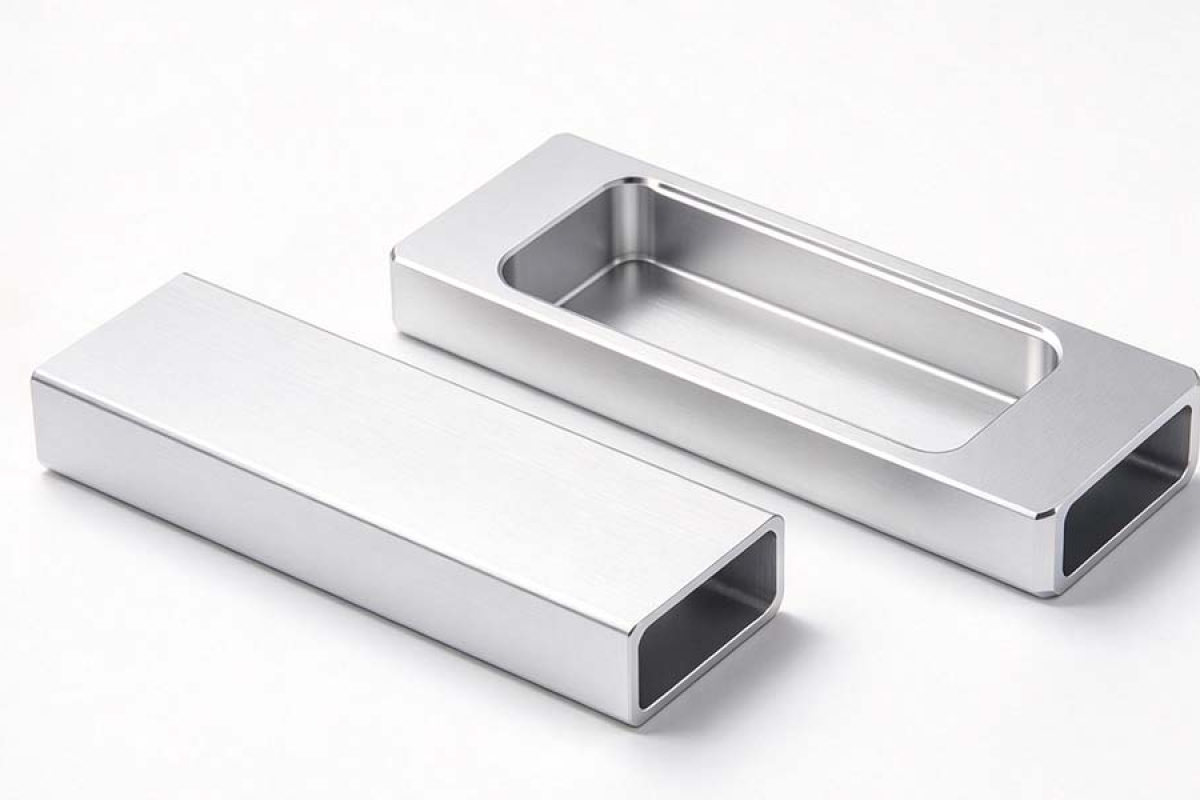
Aluminum 5052 CNC machining is a practical manufacturing solution for lightweight, corrosion-resistant components used in electronics, marine equipment, industrial systems, transportation and other demanding applications.
For international B2B buyers, however, successful 5052 machining is about more than simply cutting aluminum. The real manufacturing challenge is achieving the required dimensional accuracy, surface quality, material condition, repeatability, inspection standard and production efficiency from prototype through batch manufacturing.
This guide explains how Aluminum 5052 CNC machining in China works, what makes 5052 different from other aluminum alloys, how to control common machining problems, how to specify tolerances and surface finishes, and what international buyers should evaluate when selecting a China CNC machining supplier.
Article Summary: What This Guide Answers
Buyer Question | Engineering Answer |
|---|
Can 5052 aluminum be CNC machined? | Yes. 5052 can be milled, turned, drilled, tapped and otherwise machined. Its machinability is generally considered fair, so tooling, chip control, lubrication and workholding require careful process planning. |
What makes 5052 different? | 5052 is a 5xxx-series aluminum-magnesium alloy valued for corrosion resistance, ductility, formability, weldability and useful strength. It is non-heat-treatable. |
Which 5052 temper should be used? | The correct temper depends on the mechanical, forming and dimensional requirements of the application. Common tempers include 5052-O, H32 and H34. |
Why can 5052 be challenging to machine? | Its ductile cutting behavior can contribute to built-up edge, long chips, burrs and dimensional instability if the tooling and process are not properly controlled. |
Can 5052 be anodized? | Yes. However, cosmetic anodizing consistency depends on material quality, surface preparation, alloy condition and anodizing process control. |
What tolerance can be achieved? | There is no single universal tolerance for every 5052 CNC part. Tolerance should be established from the drawing, part geometry, process capability, workholding and inspection method. |
How should buyers evaluate a China supplier? | Review material traceability, engineering capability, DFM support, quality controls, inspection equipment, production capacity, finishing capability, communication and batch-production consistency. |
What should be included in a 5052 CNC RFQ? | Provide a 3D CAD model, 2D drawing where applicable, material and temper, quantity, tolerances, GD&T, surface finish, inspection requirements and delivery requirements. |
Table of Contents
What Is Aluminum 5052?
5052 Alloy Designation and Material Identification
5052 Chemical Composition
5052 Mechanical Properties
Can 5052 Aluminum Be CNC Machined?
Why 5052 Aluminum Can Be Challenging to Machine
How to CNC Machine 5052 Aluminum
Workholding and DFM for 5052 CNC Parts
5052 CNC Machining Tolerances and GD&T
5052 Aluminum Surface Finishes
5052 vs. 6061 Aluminum for CNC Machining
5052 CNC Machining Applications
How to Evaluate a China 5052 CNC Machining Supplier
5052 CNC Machining Cost Factors
High-Volume 5052 CNC Manufacturing
How to Prepare a 5052 CNC Machining RFQ
Recommended 5052 CNC Machining Drawing Strategy
Frequently Asked Questions
Final Takeaway for B2B Buyers
1. What Is Aluminum 5052?
Aluminum 5052 belongs to the 5xxx series of wrought aluminum alloys, with magnesium as the principal alloying element. It is commonly identified as 5052 / AlMg2.5, with the UNS designation A95052.
The 5xxx aluminum family is widely associated with useful strength, corrosion resistance, weldability and good forming characteristics. 5052 is especially useful when a component needs to remain lightweight while resisting corrosion in demanding environments.
Unlike precipitation-hardened alloys such as 6061-T6 and many 7xxx-series alloys, 5052 is non-heat-treatable. Its mechanical properties are developed primarily through alloy chemistry and mechanical working rather than precipitation heat treatment.
Engineering note: Do not specify only “Aluminum 5052” when the temper, product form or certification affects the design. A production drawing should clearly identify the required material condition.
2. 5052 Alloy Designation and Material Identification
For international CNC sourcing, material identification should be more precise than simply writing “5052 aluminum.”
Material Item | Example |
|---|
Alloy | Aluminum 5052 |
International designation | 5052 / AlMg2.5 |
UNS | A95052 |
Temper | H32, H34, O, etc., as specified |
Product form | Sheet, plate, tube, bar or applicable stock form |
Applicable specification | Customer-specified ASTM, EN or other standard |
Certification | Material Test Report / MTC where required |
ASTM B209/B209M covers aluminum and aluminum-alloy sheet and plate and includes requirements relating to alloy and temper designation, testing and inspection.
View ASTM B209/B209M
3. 5052 Chemical Composition
Aluminum 5052 is primarily an aluminum-magnesium alloy. Representative 5052-H32 reference data lists magnesium at approximately 2.2–2.8% and chromium at approximately 0.15–0.35%, with aluminum making up the balance.
Element | Representative 5052-H32 Reference Range |
|---|
Aluminum | Balance |
Magnesium | 2.2–2.8% |
Chromium | 0.15–0.35% |
Iron | ≤ 0.40% |
Silicon | ≤ 0.25% |
Copper | ≤ 0.10% |
Manganese | ≤ 0.10% |
Zinc | ≤ 0.10% |
Note: Exact chemical requirements should be verified against the material standard and the supplier's certification for the purchased product.
4. 5052 Mechanical Properties
Mechanical properties vary according to the temper, thickness, product form and applicable specification. This is why a 5052-H32 value should not be automatically applied to all forms and tempers of 5052.
Representative 5052-H32 reference data includes a density of approximately 2.68 g/cm³, an elastic modulus of approximately 70.3 GPa, and tensile and yield strength values in the range of approximately 228 MPa and 193 MPa respectively.
Property | Representative 5052-H32 Value |
|---|
Density | ~2.68 g/cm³ |
Elastic modulus | ~70.3 GPa |
Ultimate tensile strength | ~228 MPa |
Yield strength | ~193 MPa |
Poisson's ratio | ~0.33 |
Thermal conductivity | ~138 W/m·K |
For engineering design, always use the values specified by the applicable material standard or certified material supplied for the actual component.
5. Can 5052 Aluminum Be CNC Machined?
Yes. Aluminum 5052 can be CNC milled, CNC turned, drilled, tapped, reamed and machined into complex industrial components.
The important qualification is that 5052 is generally considered to have fair rather than excellent machinability. Hydro describes 5052 as a highly workable alloy with very good corrosion resistance while noting that its machinability is fair.
This does not make 5052 unsuitable for precision CNC manufacturing. Instead, it means that the process should be designed around the material's behavior.
A stable 5052 machining process usually considers:
Cutting-tool geometry
Spindle speed and feed strategy
Chip evacuation
Coolant or lubrication
Workholding and part rigidity
Thin-wall deformation
Burr control
Surface-finish requirements
Inspection strategy
6. Why 5052 Aluminum Can Be Challenging to Machine
6.1 Built-Up Edge
One of the most common machining concerns with aluminum alloys is material adhesion at the cutting edge.
Built-up edge, commonly abbreviated as BUE, occurs when workpiece material adheres to the cutting edge. As the built-up material changes the effective cutting geometry, it can affect tool life, surface finish, dimensional consistency and process stability.
Problem | Potential Effect |
|---|
Built-up edge | Dimensional variation and unstable cutting |
Adhered aluminum | Poor surface finish |
Tool-edge degradation | Reduced tool life |
Unstable cutting | Chatter or inconsistent surface quality |
Tool wear | Dimensional drift during batch production |
6.2 Long Chips and Chip Evacuation
Aluminum machining may generate long chips that can interfere with the process when chip evacuation is inadequate.
Poor chip evacuation can lead to chip recutting, surface scratches, chip packing in pockets and interruptions during drilling or tapping.
For production machining, tool selection, coolant delivery, air blast and machining strategy should therefore be considered together rather than independently.
6.3 Burr Formation
The ductile behavior of 5052 can make burr control important around drilled holes, slots, pockets, intersections and thin edges.
A production drawing should distinguish functional edges from cosmetic or non-functional edges whenever different edge conditions are required.
6.4 Thin-Wall Deformation
Thin 5052 components may move when the clamping force is released. The issue is not necessarily the CNC machine itself; the combination of cutting force, residual stress, part rigidity and workholding can affect dimensional stability.
For thin-wall components, a process may use roughing, controlled semi-finishing and final finishing rather than removing all material in one aggressive operation.
7. How to CNC Machine 5052 Aluminum
CNC milling is suitable for many 5052 components, including housings, brackets, panels, covers, plates and complex machined structures.
Milling Operation | Typical Application |
|---|
Face milling | Datum and reference surfaces |
Pocket milling | Housings and internal cavities |
Profile milling | External contours |
Slot milling | Slots, openings and functional channels |
Drilling | Through and blind holes |
Thread milling | Precision internal threads |
Chamfering | Edge breaking and finishing |
3D contouring | Complex curved surfaces |
For aluminum machining, sharp, free-cutting tooling and appropriate tool geometry are commonly used to reduce the risk of built-up edge. Seco Tools provides guidance on aluminum tooling, chip evacuation and cutter geometry.
5052 can also be CNC turned when the required stock form is appropriate.
Typical turned components include:
Cylindrical housings
Spacers
Sleeves
Threaded components
Circular covers
Custom bushings
Sharp cutting edges, suitable tool geometry and controlled chip formation are especially important when turning ductile aluminum alloys.
7.3 Drilling and Tapping
Hole-making should be planned according to hole diameter, depth, tolerance, thread specification and chip evacuation requirements.
Deep holes may require dedicated chip-management strategies, while precision threads may require carefully selected taps or thread-milling processes.
The number of CNC axes should be selected according to feature accessibility rather than used simply as a marketing label.
Machine Type | Typical 5052 Application |
|---|
3-axis CNC | Plates, brackets, housings and conventional milled parts |
4-axis CNC | Parts requiring indexed rotary access |
5-axis CNC | Complex geometry, multi-face access and difficult tool orientations |
A strong CNC process starts before machining. The CAD model may look straightforward, while the manufacturing process can reveal problems involving tool access, thin walls, datum selection and workholding.
For a thin-wall 5052 electronics housing, for example, the process engineer should consider whether the part can be clamped without distortion and whether the final dimensions remain stable after the clamping pressure is released.
DFM Factor | Manufacturing Question |
|---|
Wall thickness | Is the wall rigid enough during machining? |
Pocket depth | Can the required tool reach the pocket without excessive deflection? |
Internal corner radius | Can a practical standard cutter reach the corner efficiently? |
Hole depth | Can chips be evacuated reliably? |
Datum structure | Can the part be located repeatably? |
Clamping area | Can the part be held without unacceptable deformation? |
Surface treatment | Will anodizing or coating affect functional dimensions? |
Inspection access | Can all critical features be measured? |
9. 5052 CNC Machining Tolerances and GD&T
One of the most common mistakes in CNC sourcing is asking:
“What is your maximum CNC tolerance?”
A more useful engineering question is:
“What tolerance is required for each functional feature, and how will that feature be produced and verified?”
Final dimensional capability depends on machine condition, cutter condition, workholding, thermal behavior, geometry, material condition, tool deflection and inspection method.
GD&T for 5052 CNC Parts
ISO 1101 provides the international framework for geometrical tolerancing, covering requirements related to form, orientation, location and run-out.
ISO 2768 can be used where general tolerances are required, subject to the specific drawing and applicable standard.
A typical engineering drawing may contain requirements such as:
Critical bore:       Ø20.000 ±0.010 mm
Position tolerance:  ⌀0.020 | A | B | C
Flatness:             0.030 mm
Surface texture:      Ra 1.6 µm
The purpose of tight tolerancing is not to make every feature extremely precise. The better approach is to specify tighter tolerances only where function requires them. This can improve manufacturing efficiency and reduce unnecessary cost.
ISO 1101: Geometrical Tolerancing
ISO 2768: General Tolerances
10. 5052 Aluminum Surface Finishes
Aluminum 5052 can be supplied in a variety of surface conditions and can receive additional finishing treatments after CNC machining.
Finish | Typical Purpose |
|---|
As-machined | Functional CNC components |
Bead blasting | Uniform matte appearance |
Brushing | Directional cosmetic appearance |
Anodizing | Appearance, surface protection and application-specific requirements |
Powder coating | Protective and decorative finish |
10.1 Anodizing 5052 Aluminum
5052 can be anodized, but cosmetic consistency depends on the material, surface preparation and anodizing process.
When cosmetic appearance is critical, buyers should specify:
Anodizing type
Color
Gloss or appearance requirement
Cosmetic acceptance criteria
Masking requirements
Color variation tolerance where applicable
Material requirements for anodizing quality
Novelis publishes anodizing-quality 5052 products for demanding cosmetic applications, illustrating the importance of material selection when appearance consistency is critical.
View Novelis Anodized Quality Information
For technical product documentation, ISO 21920-1 provides the framework for specification of surface texture.
ISO 21920-1: Surface Texture
11. 5052 vs. 6061 Aluminum for CNC Machining
Engineers frequently compare 5052 and 6061 aluminum. The correct choice depends on the application's priorities rather than a simple “better versus worse” ranking.
Factor | 5052 | 6061 |
|---|
Alloy family | 5xxx | 6xxx |
Main alloying system | Aluminum-magnesium | Aluminum-magnesium-silicon |
Heat treatable | No | Yes |
Corrosion resistance | Very good | Good |
Formability | Very good | Good |
Weldability | Good | Good |
Machinability | Fair | Generally better suited to machining |
Common use emphasis | Enclosures, formed components, corrosion-sensitive applications | Machined structural parts, fixtures, housings |
5052 is often attractive when corrosion resistance, ductility and formability are important. 6061 is often selected when machining efficiency and strength in a heat-treated condition are more important.
The engineering question should therefore be: Which material best matches the functional requirements of the component?
12. 5052 CNC Machining Applications
5052 is used in a wide range of industrial applications because it combines low density, useful strength, corrosion resistance, workability and weldability.
12.1 Electronics Housings
5052 can be a practical material for lightweight electronics housings, equipment covers, instrument enclosures, control panels and protective housings.
12.2 Marine Components
5052 has strong corrosion-resistance characteristics that make it suitable for many marine-related applications.
However, buyers should not assume that every 5052 product automatically meets every marine specification. Alloy, temper, product form and applicable standard should be confirmed for the application.
12.3 Industrial Brackets and Panels
5052 is suitable for a range of lightweight brackets, panels, covers and industrial components where corrosion resistance and workability are important.
12.4 Automotive and Transportation
5052 is also associated with transportation-related components where weight, corrosion resistance and manufacturability are relevant.
Application | Typical Reason for Considering 5052 |
|---|
Electronics housings | Light weight, corrosion resistance and good formability |
Marine components | Corrosion resistance |
Industrial panels | Workability and lightweight construction |
Brackets and covers | Balance of strength, formability and corrosion resistance |
Transportation components | Low density and corrosion resistance |
13. How to Evaluate a China 5052 CNC Machining Supplier
When sourcing 5052 CNC machining in China, procurement teams should evaluate the supplier as a manufacturing partner rather than simply comparing unit prices.
Evaluation Area | What Buyers Should Verify |
|---|
Material control | Alloy, temper, supplier, certification and traceability |
Process engineering | DFM review, tool selection, process planning and workholding |
Quality | CMM capability, inspection reports and first-article inspection |
Production | Prototype, low-volume and repeat batch capability |
Communication | Engineering feedback, change control and production communication |
Material Traceability
When material certification is part of the purchase specification, the supplier should be able to identify the material used and provide the agreed documentation.
Quality Management
ISO 9001 provides a framework for quality management systems, but certification should be evaluated together with actual manufacturing controls.
Buyers should review the complete process:
Incoming Material
       ↓
DFM / Engineering Review
       ↓
CNC Programming
       ↓
First Article
       ↓
Dimensional Inspection
       ↓
Batch Production
       ↓
In-Process Inspection
       ↓
Surface Treatment
       ↓
Final Inspection
       ↓
Packing and Shipment
A quality certificate is useful, but the manufacturing process itself is what ultimately determines whether the parts are consistent.
ISO 9001 — Quality Management Systems
14. 5052 CNC Machining Cost Factors
There is no responsible single “price per kilogram” for CNC-machined 5052 parts. Material price is only one factor in the total manufacturing cost.
Cost Driver | Influence on Cost |
|---|
Material volume | Raw material cost |
Material utilization | Scrap and material-efficiency impact |
Part geometry | Programming and machining time |
Machining volume | Cycle time |
Number of setups | Setup and labor requirements |
Tight tolerances | Additional process and inspection requirements |
Deep pockets | Longer tools and potential deflection |
Thin walls | More demanding workholding and process control |
Surface treatment | Secondary processing cost |
Inspection | Measurement and documentation time |
Quantity | Setup and tooling amortization |
Logistics | Packaging and shipping cost |
For low quantities, setup and programming may represent a relatively large portion of the cost. For high-volume manufacturing, tooling, fixtures, cycle-time optimization and process automation can have a much greater effect on unit pricing.
15. High-Volume 5052 CNC Manufacturing
Prototype manufacturing asks: “Can we make this part?”
High-volume manufacturing asks: “Can we make the same part repeatedly?”
This difference is critical when selecting a China CNC machining supplier for production.
A high-volume 5052 program should consider:
Dedicated fixtures where justified
Stable CNC programs
Tool-life management
Automated probing where appropriate
First-article validation
In-process inspection
Final batch inspection
Change-control procedures
Recommended Production Workflow
CAD / Drawing Review
        ↓
Material Verification
        ↓
DFM Review
        ↓
Tool & Fixture Planning
        ↓
CNC Programming
        ↓
First Article Machining
        ↓
Dimensional Inspection
        ↓
Process Approval
        ↓
Batch Production
        ↓
In-Process Inspection
        ↓
Final Inspection
        ↓
Surface Treatment
        ↓
Final Verification
        ↓
Packaging & Shipment
For international B2B procurement, repeatability often matters more than a supplier's headline machining tolerance. The goal is a manufacturing process capable of producing consistent results throughout the production run.
16. How to Prepare a 5052 CNC Machining RFQ
A complete RFQ reduces ambiguity before production begins.
RFQ Item | Example |
|---|
Part number | ABC-5052-001 |
Material | Aluminum 5052 |
Temper | H32 |
Quantity | 500 pcs |
3D model | STEP / STP |
2D drawing | PDF / DWG |
Critical tolerance | ±0.02 mm |
GD&T | Position, flatness, perpendicularity, etc. |
Surface texture | Ra 1.6 µm |
Surface finish | Clear anodizing |
Cosmetic requirements | No visible tool marks on specified cosmetic faces |
Inspection | CMM + dimensional report |
Material certificate | Required |
Packaging | Individual protection |
Delivery | Customer-specified lead time |
The more precisely the requirements are defined, the less likely it is that engineering, purchasing and manufacturing teams will interpret the same drawing differently.
17. Recommended 5052 CNC Machining Drawing Strategy
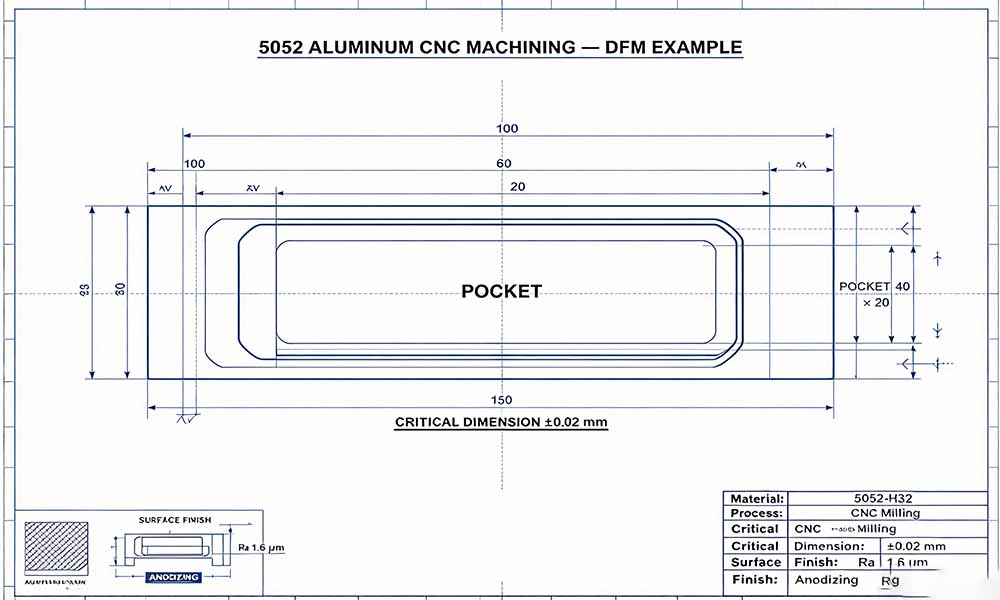
A professional 5052 CNC machining page should include original engineering drawings, process illustrations and inspection examples instead of relying only on generic factory photography.
Example of Engineering Drawing for Aluminum 5052 Parts
Another useful visual is a 5052 vs. 6061 material selection chart that connects alloy characteristics to actual component requirements.
5052 Selection Considerations | 6061 Selection Considerations |
|---|
Corrosion resistance | Machinability |
Ductility | Heat-treatable strength |
Formability | Structural applications |
Electronics / enclosures | Fixtures / structural housings |
18. Frequently Asked Questions About Aluminum 5052 CNC Machining
Can 5052 aluminum be CNC machined?
Yes. 5052 can be CNC milled, turned, drilled and tapped. Its machinability is generally considered fair, so suitable tooling, lubrication and chip control are important.
Is 5052 aluminum difficult to machine?
It is machinable, but its ductile and adhesive cutting behavior can make chip control and built-up edge more challenging than with easier-cutting aluminum alloys.
What is 5052-H32?
5052-H32 is a specific temper of aluminum 5052. Its mechanical properties differ from other tempers, so the required temper should be specified when it affects component performance.
Is 5052 stronger than 6061?
Strength depends on the exact alloy, temper and product form. A generic statement that one alloy is always stronger is not appropriate for engineering selection.
Can 5052 be anodized?
Yes. The quality and appearance of anodizing depend on material quality, surface preparation and process control.
Is 5052 good for marine applications?
5052 has strong corrosion-resistance characteristics and is used in marine-related applications. The exact material specification should nevertheless be confirmed for the actual marine service condition.
What tolerance can be achieved with 5052 CNC machining?
There is no single universal tolerance. Capability depends on feature size, geometry, machine condition, workholding, tooling, environment and inspection. Functional critical dimensions should be explicitly specified.
Is 5052 suitable for high-volume CNC production?
Yes, where the material and component requirements are appropriate. High-volume production requires stable tooling, workholding, process control and inspection to maintain consistency across the batch.
What surface finishes are available for 5052?
Typical options include as-machined surfaces, bead blasting, brushing, anodizing and powder coating, depending on the specific part and application.
Can 5052 be used for electronics housings?
Yes. 5052 is used in electronics-related applications, including housings and casings where lightweight construction and corrosion resistance are useful.
Should the drawing specify 5052 or 5052-H32?
Where the material temper affects mechanical or manufacturing requirements, specifying the exact temper is preferable to specifying only the alloy.
What files should I provide for a 5052 CNC machining quote?
A 3D STEP/STP model and a 2D engineering drawing are ideal starting points, accompanied by material and temper, quantity, critical tolerances, GD&T, surface finish, inspection requirements and delivery requirements.
19. Final Takeaway for B2B Buyers
Aluminum 5052 CNC machining is a viable and widely useful manufacturing process, but it should be treated as an engineered process rather than simply another aluminum cutting operation.
5052 is a 5xxx-series aluminum-magnesium alloy known for its corrosion resistance, workability, weldability, ductility and useful strength. Its non-heat-treatable characteristics distinguish it from many 6xxx and 7xxx-series machining materials.
From the manufacturing perspective, the most important considerations are:
Material condition → Tool geometry → Chip control → Workholding → Burr control → Tolerance strategy → Surface finishing → Inspection
For international companies sourcing Aluminum 5052 CNC machining in China, supplier selection should therefore extend beyond quotation price.
The most useful questions are:
Can the supplier correctly interpret the engineering drawing?
Can it control thin walls, burrs and difficult features?
Can it provide material traceability?
Can it validate critical dimensions?
Can it maintain consistency throughout the production batch?
That is the difference between purchasing a machined component and establishing a dependable manufacturing supply chain.
Request a Quote for Custom 5052 CNC Parts
Need custom Aluminum 5052 CNC machining in China? Send your CAD model, engineering drawing, material/temper specification, quantity and finishing requirements for an engineering review and quotation.
Recommended files: STEP / STP / IGES / IGS / SLDPRT / DWG / DXF / PDF
Typical production scope: CNC milling, CNC turning, multi-axis machining, prototyping, low-volume manufacturing and high-volume batch production.
Request a 5052 CNC Machining Quote
Authoritative Industry References
The Aluminum Association — Aluminum Standards
https://www.aluminum.org/standards
ASTM B209/B209M — Aluminum and Aluminum-Alloy Sheet and Plate
https://store.astm.org/b0209_b0209m-21a.html
Hydro — 5052 Aluminum
Hydro 5052 Aluminum
Kaiser Aluminum — 5052 Technical Data
Kaiser Aluminum 5052 Technical Data
Seco Tools — Aluminum Machining Guidance
Seco Tools Aluminum Machining
ISO 1101 — Geometrical Tolerancing
ISO 1101
ISO 2768 — General Tolerances
ISO 2768
ISO 21920-1 — Surface Texture
ISO 21920-1
ISO 9001 — Quality Management Systems
ISO 9001
Novelis — Anodizing Quality Aluminum
Novelis Anodizing Quality Brochure
Get an Instant Quotefor your custom China Shenzhen Aluminum 5052 CNC Machining Service parts today.