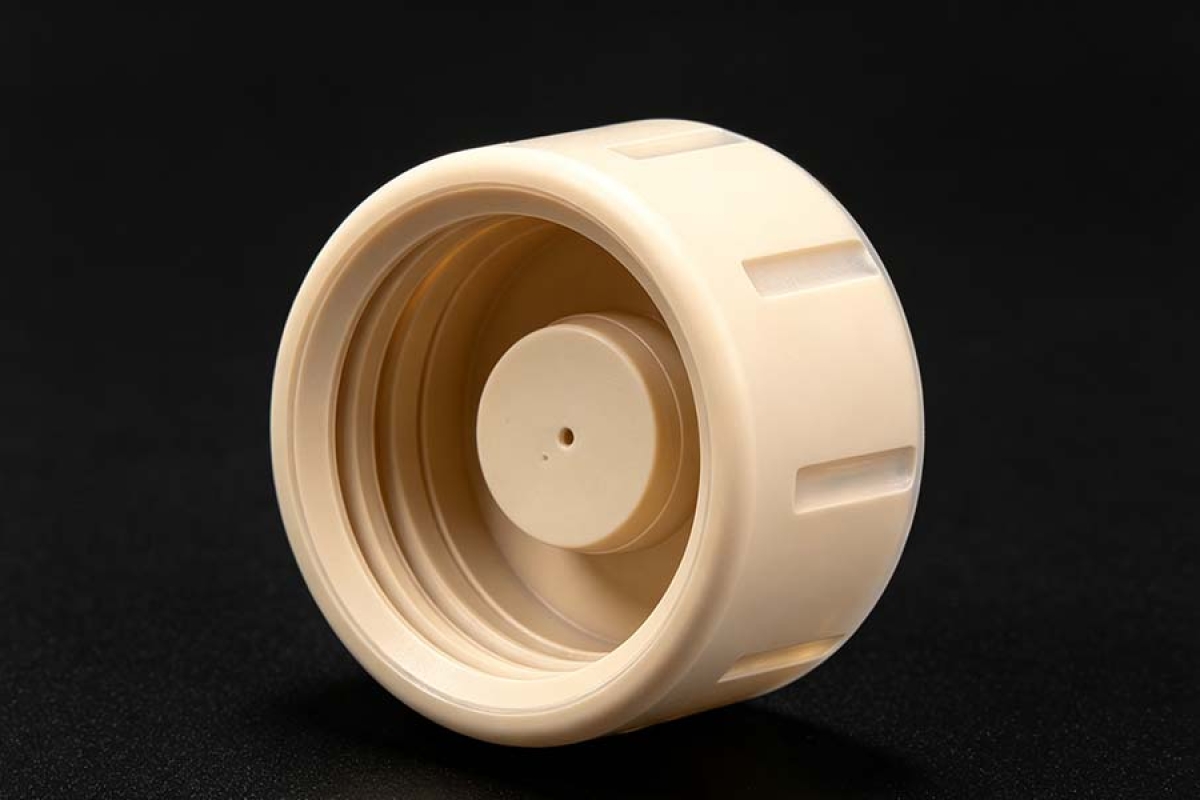
What Is PPSU?
PPSU (Polyphenylsulfone) is a high-performance amorphous engineering thermoplastic belonging to the polysulfone family. It combines high temperature resistance, excellent hydrolytic stability, impact toughness, chemical resistance, dimensional stability and transparency in many unfilled grades.
Compared with many conventional engineering plastics, PPSU is particularly suitable for components exposed repeatedly to hot water, steam, cleaning agents and sterilization cycles. This makes it useful for medical equipment, laboratory systems, fluid-handling components, food-processing equipment, aerospace interiors and demanding industrial applications.
For CNC machining, PPSU is attractive when a component needs high toughness together with thermal and chemical performance, while maintaining the dimensional advantages of an amorphous thermoplastic.
MaterialPolyphenylsulfone
AbbreviationPPSU
Polymer FamilyPolysulfone high-performance thermoplastic
MachinabilityModerate
Material grade matters: PPSU is a material family rather than one universal formulation. Mechanical properties, sterilization performance, chemical resistance, color and machining behavior can vary by manufacturer and grade. The exact grade should be confirmed against the supplier's technical data sheet before production.
Core Advantages of PPSU
Thermal Performance
PPSU provides strong high-temperature capability and performs well in demanding thermal environments.
Hydrolytic Stability
Excellent resistance to hot water, steam and repeated hydrothermal exposure.
Impact Toughness
PPSU provides excellent toughness and is less prone to brittle fracture than many high-performance plastics.
Chemical Resistance
Good resistance to many acids, alkalis, detergents, alcohol-based cleaners and laboratory chemicals.
Dimensional Stability
Low moisture absorption and stable thermal behavior help maintain dimensional consistency.
Electrical Insulation
PPSU offers excellent electrical insulation properties in many grades.
Physical Properties of PPSU
The following values represent typical ranges for representative unfilled PPSU grades. They should be used for engineering reference rather than treated as guaranteed specifications.
Property | Typical Value / Range |
|---|
Density | ~1.29–1.30 g/cm³ |
Tensile Strength | ~65–75 MPa |
Tensile Modulus | ~2.3–2.5 GPa |
Elongation at Break | Commonly ~50–100%+ |
Flexural Modulus | ~2.3–2.5 GPa |
Notched Izod Impact Strength | Very high; grade/test dependent |
Glass-Transition Temperature | ~220°C |
Heat Deflection Temperature | Approximately 200°C-class |
Continuous Service Capability | Approximately 180°C-class, grade dependent |
Water Absorption | Low |
Thermal Conductivity | Approximately ~0.2 W/m·K |
Electrical Insulation | Excellent in many grades |
Dimensional Stability
PPSU is an amorphous thermoplastic, which gives it different dimensional behavior from semicrystalline materials such as PPS, PEEK and POM.
Its relatively low moisture absorption and good thermal stability help PPSU components maintain dimensional consistency in demanding environments.
CNC machining can nevertheless release residual stresses in polymer stock. This is especially important for thin walls, deep pockets, large flat plates, precision bores and long slender components.
Impact Resistance
One of PPSU's key advantages is toughness. PPSU offers excellent impact resistance and is less prone to brittle fracture than many high-performance thermoplastics.
Mechanical shock
Repeated assembly
Drop impact
Pressure cycling
Thermal cycling
Temperature Resistance
PPSU has a glass-transition temperature around 220°C, providing strong high-temperature capability for an amorphous engineering thermoplastic.
Actual service temperature depends on mechanical load, exposure duration, chemical environment, sterilization method, part geometry and the specific resin grade.
Chemical Properties of PPSU
Chemical Resistance
PPSU has good resistance to many chemicals and cleaning agents, including many acids, alkalis, detergents, alcohol-based cleaners, hot water, steam and laboratory chemicals.
PPSU is not universally resistant to every solvent. Certain aggressive organic solvents may cause stress cracking, swelling, softening or surface degradation. Chemical compatibility should be evaluated using the actual concentration, temperature, exposure duration and mechanical loading conditions.
Hydrolytic Stability
Hydrolytic stability is one of PPSU's strongest characteristics. Unlike many plastics that experience significant degradation after repeated exposure to hot water or steam, PPSU is designed for demanding hydrothermal environments.
Oxidation and Environmental Stability
PPSU provides strong resistance to thermal aging and maintains useful mechanical properties over a broad temperature range. Outdoor applications require additional evaluation because UV resistance depends on the specific grade, pigmentation and application environment.
Chemical Composition
PPSU is an aromatic polysulfone containing carbon, hydrogen, oxygen and sulfur. The exact elemental composition varies according to polymer architecture and commercial formulation.
Bonding Compatibility
PPSU CNC Machining: Machinability Analysis
Recommended difficulty rating: Moderate. PPSU can generally be machined using standard CNC milling and turning equipment. Its excellent toughness, however, means that machining behavior differs from more brittle engineering plastics.
Stringy Chips
PPSU's toughness and ductility can generate long continuous chips during machining.
Heat Accumulation
Low thermal conductivity can concentrate heat around the cutting zone.
Burr Formation
Burrs can develop around holes, pockets, slots and thin-wall features.
Tool Deflection
Proper tool selection and machine rigidity are important for dimensional accuracy.
Part Distortion
Thin or flexible features require controlled workholding and finishing strategy.
Residual Stress
Stress release from polymer stock can affect final dimensions after rough machining.
Recommended Tool Materials
Sharp carbide tooling is generally suitable for precision PPSU machining.
General CNC Machining Parameter Starting Points
Exact parameters must be developed according to tool diameter, tool geometry, machine rigidity, PPSU grade, component geometry and workholding.
Process | General Approach |
|---|
Rough Milling | Moderate cutting conditions with efficient chip evacuation |
Finish Milling | Sharp carbide tool and light finishing passes |
Drilling | Sharp drill with controlled feed |
Deep-Hole Drilling | Pecking or optimized chip evacuation |
Turning | Sharp positive-geometry carbide tooling |
Reaming | Controlled feed with rigid workholding |
Threading | Sharp tool and conservative cutting conditions |
Machining priority: For PPSU, heat management and chip evacuation are often more important than simply maximizing cutting speed.
Common PPSU CNC Machining Problems
1. Stringy Chips
PPSU is tough and ductile, which can generate long continuous chips.
2. Burr Formation
Burrs can develop around through-holes, pocket edges, slot exits and thin-wall features.
Sharp tooling and controlled finishing passes can reduce burrs. Secondary deburring may be required for precision assemblies.
3. Heat Accumulation
PPSU has relatively low thermal conductivity, so heat can remain concentrated around the cutting zone.
Local deformation
Dimensional drift
Surface smearing
Burr growth
4. Residual-Stress Release
Machining large PPSU blocks or plates can release internal stresses originating from stock production.
STEP 01
Rough MachiningRemove bulk material while retaining support.
STEP 02
StabilizationAllow the component to stabilize.
STEP 03
Semi-FinishingPrepare critical surfaces and features.
STEP 04
FinishingApply controlled final machining passes.
STEP 05
InspectionVerify critical dimensions and quality.
5. Thin-Wall Deflection
PPSU's relatively low modulus compared with metals makes thin walls flexible during machining.
Reduce cutting engagement
Increase workholding support
Use multiple finishing passes
Avoid excessive clamping force
Finish critical walls after roughing
PPSU CNC Machining Tolerance & Surface Finish
Typical Tolerance
For suitable geometries, ±0.05 mm can be a practical target when the process is properly controlled.
Typical Surface Finish
Optimized CNC finishing can achieve approximately Ra 1.6–3.2 μm.
Precision Control
Stock condition, temperature, workholding, tool wear, geometry and inspection conditions all influence results.
Achievable CNC Tolerances
PPSU can be CNC machined to relatively tight tolerances when the manufacturing process is properly controlled.
Tighter tolerances may be possible on specific features, but they require careful control of stock condition, thermal environment, workholding, tool wear, machine accuracy, part geometry and inspection temperature.
For critical dimensions, GD&T should be used rather than applying unnecessarily tight bilateral tolerances to every feature.
Surface Finish
A typical CNC-machined PPSU component can achieve approximately Ra 1.6–3.2 μm with optimized finishing conditions.
Finer finishes may be achievable depending on tool geometry, tool sharpness, feed rate, cutting depth, machine vibration and part stiffness.
Transparent or translucent PPSU components require additional care because machining marks can be visually more apparent than on opaque materials.
PPSU CNC Machining Processes
PPSU is suitable for 3-axis, 4-axis and 5-axis CNC milling. Typical components include medical housings, manifolds, laboratory fixtures, valve bodies and custom covers.
PPSU rod and tube stock can be precision turned into bushings, sleeves, rings, spacers, fittings and cylindrical housings.
CNC Drilling
Sharp high-speed or carbide drills can be used. Deep holes require careful chip evacuation and heat control.
CNC Tapping
PPSU can be tapped for low-to-moderate mechanical loading. Metal threaded inserts can improve durability for repeated assembly.
Complex PPSU components can benefit from fewer setups, improving feature-to-feature accuracy and positional consistency.
Precision Finishing
Controlled finishing passes help achieve dimensional accuracy and consistent surface quality.
Advantages of 5-Axis PPSU Machining
Fewer machining setups
Improved feature-to-feature accuracy
Better positional consistency
Improved surface continuity
Higher production efficiency
PPSU for Thin-Walled and Complex Parts
PPSU's toughness makes it useful for complex components, but its relatively low stiffness compared with metals requires careful process planning.
Recommended Machining Strategy
Use rigid workholding with controlled clamping force.
Rough the component while leaving sufficient machining allowance.
Avoid removing all surrounding support too early.
Use sharp finishing tools.
Minimize heat generation.
Finish critical dimensions in the final machining stage.
Allow the component to stabilize before final inspection.
For transparent PPSU components, surface quality should be considered together with dimensional accuracy because tool marks can remain visually noticeable.
Typical PPSU Applications and Part Scenarios
Medical Equipment
PPSU is particularly suitable for components exposed to repeated sterilization cycles.
Laboratory Equipment
Suitable for parts exposed to hot water, steam, cleaning agents and laboratory chemicals.
Fluid manifolds
Laboratory fittings
Pump components
Sample-handling fixtures
Instrument housings
Food & Beverage
Suitable food-contact PPSU grades can be used in selected hot-water and fluid-handling applications.
Hot-water systems
Fluid connectors
Pump components
Valve bodies
Processing equipment
Aerospace
PPSU can be considered for selected aerospace interior applications where impact, thermal and chemical performance are important.
Fluid Handling
Hydrolytic stability makes PPSU attractive for demanding fluid-handling components.
Fluid manifolds
Connectors
Valve components
Pump components
Fittings
Tubing interfaces
Industrial Equipment
PPSU can be used for custom industrial components where thermal, chemical and impact performance are required.
Medical, food-contact and aerospace applications require the exact resin grade and applicable regulatory requirements to be verified before production.
PPSU vs. Other Engineering Plastics
Property | PPSU | PPS | PEEK | PC |
|---|
Temperature Resistance | Excellent | Excellent | Excellent | Good |
Impact Resistance | Excellent | Moderate | Excellent | Excellent |
Hydrolytic Stability | Excellent | Excellent | Excellent | Moderate |
Chemical Resistance | Excellent | Excellent | Excellent | Moderate |
Moisture Absorption | Low | Very low | Very low | Low–Moderate |
Dimensional Stability | Very good | Excellent | Excellent | Good |
Sterilization Resistance | Excellent | Good | Excellent | Limited by process |
Transparency | Possible in natural grades | Generally opaque | Generally opaque | Excellent |
CNC Machinability | Moderate | Moderate | Moderate | Easy–Moderate |
Relative Cost | High | High | Very high | Moderate |
PPSU vs. PPS
PPS generally provides superior dimensional stability and chemical resistance, while PPSU offers much higher impact toughness and excellent hydrolytic and sterilization performance.
PPSU vs. PEEK
PEEK generally provides higher mechanical performance and wear resistance, while PPSU offers excellent toughness and sterilization resistance at a potentially lower material cost.
PPSU vs. Polycarbonate
Polycarbonate is easier to machine and typically less expensive, while PPSU provides significantly better high-temperature, chemical and hydrolytic performance.
Evefab PPSU CNC Machining Advantages
PPSU machining requires more than simply selecting a plastic cutting tool. Evefab focuses on material selection, machining strategy, dimensional control and production repeatability.
Material Selection Support
Evefab can help evaluate PPSU material selection according to the application requirements.
Precision CNC Process Development
For precision PPSU components, Evefab's process planning focuses on:
Quality Inspection
Depending on project requirements, inspection can include:
Dimensional inspection reports
First Article Inspection (FAI)
GD&T verification
Surface-finish inspection
Material certificates / MTR documentation
Certificate of Conformance
From Prototype to Repeat Batch Production
Evefab supports PPSU CNC machining across different production stages:
01
Engineering PrototypeValidate design and machining feasibility.
02
Low VolumeProduce initial production quantities.
03
Pilot ProductionOptimize process consistency and inspection.
04
Repeat BatchMaintain stable machining and quality.
05
Process OptimizationImprove efficiency and manufacturing cost.
PPSU CNC Machining Design Guidelines
Avoid Excessively Thin Walls
Thin PPSU walls are susceptible to machining deflection. Where the application permits, increase wall thickness or introduce supporting ribs.
Use Internal Radii
Internal radii reduce sharp-corner stress concentration and make milling more efficient.
Control Clamping Force
Excessive clamping can temporarily deform PPSU and cause dimensional errors after part release.
Consider Threaded Inserts
For frequently assembled components, metal threaded inserts can improve thread life.
Account for Transparency
If optical appearance matters, specify surface finish, tool-mark requirements, color and transparency criteria.
Specify the Exact Grade
Drawings and purchase specifications should identify the exact PPSU grade when performance is critical.
PPSU CNC Machining FAQ
Is PPSU easy to CNC machine?
PPSU is generally considered moderately machinable. Its toughness makes it less brittle than many engineering plastics, but it can generate long chips and requires effective heat and chip control.
Can PPSU be CNC milled?
Yes. PPSU can be CNC milled using sharp carbide tooling and controlled cutting conditions.
Can PPSU be CNC turned?
Yes. PPSU rod and tube stock can be precision CNC turned for bushings, sleeves, fittings, valve components and other cylindrical parts.
Is PPSU suitable for medical components?
Appropriate PPSU grades are widely used in medical and healthcare equipment, particularly where repeated sterilization is required. The selected grade must meet applicable medical and regulatory requirements.
Can PPSU withstand autoclaving?
Many PPSU grades are specifically designed for repeated steam sterilization and autoclave exposure. Always verify the manufacturer's validated cycle limits for the selected grade.
Is PPSU better than PPS?
Neither is universally better. PPS generally provides stronger chemical resistance and dimensional stability, while PPSU provides substantially better impact toughness and hydrolytic and sterilization performance.
Is PPSU transparent?
Natural unfilled PPSU can be transparent to translucent and typically has an amber or natural appearance. Filled or pigmented grades may be opaque.
Is PPSU suitable for high-volume CNC machining?
Yes. PPSU can be CNC machined in repeat batches provided that tool wear, workholding, dimensional compensation and inspection procedures are properly controlled.
Why Choose PPSU for Precision CNC Machining?
PPSU (Polyphenylsulfone) combines high-temperature capability, exceptional toughness, hydrolytic stability, chemical resistance, dimensional stability and repeated sterilization resistance.
It is particularly suitable for precision CNC-machined components used in medical equipment, laboratory systems, fluid-handling systems, food-processing equipment, industrial automation, aerospace interiors and chemical-processing equipment.
Compared with PPS, PPSU provides greater toughness and impact resistance. Compared with PC, it provides substantially better thermal, chemical and hydrolytic performance. Compared with PEEK, PPSU can offer a more cost-effective solution when extreme mechanical strength or wear resistance is not the primary requirement.
The key to successful PPSU CNC machining is process control. Heat, chips, clamping force, residual stress and finishing operations must be controlled while selecting the correct material grade for the application.
Get an Instant Quotefor your custom PPSU parts today.