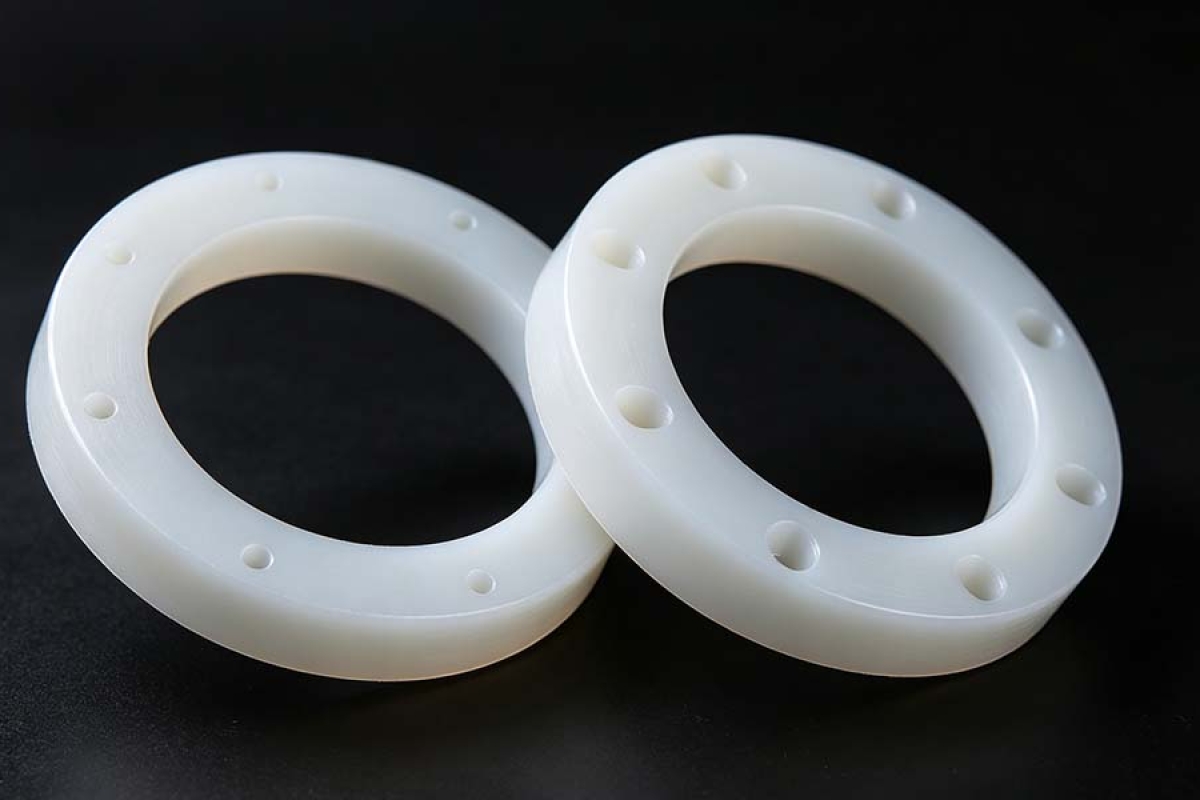
PP (Polypropylene) is a lightweight, chemically resistant thermoplastic widely used for CNC-machined components that require low density, excellent moisture resistance, good fatigue performance, and strong resistance to many acids, alkalis, and chemicals. Compared with rigid engineering plastics such as POM, PAI, or PC, PP is softer and more flexible, but it offers excellent chemical resistance and an exceptionally low density.
For CNC machining, polypropylene is commonly used for chemical-processing components, fluid manifolds, laboratory fixtures, tanks, liners, valve components, pump parts, electrical insulation components, lightweight housings, and custom industrial parts.
1. Basic Material Information
Standard Material Designations & Classification
Item | PP / Polypropylene |
Chemical name | Polypropylene |
Common abbreviation | PP |
Material family | Polyolefin |
Polymer type | Semi-crystalline thermoplastic |
Common grades | PP-H, PP-R, PP-B |
Common CNC stock | Sheet, plate, rod, block, tube |
Typical appearance | Natural translucent, white, black, custom colors |
Common manufacturing processes | CNC machining, injection molding, extrusion, thermoforming |
Relevant standards | ISO 1873; ASTM D4101 |
Typical applications | Chemical, medical, laboratory, fluid handling, industrial |
Common PP Grades
PP-H — Polypropylene Homopolymer Features higher stiffness, excellent chemical resistance, stable temperature resistance and superior machinability, widely applied in industrial chemical processing components.
PP-R — Polypropylene Random Copolymer Optimized in impact resistance, material toughness and low-temperature adaptability, mainly used for piping systems and fluid transmission equipment parts.
PP-B — Polypropylene Block Copolymer Boasts greatly improved impact performance compared with standard homopolymer PP, suitable for parts requiring anti-collision and anti-shock performance.
Core Material Positioning
PP is a cost-effective lightweight industrial thermoplastic focusing on chemical and moisture resistance.
Core Advantages:
Extremely low density, ultra-lightweight
Excellent resistance to acids, alkalis and various chemicals
Near-zero water absorption, superior moisture resistance
Outstanding fatigue resistance, tolerates repeated flexing
Stable electrical insulation performance
Low material and processing cost
No metal corrosion risk
Main Limitations:
Lower stiffness than POM and reinforced engineering plastics
High thermal expansion coefficient, sensitive to temperature changes
Limited continuous high-temperature resistance
Moderate wear and friction resistance
Difficult to maintain ultra-tight precision tolerances
2. PP Physical Properties
Property | Typical PP Range |
Density | ~0.90–0.91 g/cm³ |
Tensile strength | ~25–40 MPa |
Tensile modulus | ~1.0–1.8 GPa |
Yield strength | ~25–35 MPa |
Elongation at break | ~100–600%+ |
Flexural modulus | ~1.0–1.8 GPa |
Hardness | Typically Rockwell R80–R110 |
Water absorption | Very low, typically <0> |
Thermal conductivity | ~0.1–0.25 W/m·K |
Melting temperature | ~160–170°C for PP grades |
Glass transition temperature | Approximately −10°C |
Continuous service temperature | Commonly ~80–100°C, grade/load dependent |
Density
Ultra-low density is the most prominent advantage of PP. With a density of 0.90–0.91 g/cm³, it is one of the lightest CNC-machinable thermoplastics, far lighter than POM, nylon, PC, PVC and all metal materials.
It is the preferred material for lightweight industrial parts, including portable equipment components, chemical containers, floating structural parts and low-mass mechanical mechanisms.
Tensile Strength & Stiffness
Unfilled PP has a tensile strength of 25–40 MPa and a tensile modulus of 1.0–1.8 GPa, with lower rigidity than POM. It is not suitable for high-load precision bearing structures, but perfectly matches application scenarios that prioritize flexibility, chemical resistance and lightweight performance.
Impact Resistance
Standard PP has excellent toughness at room temperature. Copolymer PP grades further enhance impact resistance and low-temperature toughness. It should be noted that the impact performance of PP will decrease sharply in low-temperature environments, and targeted grade selection is required for low-temperature working scenarios.
Fatigue Resistance
PP has industry-leading fatigue resistance, capable of withstanding long-term repeated bending and flexing without fracture. It is widely used for living hinges, elastic clips, snap-fit structures and repeatedly actuated functional parts. Due to structural differences, CNC-machined PP flexible parts have different fatigue characteristics from injection-molded parts.
Temperature Performance
The melting point of PP is 160–170°C, but the actual continuous service temperature is only 80–100°C. Long-term high-temperature operation will lead to reduced stiffness, increased creep deformation, dimensional deviation and decreased load-bearing capacity. For high-temperature working environments, PPS, PEEK and other high-performance plastics are recommended instead.
Thermal Expansion
PP has a high thermal expansion coefficient, and its dimensional changes with temperature are far more obvious than metal materials. For precision PP CNC parts, processing and dimensional inspection must be carried out under constant temperature conditions to ensure accuracy.
Wear Resistance
Standard unfilled PP only has moderate wear resistance, so it is not suitable for high-load bearings, precision gears, sliding friction parts and severe abrasion scenarios. POM, nylon and filled modified polymers have better wear resistance and are more applicable for friction parts.
3. PP Chemical Properties
Chemical Composition
PP is a pure polyolefin polymer composed only of carbon and hydrogen elements with stable molecular structure. Commercial PP materials are added with antioxidants, UV stabilizers, pigments, nucleating agents, glass fiber and impact modifiers to adapt to different industrial scenarios.
Chemical Resistance
Excellent chemical stability is the core advantage of PP. It can resist erosion of most acids, alkalis, salts, aqueous solutions, detergents and conventional solvents, and is the mainstream material for chemical processing and fluid handling equipment.
It should be noted that PP will be swollen and corroded by aromatic hydrocarbons, chlorinated hydrocarbons and strong oxidizing agents. Chemical compatibility must be verified according to actual medium concentration, temperature and exposure time.
Water Resistance
PP has extremely low water absorption (less than 0.1%), with almost no moisture absorption and dimensional deformation in humid and water-immersed environments. Its moisture stability is far superior to hygroscopic materials such as nylon, ensuring long-term stable dimensional accuracy of fluid equipment parts.
Corrosion Resistance
PP does not produce electrochemical corrosion like metal materials. It can work stably in chemical processing, water treatment, laboratory, marine and humid industrial environments, effectively avoiding rust and corrosion failure of equipment parts.
UV Resistance
Ordinary PP has poor long-term UV resistance. Long-term sunlight exposure will cause surface oxidation, chalking, embrittlement and mechanical strength attenuation. Outdoor equipment parts must adopt professional UV-stabilized modified PP grades.
Electrical Properties
PP is an excellent insulating material with high resistivity and stable dielectric properties. Combined with ultra-low moisture absorption, it is widely used for electrical housings, insulating spacers, cable accessories and electrical protective components, with stable electrical performance in conventional working environments.
Welding & Bonding
PP supports hot-gas welding, butt fusion, thermal welding, ultrasonic welding and mechanical fastening. Due to low surface energy, ordinary adhesive bonding is difficult to form high-strength connections, and professional surface activation treatment is required for adhesive assembly.
4. PP CNC Machinability Analysis
Machining Difficulty: Moderate
PP is processable by various CNC processes, but its soft and flexible characteristics bring unique processing challenges: part deflection, heat accumulation, burrs, stringy chips, thermal expansion deformation and thin-wall dimensional instability. Reasonable tool selection and fixture scheme can achieve high-quality CNC processing.
Recommended Cutting Tools
It is recommended to use sharp carbide end mills, polished carbide tools, single-flute/two-flute special plastic cutters and precision sharp drills. Tools must adopt positive rake angle design, adhere to "cutting instead of rubbing" processing principle. Dull tools will cause material smearing, heat accumulation and surface damage.
General CNC Cutting Parameter Guidance
The following parameters are standard starting values for unfilled PP, which can be adjusted according to tool specification, spindle performance, material grade, part structure and surface finish requirements.
Parameter | Typical Starting Range |
Cutting speed | ~200–600 m/min |
Feed per tooth | ~0.05–0.25 mm/tooth |
Tool | Sharp carbide |
Coolant | Air blast / compatible coolant |
Chip evacuation | High priority |
Finishing | Light finishing pass |
CNC Milling PP
PP is suitable for milling processes such as pocketing, profiling, slotting, contouring, drilling, threading and 3D machining. Due to its flexibility, fixture support and clamping force control are the key to ensuring dimensional accuracy of milled parts.
CNC Turning PP
CNC turning can process PP into bushings, rings, sleeves, spacers, valve parts, cylindrical housings and fluid handling components. Ultra-sharp tools and auxiliary structural support are essential for thin-wall rotary parts to prevent deformation.
Drilling PP
PP drilling has low processing difficulty, but it is easy to produce burrs, hole deformation, material deflection and long stringy chips. Strengthening chip evacuation and stabilizing feed speed can effectively improve hole quality.
Tapping PP
PP can be directly tapped for low and medium-load threaded connections. Due to its soft texture and low rigidity, ordinary threads have limited load capacity. For frequent disassembly and high-load scenarios, threaded inserts and through-bolt structures are recommended.
Common PP CNC Machining Problems
1. Part Deflection The most common problem in PP processing, caused by low material modulus and easy deformation under clamping/cutting force. Solutions: reduce cutting load, adopt soft jaw fixtures, increase auxiliary support, reduce tool engagement and avoid excessive clamping pressure.
2. Heat and Melting Caused by dull tools, excessive spindle speed, low feed rate and poor chip evacuation. Solutions: replace sharp tools, optimize speed and feed parameters, match air blast cooling and avoid repeated cutting of chips.
3. Stringy Chips PP is easy to produce continuous long chips, which will wrap tools, scratch workpiece surfaces and affect processing stability. Efficient chip evacuation is the core solution.
4. Burr Formation Burrs are easy to appear at hole exits, slots, thin walls and intersecting features. Sharp tools and optimized finishing processes can effectively reduce burrs.
5. Dimensional Drift Caused by thermal expansion, material stress relaxation and clamping deformation. Precision parts need constant-temperature processing and inspection to stabilize dimensions.
CNC Tolerance Capability
With standardized process control, PP CNC machining can stably achieve ±0.05–0.10 mm precision for conventional features. Due to the flexibility and thermal expansion characteristics of PP, ultra-tight full-scale tolerances are difficult to realize and costly. It is recommended to only mark key functional dimensions with high precision requirements on drawings.
Surface Finish
Optimized tooling and processing parameters can make PP machined surface reach Ra 1.6–3.2 μm. Tool sharpness, feed speed, tool geometry and chip evacuation effect directly determine the surface quality, and polished tools can effectively avoid material smearing.
5. Typical PP Applications & Part Scenarios
Chemical Processing Equipment
Relying on excellent chemical resistance, PP is widely used for CNC customized chemical tanks, valve components, pipe fittings, flanges, fluid manifolds, pump parts and corrosion-resistant fixtures, adapting to various corrosive chemical working environments.
Water Treatment
PP fluid manifolds, valve components, pump accessories, pipe supports and chemical dosing parts have stable water and chemical corrosion resistance, no rust and long service life, and are core customized parts of water treatment equipment.
Laboratory Equipment
PP laboratory fixtures, chemical trays, fluid handling components, equipment housings and sample processing parts have ultra-low moisture absorption and chemical stability, meeting the high-clean and corrosion-resistant use requirements of laboratory environments.
Semiconductor & Chemical Equipment
Pure-grade PP can be used for semiconductor chemical handling fixtures, fluid manifolds, equipment protective covers and drainage components. High-purity and low-outgassing modified grades are required for high-standard semiconductor production scenarios.
Medical Equipment
Medical-grade PP is suitable for fluid handling components, laboratory auxiliary parts, equipment protective covers and disposable medical auxiliary parts, with non-toxic, corrosion-resistant and easy-to-disinfect characteristics, meeting medical regulatory requirements.
Automotive
As a mainstream lightweight automotive plastic, PP is used for CNC prototype parts, fluid system components, equipment covers, functional housings and lightweight fixture parts, widely applied in automotive lightweight design and trial production verification.
Packaging Machinery
PP can be customized into packaging machine guides, wear strips, positioning fixtures, grippers and protective parts. It is cost-effective and corrosion-resistant, but needs to be replaced with POM or UHMW-PE for high-wear working positions.
6. Our PP CNC Machining Advantages
Professional PP Grade Selection
Evefab's professional engineering team provides precise material matching services, accurately distinguishing PP-H, PP-R, PP-B, glass-filled PP, UV-stabilized PP and other modified grades. We select the most suitable material according to chemical environment, working temperature, impact demand, mechanical load, outdoor exposure and electrical standards to avoid material mismatch failure.
Experienced CNC Process Planning
Aiming at the flexible and heat-sensitive characteristics of PP, Evefab formulates targeted processing schemes, strictly controlling cutting force, processing heat, chip evacuation, fixture support and thin-wall protection. We support stable processing from prototype verification to mass batch production.
Precision PP Machining
We realize high-precision control of PP parts' hole diameter, flatness, parallelism, position degree, profile, concentricity and thread size. For high-precision parts, we adopt constant-temperature processing and inspection standards to eliminate dimensional deviation caused by thermal expansion.
Chemical-Resistant Component Manufacturing
Evefab focuses on customized production of PP corrosion-resistant parts, covering chemical processing, water treatment, laboratory equipment, fluid transmission and semiconductor chemical system parts. We strictly verify material chemical compatibility to ensure long-term stable operation of equipment parts.
Prototype to Batch Production
We provide one-stop services including PP one-off customized parts, functional prototypes, equipment replacement parts, low-volume trial production and mass batch production. Custom fixtures and optimized tool paths effectively improve production efficiency and reduce unit cost for large orders.
Quality Inspection & Material Documentation
Full-process quality inspection is implemented, including dimensional detection, GD&T geometric tolerance verification, thread inspection, surface finish testing and visual cosmetic inspection. Complete material certification and quality reports can be provided to meet industrial compliance requirements.
PP CNC Machining Material Selection Summary
Requirement | PP Suitability |
CNC milling | Excellent |
CNC turning | Excellent |
Drilling | Excellent |
Tapping | Good |
Chemical resistance | Excellent |
Water resistance | Excellent |
Moisture absorption | Very low |
Fatigue resistance | Excellent |
Lightweight components | Excellent |
Electrical insulation | Excellent |
Impact resistance | Good |
Wear resistance | Moderate |
Dimensional stability | Moderate |
High-temperature performance | Moderate–Limited |
UV resistance | Grade-dependent |
Thin-wall machining | Moderate |
Chemical equipment | Excellent |
Fluid-handling components | Excellent |
Precision mechanical components | Moderate |
Cost efficiency | Excellent |
PP vs. POM vs. PE vs. PVC vs. Nylon
Property | PP | POM | PE | PVC-U | Nylon |
Density | Very low | Moderate | Low | High | Moderate |
Chemical resistance | Excellent | Good | Excellent | Excellent | Good |
Machinability | Good | Excellent | Moderate | Excellent | Excellent |
Stiffness | Moderate | Excellent | Low–Moderate | Good | Good |
Wear resistance | Moderate | Excellent | Good | Moderate | Excellent |
Moisture absorption | Very low | Very low | Very low | Very low | High |
Fatigue resistance | Excellent | Good | Excellent | Moderate | Good |
Temperature capability | Moderate | Good | Limited–Moderate | Limited | Good |
Precision machining | Moderate | Excellent | Moderate | Good | Good |
Chemical equipment | Excellent | Moderate | Excellent | Excellent | Good |
Lightweight applications | Excellent | Good | Excellent | Moderate | Good |
Cost | Low | Moderate | Low | Low | Moderate |
PP vs. Other Engineering Plastics: When Should You Choose It?
Choose PP for: Ultra-lightweight parts, high chemical/moisture resistance requirements, repeated flexing fatigue-resistant structures, low-cost industrial parts and insulating components.
Choose POM for: High stiffness, high dimensional stability, low friction, wear-resistant precision gears and bearing parts.
Choose Nylon for: High mechanical strength, high load-bearing capacity and excellent wear resistance (note the high moisture absorption defect).
Choose PVC-U for: High-rigidity corrosion-resistant chemical equipment and ultra-low-cost industrial parts (limited temperature resistance).
Choose PE for: Ultra-low friction, high toughness and ultra-stable chemical-resistant lightweight parts.
Final Engineering Recommendation
PP is a cost-effective and versatile CNC machining engineering plastic, famous for ultra-low density, excellent chemical resistance, superior moisture resistance and outstanding fatigue performance. It is the preferred material for customized parts in chemical processing, water treatment, laboratory equipment, semiconductor auxiliary equipment and industrial automation fluid systems.
In engineering design, it is necessary to avoid applying PP to high-rigidity, high-precision, high-temperature and high-wear scenarios. The key to high-quality PP processing is sharp tooling, low cutting force, efficient chip evacuation, heat control and scientific fixture support for thin-wall parts.
For procurement and design specifications, engineers must clarify the exact PP grade, working temperature, chemical environment, precision requirements, UV exposure and certification standards instead of simply marking "PP".
Contact Evefab for professional CNC machining quotes and DFM design consultation for custom PP components. We provide full-service solutions including professional PP grade selection, corrosion-resistant fluid part customization, precision CNC machining, prototype verification and batch mass production to meet your diverse industrial manufacturing needs.
Get an Instant Quotefor your custom Polypropylene parts today.