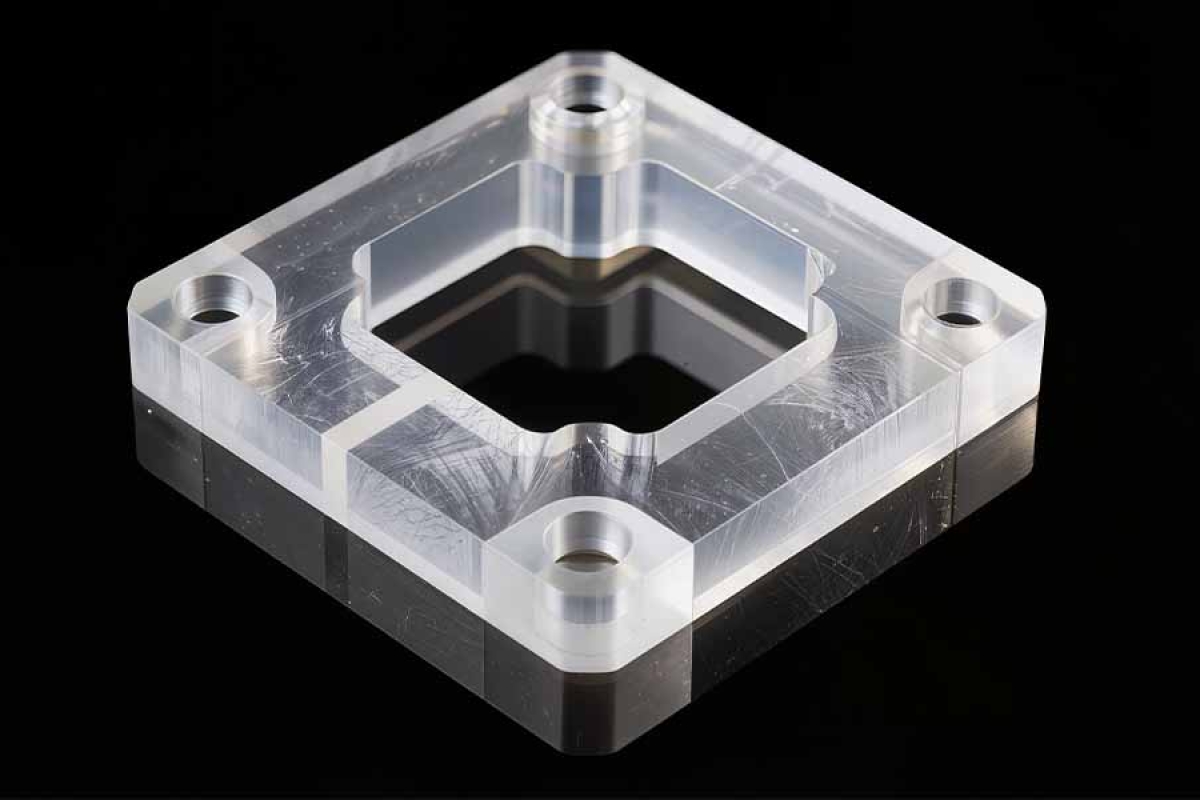
For CNC machining, PMMA is especially valuable when a part needs high transparency, good dimensional accuracy, low weight, and a polished or visually clean appearance. However, acrylic is more brittle than materials such as polycarbonate and requires careful tooling and workholding to prevent cracking, chipping and stress-related defects.
Material terminology note: PMMA is the polymer family. “Acrylic” is the common industry name. Commercial PMMA grades can differ substantially in optical, impact, UV and thermal performance, so the exact grade should be confirmed against the manufacturer's technical data sheet.
1. Basic Material Information
Standard Material Designations & Classification
Item | PMMA / Acrylic |
Chemical name | Polymethyl Methacrylate |
Common names | PMMA, Acrylic, Acrylic Glass |
Common abbreviation | PMMA |
Material category | Engineering thermoplastic |
Polymer type | Amorphous thermoplastic |
Typical forms | Sheet, plate, rod, tube, block |
Typical colors | Clear, transparent, translucent, black, white, custom colors |
Common manufacturing methods | CNC machining, injection molding, extrusion, casting |
Relevant standards | ISO 7823; ASTM D788 and applicable product/test standards |
PMMA is commonly supplied as either:
Cast acrylic (PMMA)
Extruded acrylic (PMMA)
These materials are chemically similar but can behave differently during machining and may have different optical and dimensional characteristics.
ASTM / ISO Considerations
Unlike metallic materials, PMMA does not use a universal UNS designation system.
For purchasing, it is preferable to specify:
PMMA/acrylic
Cast or extruded grade
Manufacturer/grade where critical
Optical requirements where applicable
Thickness
Color/transparency
Required mechanical and thermal properties
This avoids treating different commercial acrylic products as interchangeable.
What Is PMMA?
PMMA is a transparent thermoplastic polymer based on methyl methacrylate.
It is often used as a lightweight alternative to glass because it provides:
PMMA is not, however, an ideal substitute for polycarbonate where high impact resistance is the primary requirement.
Core Market Positioning
PMMA occupies an important position in applications requiring optical transparency and appearance rather than maximum impact strength.
It is particularly attractive for:
Custom transparent housings
2. PMMA Physical Properties
The following are typical values for unfilled PMMA. Actual values vary with cast/extruded processing, molecular weight, grade, additives and test method.
Property | Typical PMMA Value |
Density | ~1.17–1.20 g/cm³ |
Tensile strength | ~60–80 MPa |
Tensile modulus | ~2.5–3.3 GPa |
Elongation at break | ~2–10% |
Flexural strength | ~90–130 MPa |
Flexural modulus | ~2.5–3.5 GPa |
Hardness | Typically Rockwell M80–M100 |
Water absorption | Generally <0> |
Thermal conductivity | ~0.18–0.25 W/m·K |
Glass transition temperature | ~100–105°C |
Continuous service temperature | Commonly around 70–90°C |
Visible light transmission | Up to approximately 90–92% for clear grades |
These figures should be treated as typical engineering reference values rather than specification limits.
Density
PMMA has a density of approximately 1.17–1.20 g/cm³.
This is approximately half the density of common glass, making acrylic attractive where reducing component weight is important.
Compared with aluminum, PMMA is substantially lighter.
Tensile Strength & Stiffness
Typical PMMA provides tensile strength around 60–80 MPa, depending on grade and test method.
Its modulus is commonly around 2.5–3.3 GPa.
PMMA therefore has relatively good rigidity for a transparent plastic.
However, PMMA is relatively brittle compared with tougher thermoplastics.
This means designers should pay particular attention to:
Sharp internal corners
Small cross-sections
Impact loading
Stress concentrations
Thread roots
Press-fit interference
·
Optical Clarity
Optical transparency is one of PMMA's defining advantages.
Clear PMMA can transmit approximately 90–92% of visible light for suitable grades and thicknesses.
It is therefore frequently selected for:
CNC machining, however, can produce a surface that is optically transparent in bulk but not necessarily optically polished.
For optical applications, the machining and polishing process must be specified separately.
Impact Resistance
PMMA has reasonable impact resistance for a rigid transparent plastic but is significantly more brittle than polycarbonate.
Acrylic can crack or fracture under:
Sudden impact
Excessive clamping force
Sharp machining edges
Stress concentration
Improper drilling
Aggressive press fits
Where impact resistance is the primary requirement, polycarbonate is often a better engineering choice.
Temperature Performance
PMMA has a glass transition temperature of approximately 100–105°C.
Its practical continuous-use temperature is normally substantially lower.
Long-term exposure to elevated temperatures can cause:
For sustained high-temperature applications, materials such as polycarbonate, PEEK or specialized high-temperature polymers may be more appropriate depending on requirements.
Wear Resistance
Standard PMMA provides only moderate wear resistance.
It is not normally the first choice for:
Sliding bearings
Gears
High-cycle wear surfaces
Heavy-duty bushings
POM, PA or specialized tribological plastics are generally more suitable for these applications.
Weather & UV Resistance
One of PMMA's major advantages is excellent resistance to outdoor weathering and UV exposure compared with many other transparent plastics.
This is why acrylic is widely used in:
Outdoor signage
Lighting
Architectural components
Transparent covers
Displays
However, actual UV performance depends on the grade and additives.
3. PMMA Chemical Properties
Chemical Composition
PMMA consists primarily of polymerized methyl methacrylate units.
The polymer contains carbon, hydrogen and oxygen.
Unlike metallic alloys, PMMA does not have a fixed elemental composition table equivalent to a stainless-steel or aluminum alloy specification.
Commercial PMMA formulations may contain:
UV stabilizers
Pigments
Impact modifiers
Processing additives
Optical modifiers
The exact formulation should be obtained from the material supplier when chemical compatibility is critical.
Chemical Resistance
PMMA generally provides useful resistance to:
Particular caution should be taken with:
Acetone
Ketones
Aromatic hydrocarbons
Chlorinated solvents
Some alcohol-containing mixtures
Certain solvent-based cleaners
These chemicals can cause:
Crazing
Cracking
Surface whitening
Softening
Loss of optical quality
Stress Cracking
This is particularly important for CNC-machined acrylic parts.
Residual machining stress combined with chemical exposure can cause delayed cracking.
Therefore, components intended for chemical environments should be evaluated using the actual PMMA grade, stress condition, chemical concentration and operating temperature.
Corrosion Resistance
PMMA does not rust or undergo metallic corrosion.
It is therefore suitable for environments where metallic corrosion would be undesirable.
However, chemical attack remains possible, so PMMA should not simply be classified as universally "chemical resistant."
Welding & Bonding
PMMA can be joined using:
Solvent bonding can produce very clean transparent assemblies when properly controlled.
However, poorly controlled bonding may create:
Whitening
Bubbles
Crazing
Optical distortion
Residual stress
For transparent assemblies, bonding process control is therefore critical.
4. PMMA CNC Machinability Analysis
Machining Difficulty: Moderate
PMMA is generally machinable with CNC milling, turning, drilling and routing, but it requires more process control than POM.
The main machining risks are:
Cracking
Chipping
Melting
Crazing
Burrs
Surface scratching
Optical distortion
For clear acrylic parts, cosmetic quality can be just as important as dimensional accuracy.
Recommended Cutting Tools
Recommended tools include:
Sharp carbide end mills
Polished carbide tools
Single-flute/O-flute cutters
Acrylic-specific cutters
Sharp drills designed for plastics
The cutting edge should be extremely sharp.
A dull tool tends to rub rather than cut, increasing heat and creating the risk of melting or stress formation.
Tool Geometry
For PMMA, useful tooling characteristics include:
Positive rake
Sharp cutting edges
Good chip evacuation
Polished flutes
Low tendency to rub the workpiece
Tool selection should be adjusted according to:
Material thickness
Cutter diameter
Machine spindle speed
Required surface quality
Part geometry
General CNC Cutting Parameter Guidance
The following values are starting ranges for unfilled PMMA, not universal production settings.
Parameter | Typical Starting Range |
Cutting speed | ~150–400 m/min |
Feed per tooth | ~0.03–0.15 mm/tooth |
Tool | Sharp carbide |
Coolant | Air blast / suitable compatible coolant |
Cutting strategy | High chip evacuation, low rubbing |
Finishing | Dedicated light finishing pass |
For transparent parts, machining conditions should be optimized experimentally when optical appearance is critical.
CNC Milling PMMA
PMMA is well suited to:
2D contouring
Pocket machining
Slotting
Drilling
Profiling
3D surface machining
Engraving
For clear acrylic, chip evacuation is particularly important.
Re-cutting chips can scratch the surface and increase localized heat.
Compressed air can help remove chips while limiting the risk associated with unsuitable coolants.
CNC Turning PMMA
PMMA can be turned into:
Transparent cylinders
Optical housings
Bushings
Rings
Spacers
Tubes
Custom knobs
Sharp tools and controlled cutting conditions are essential.
Poor turning conditions can create:
Cloudy surfaces
Microcracks
Melted edges
Chatter marks
Drilling Acrylic
Drilling is one of the operations requiring particular care.
Standard metal drills can sometimes produce excessive force or grab the material.
Possible problems include:
Cracking
Chipping at breakthrough
Melting
Hole distortion
Stress concentration·
For critical acrylic holes, specialized plastic drills or appropriately modified drill geometry can improve results.
A controlled feed near breakthrough is especially important.
Tapping
PMMA can be tapped, but its brittleness makes threaded features more sensitive than those in POM.
For lightly loaded assemblies, direct threads may be acceptable.
For repeated assembly, consider:
Threaded inserts
Brass inserts
Stainless-steel inserts
Through-bolts and nuts
Avoid excessive interference when installing inserts because it can generate stress and lead to delayed cracking.
Common PMMA CNC Machining Problems
1. Cracking
Typical causes:
Solutions:
Consider stress-relief procedures when appropriate
2. Melting
PMMA has low thermal conductivity, so machining heat can accumulate.
Causes include:
Excessive spindle speed
Insufficient feed
Dull cutter
Recutting chips
Poor chip evacuation
Solutions:
Optimize spindle speed and feed
Use sharp tools
Increase chip evacuation
Use air blast
Avoid excessive rubbing
3. Chipping
Chipping can occur around:
Thin edges
Holes
Slots
Sharp corners
Exit points
A controlled toolpath and sharp cutter can reduce the risk.
4. Surface Scratches
Clear PMMA is extremely sensitive to cosmetic damage.
Even when dimensional tolerances are correct, a part can be rejected because of:
Tool marks
Handling scratches
Embedded chips
Fixture marks
Improper packaging
Protective film, clean workholding and careful handling are therefore important for cosmetic acrylic parts.
5. Crazing
Crazing is the formation of fine cracks or stress-whitening structures.
It can result from:
For demanding applications, machining and assembly stress should be minimized.
CNC Tolerance Capability
Under controlled machining conditions, PMMA CNC parts can commonly achieve approximately:
±0.05 mm
on selected dimensions.
Tighter tolerances may be achievable on suitable geometries, but they should be validated according to:
Part dimensions
Thickness
Material grade
Temperature
Workholding
Machining sequence
Inspection method
For transparent components, thermal expansion can become important when the design contains very tight dimensional requirements.
Surface Finish
CNC-machined PMMA can achieve a good surface finish, but machined transparency and optical clarity are not the same thing.
A typical CNC-machined PMMA surface may reach approximately:
Ra 0.8–3.2 μm
depending on tool geometry and machining strategy.
For higher optical clarity, additional finishing may be required, including:
Fine sanding
Mechanical polishing
Diamond polishing
Flame polishing
Vapor polishing where compatible with the specific application
For precision optical components, the required optical specification should be defined separately from ordinary CNC surface roughness.
5. Typical PMMA Applications & Part Scenarios
Optical Components
PMMA is widely used for:
Light guides
Optical covers
Transparent windows
Display components
Lens prototypes
Optical housings
Its high visible-light transmission makes it particularly attractive for these applications.
However, true optical components require tighter control of surface quality, geometry and optical distortion than standard transparent CNC parts.
Automation Equipment
Typical applications include:
PMMA provides good visibility while maintaining relatively low weight.
For impact-critical machine guarding, however, the appropriate safety standard and material should be verified; polycarbonate may be more suitable where high impact resistance is required.
Consumer Electronics
PMMA can be used for:
Display windows
Indicator panels
Light pipes
Decorative covers
Transparent housings
Interface components
Its optical appearance makes it particularly attractive for visible consumer products.
Lighting
Potential applications include:
Light guides
LED covers
Diffusers
Lighting housings
Transparent panels
The exact PMMA grade should be selected according to:
Light transmission
Diffusion
Temperature
UV exposure
Flame requirements
Medical & Laboratory Equipment
PMMA can be used for selected:
However, medical applications require suitable grades and validation for:
Standard PMMA should not automatically be assumed to meet medical-grade requirements.
Automotive
Potential applications include:
Lighting prototypes
Display components
Interior trim prototypes
Transparent covers
Sensor prototypes
For production automotive applications, the specific automotive-grade PMMA and applicable OEM specifications must be verified.
Architectural & Display Products
PMMA is extensively used for:
CNC machining allows manufacturers to produce complex custom geometries without requiring dedicated injection molds.
6. Our PMMA CNC Machining Advantages
Material Selection Support
We can help determine whether the application requires:
Material selection can be based on:
Optical requirements
Thickness
Mechanical load
UV exposure
Temperature
Chemical environment
Appearance
Proven CNC Process Parameters
PMMA machining requires a different strategy from metal machining.
Our process planning focuses on:
For clear acrylic, the process is designed around both dimensional accuracy and visual quality.
Precision CNC Machining
Critical features can be controlled for:
Hole diameter
Flatness
Parallelism
Profile
Position
Overall dimensions
Assembly interfaces
GD&T requirements can be incorporated into CNC process planning and inspection.
Transparent Surface Quality
Where required, machining can be combined with appropriate finishing processes to improve:
Transparency
Surface smoothness
Edge appearance
Cosmetic quality
This is especially useful for display windows, optical prototypes and transparent equipment covers.
Prototype to Batch Manufacturing
PMMA CNC machining is suitable for:
For larger quantities, production planning can optimize material utilization, fixture design and machining cycle time.
Quality Inspection & Material Documentation
Quality control may include:
Dimensional inspection
GD&T inspection
Visual inspection
Hole and thread inspection
Surface-finish verification
Optical appearance inspection
Material documentation where available
For clear PMMA parts, visual inspection can be particularly important because cosmetic defects may affect functional or optical performance.
PMMA CNC Machining Material Selection Summary
Requirement | PMMA Suitability |
CNC milling | Excellent |
CNC turning | Good–Excellent |
Drilling | Good with proper tooling |
Precision machining | Good |
Optical transparency | Excellent |
UV/weather resistance | Excellent |
Impact resistance | Moderate |
Wear resistance | Moderate–Low |
Dimensional stability | Good |
Chemical resistance | Moderate |
High-temperature applications | Limited |
Outdoor applications | Excellent with suitable grade |
Transparent enclosures | Excellent |
Light guides | Excellent |
Machine guarding | Application-dependent |
Adhesive/solvent bonding | Good with appropriate process |
Cost efficiency | Good |
PMMA vs. Polycarbonate vs. POM
Characteristic | PMMA | Polycarbonate | POM |
Transparency | Excellent | Excellent | Poor/opaque |
Impact resistance | Moderate | Excellent | Good |
Machinability | Good | Good | Excellent |
Wear resistance | Moderate | Moderate | Excellent |
Dimensional stability | Good | Good | Excellent |
UV resistance | Excellent | Grade-dependent | Limited |
Chemical resistance | Moderate | Moderate | Good |
Friction | Moderate | Moderate | Low |
Optical appearance | Excellent | Excellent | Low |
Gears/bushings | Limited | Limited | Excellent |
Transparent covers | Excellent | Excellent | Not suitable |
High-temperature performance | Limited | Better | Moderate |
Final Engineering Recommendation
PMMA is an excellent CNC machining material when optical clarity, appearance, UV/weather resistance, dimensional accuracy and low weight are key requirements. Its main limitations are relatively low impact resistance, sensitivity to stress cracking, and limited high-temperature capability.
For designers and procurement engineers, the material specification should go beyond simply stating “PMMA” or “acrylic.” For critical parts, identify the cast/extruded form, commercial grade, transparency requirement, thickness, operating temperature, chemical environment and required surface/optical quality.
Contact us for a CNC machining quote and DFM consultation for custom PMMA/acrylic parts, including material selection, transparent-part machining, precision tolerances, surface finishing and batch-production planning.
Get an Instant Quotefor your custom Acrylic parts today.