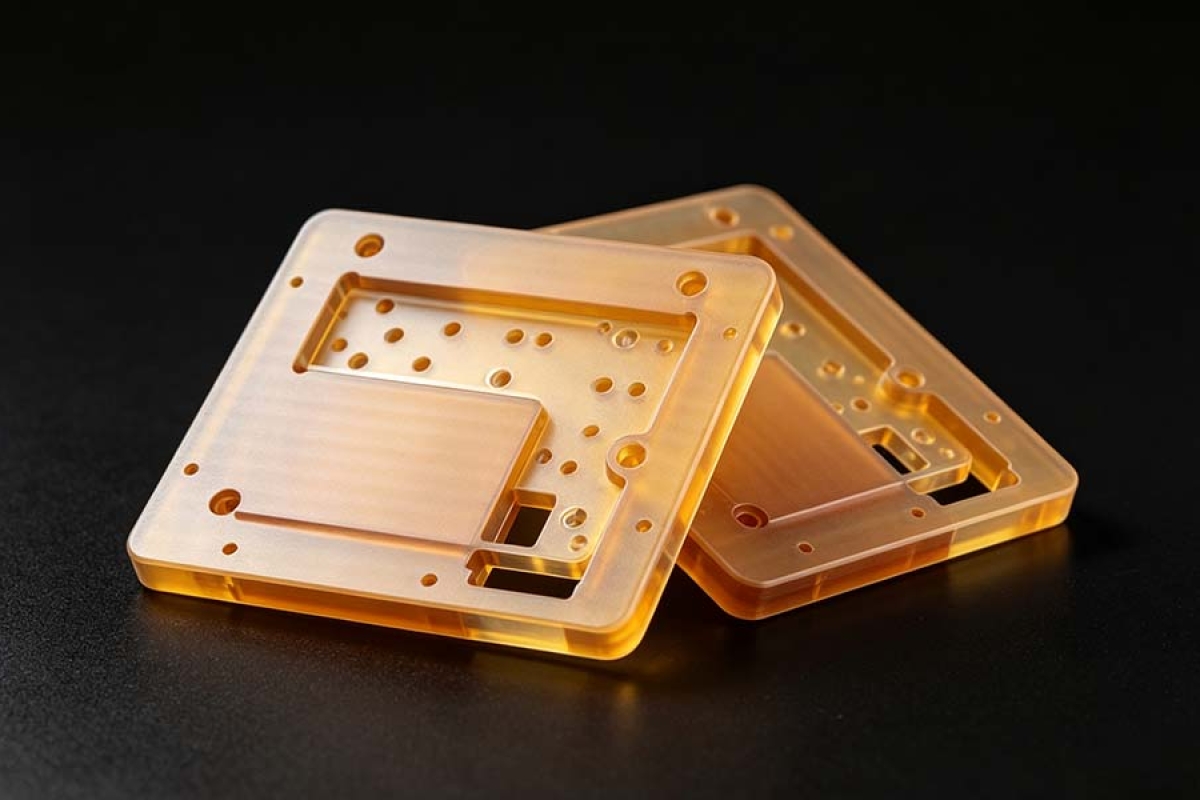
PEI (Polyetherimide) is a high-performance amorphous engineering thermoplastic recognized for its high strength-to-weight ratio, excellent dimensional stability, inherent flame resistance, low smoke characteristics, electrical insulation, and relatively high continuous-use temperature.
Commercially, PEI is widely known through grades such as ULTEM™, although ULTEM is a trademark associated with specific SABIC grades rather than a generic name for every PEI material.
For CNC machining, PEI is particularly suitable for aerospace components, electrical and electronic insulators, semiconductor equipment, medical-device components, high-temperature fixtures, connectors, housings, and precision structural parts where conventional plastics such as ABS, PP, PVC or PC cannot provide sufficient thermal or mechanical performance.
1. Basic Material Information
Standard Material Designations & Classification
Item | PEI / Polyetherimide |
Chemical name | Polyetherimide |
Common abbreviation | PEI |
Common commercial family | ULTEM™ and other PEI grades |
Material category | High-performance engineering thermoplastic |
Polymer type | Amorphous thermoplastic |
Common CNC stock | Sheet, plate, rod, tube, block |
Typical appearance | Amber/translucent, opaque black or other colors |
Common manufacturing processes | CNC machining, injection molding, extrusion |
Relevant material standard | ISO 20557 |
Common applications | Aerospace, electronics, medical, semiconductor, industrial |
PEI does not have a metal-style UNS designation. When purchasing PEI stock, the material specification should ideally include: exact PEI grade, manufacturer, color, reinforcement type, temperature resistance requirements, electrical performance standards, flame and smoke specifications, as well as medical or aerospace qualification requirements for special scenarios.
What Is PEI?
PEI is an amorphous, high-temperature aromatic thermoplastic containing ether and imide structures. Its unique molecular architecture endows it with comprehensive superior performance that far exceeds commodity plastics like PP, PE and PVC:
Ultra-high structural stiffness
Excellent tensile mechanical strength
Outstanding high-temperature resistance
Low creep deformation under long-term load
Superior dimensional stability
Stable electrical insulation performance
Inherent flame retardant and low smoke characteristics
Core Market Positioning
PEI belongs to the high-end high-performance engineering plastic segment. It is the preferred material for industrial components that require the composite performance of high temperature resistance, mechanical strength, dimensional stability, electrical insulation and flame retardancy. It is widely used to replace heavy metal parts to realize lightweight equipment design while ensuring structural and functional reliability.
2. PEI Physical Properties
Property | Typical PEI Value/Range |
Density | ~1.27 g/cm³ |
Tensile strength | ~95–110 MPa |
Tensile modulus | ~3.0–3.4 GPa |
Yield strength | ~105 MPa, grade-dependent |
Elongation at break | ~5–10% |
Flexural modulus | ~3.1–3.5 GPa |
Hardness | Typically Rockwell M95–M110 |
Water absorption | ~0.2–0.7% |
Thermal conductivity | ~0.20–0.25 W/m·K |
Glass transition temperature | ~215–220°C |
Continuous service temperature | Commonly around 170–180°C, grade/application dependent |
UL 94 behavior | Many grades available with V-0 classifications |
Density
PEI has a standard density of 1.27 g/cm³, which is far lighter than various metal materials. It can effectively reduce the overall weight of equipment while maintaining high mechanical strength, making it an ideal lightweight structural material for aerospace, precision industrial equipment and portable devices.
Tensile Strength & Modulus
Unfilled PEI features a tensile strength of 95–110 MPa and a tensile modulus of 3.0–3.4 GPa, with mechanical properties significantly superior to most commodity plastics. The excellent strength-to-weight ratio makes it suitable for manufacturing structural brackets, electrical functional parts, precision fixtures, aerospace hardware and sensor housings.
Dimensional Stability
Dimensional stability is one of PEI's core competitive advantages. Compared with soft thermoplastics, PEI has high rigidity, low creep, minimal load deformation and excellent thermal dimensional stability, which can maintain high precision of parts in high-temperature working environments. It should be noted that PEI still has a higher thermal expansion coefficient than metals, and thermal matching needs to be considered in hybrid assembly structures.
Impact Resistance
As a high-temperature amorphous polymer, PEI has excellent toughness, but it is not designed for extreme anti-impact scenarios. Compared with PC materials, PEI has better high-temperature resistance and structural stiffness, while PC is superior in impact toughness performance.
Temperature Performance
PEI has an ultra-high glass transition temperature of 215–220°C, which is the core basis for its classification as a high-performance plastic. Most PEI grades can stably work continuously at 170–180°C. The actual service temperature is affected by mechanical load, working environment, material grade and service cycle, and it can withstand higher temperature impact in short-term exposure scenarios.
Creep Resistance
PEI has far better creep resistance than ordinary thermoplastics, and will not produce permanent deformation under long-term continuous mechanical load and high-temperature conditions. It is widely used for long-service-cycle components bearing mechanical and electrical loads. Glass-reinforced modified PEI can further enhance structural stiffness and anti-creep performance.
Wear Resistance
Standard unfilled PEI has moderate wear resistance, which can meet conventional static and low-friction working conditions. For severe sliding friction, high-load bearing and abrasive scenarios, PEEK, PAI, POM and special tribological modified plastics are more suitable. Custom wear-resistant PEI grades can be selected for medium wear working requirements.
3. PEI Chemical Properties
Chemical Composition
PEI is composed of carbon, hydrogen, oxygen and nitrogen elements, with stable aromatic imide and ether group molecular structures. Commercial PEI products can be added with glass fiber, lubricants, pigments, reinforcing agents and processing modifiers to realize customized performance upgrades.
Chemical Resistance
PEI has good resistance to hydrocarbons, grease, weak acid, weak alkali and conventional alcohols, and can work stably in most conventional industrial environments. However, it is not chemically inert. Chlorinated solvents, strong alkalis, aromatic solvents and ketones will cause PEI swelling, cracking, stress damage and material degradation. It is necessary to verify chemical compatibility according to actual working conditions.
Hydrolysis & Moisture
Compared with hygroscopic plastics such as nylon, PEI has low water absorption, but it is still affected by humid environments. Moisture absorption will cause slight changes in the size, mechanical strength and electrical properties of PEI parts. For high-precision components, environmental humidity control is required during processing and inspection.
UV Resistance
Long-term ultraviolet radiation will cause aging and performance attenuation of ordinary PEI materials. For outdoor application scenarios, UV-stabilized modified PEI grades must be selected or protective structural design should be adopted to avoid material aging failure.
Flame & Smoke Performance
Inherent flame retardancy and low smoke generation are the most prominent advantages of PEI. Most commercial PEI grades have excellent flame resistance, low flame propagation speed and low smoke density, and can meet UL 94 V-0 flame retardant standards and strict aerospace fire and smoke certification requirements, which is irreplaceable for high-end safety-sensitive equipment.
Electrical Properties
PEI is a high-quality insulating material with high dielectric strength and volume resistivity. Its electrical performance is stable and barely affected by humidity. It is widely used to manufacture connectors, insulating parts, coil brackets, electrical housings and semiconductor precision electronic components.
Welding & Bonding
PEI supports a variety of connection methods including mechanical fastening, ultrasonic welding, thermal welding, heat staking and adhesive bonding. For high-performance precision assemblies, it is necessary to strictly control joint temperature, residual stress, chemical compatibility and long-term thermal aging risk to ensure connection reliability.
4. PEI CNC Machinability Analysis
Machining Difficulty: Moderate–Difficult
PEI can be processed by conventional CNC equipment, but its high rigidity, low toughness and stress characteristics make the processing difficulty higher than ordinary plastics such as PP, ABS and POM. The main processing challenges include internal residual stress, cutting heat accumulation, edge chipping, dimensional offset, thin-wall deformation and surface damage, which require professional processing technology control.
Recommended Tool Materials
It is recommended to use sharp carbide tools, polished carbide fine-edge milling cutters for conventional processing; diamond tools are suitable for high-volume finishing of high-precision parts. For glass-filled reinforced PEI, carbide tools are mandatory to reduce tool wear caused by glass fiber abrasion.
General CNC Cutting Parameter Guidance
The following parameters are standard starting values for unfilled PEI, which need to be adjusted according to material grade, tool specification, equipment rigidity, part structure and surface finish requirements.
Parameter | Typical Starting Range |
Cutting speed | ~150–300 m/min |
Feed per tooth | ~0.03–0.15 mm/tooth |
Tool | Sharp carbide |
Coolant | Air blast / suitable coolant |
Finishing allowance | Light |
Chip evacuation | High priority |
CNC Milling PEI
PEI is suitable for CNC milling processes such as pocketing, contouring, drilling, slotting, thread milling and 3D precision machining, and is widely used for customized precision fixtures and structural parts. For thin-wall PEI parts, separate roughing and finishing processes are required to release internal stress and avoid dimensional deformation.
CNC Turning PEI
CNC turning can process PEI into precision bushings, insulating rings, sleeves, spacers, sensor housings and cylindrical structural parts. Ultra-sharp tools and strict cutting heat control are the key to ensure the roundness and surface quality of rotary parts.
Drilling PEI
PEI drilling is prone to edge chipping, cracking, hole size deviation and thermal damage. In the processing process, tool sharpness, stable feed speed, efficient chip evacuation and breakthrough protection must be strictly controlled to ensure the precision and integrity of hole features.
Tapping PEI
PEI can be directly tapped for internal threads. For high-load and frequently assembled threaded structures, it is necessary to optimize thread engagement length, avoid stress concentration and creep deformation. Metal threaded inserts are recommended to improve the long-term assembly stability and load capacity of threads.
Common PEI CNC Machining Problems
1. Residual Stress & Warpage CNC processing will release the internal residual stress of PEI raw materials, resulting in part warpage, flatness deviation and feature position offset. Precision parts adopt the process of roughing first, stress relaxation and then finishing to stabilize dimensional accuracy.
2. Cutting Heat Damage Excessive processing heat will cause PEI surface discoloration, material softening, dimensional changes and secondary residual stress. The solutions are to use sharp tools, optimize speed and feed parameters, match air blast cooling and strengthen chip evacuation.
3. Edge Chipping Dull tools, excessive feed and unreasonable tool engagement will cause PEI edge chipping. Adopting sharp fine-edge tools and graded cutting processing can effectively protect part edges and corners.
4. Thin-Wall Deformation Thin-wall PEI parts are easily deformed by cutting force, clamping force and stress release. Vacuum fixtures, soft jaw clamping, distributed force application and multiple finishing passes are adopted to ensure structural stability.
5. Dimensional Drift Thermal expansion, residual stress, moisture absorption and material relaxation will cause dimensional deviation of PEI parts. High-precision products need constant temperature processing and inspection environment to eliminate errors.
CNC Tolerance Capability
With professional process control, PEI CNC machining can stably achieve ±0.02–0.05 mm high precision for conventional features. Ultra-tight tolerance needs to be comprehensively evaluated combined with part size, wall thickness, structural complexity and processing environment. It is not recommended to set unified ultra-high precision tolerance for the whole part.
Surface Finish
By optimizing tool geometry, cutting parameters and finishing technology, the surface roughness of CNC-machined PEI parts can reach Ra 0.8–3.2 μm. High-rigidity equipment and sharp finishing tools can effectively avoid tool marks and material tearing, improving surface finish quality.
5. Typical PEI Applications & Part Scenarios
Aerospace
Relying on lightweight, high temperature resistance and low smoke flame retardant performance, PEI is used for aerospace electrical brackets, cable management parts, insulating components, sensor housings, lightweight structural parts and aircraft interior accessories, meeting strict aerospace safety and performance standards.
Electrical & Electronics
PEI's stable dielectric performance and high-temperature resistance make it the preferred material for high-end electronic components, including electrical insulators, precision connectors, coil forming parts, terminal blocks, high-temperature resistant housings and electrical precision fixtures.
Semiconductor Equipment
Pure-grade PEI is widely used for semiconductor wafer handling fixtures, insulating components, sensor fixing seats, equipment brackets and chemical processing auxiliary parts. It can meet the high requirements of semiconductor manufacturing for material purity, low outgassing and low particle generation.
Medical Equipment
Medical-certified PEI grades have excellent high-temperature resistance, dimensional stability, chemical corrosion resistance and sterilization adaptability, and are used for processing medical instrument parts, equipment housings, experimental fixtures, operating handles and laboratory precision equipment parts.
Automotive
PEI is suitable for automotive high-temperature working parts such as engine cabin components, sensor parts, electrical connectors, high-temperature resistant housings and insulating brackets, realizing lightweight and high-temperature stable operation of automotive electronic systems.
Industrial Automation
In high-temperature industrial environments where ordinary plastics fail, PEI can maintain stable stiffness and precision, and is used for automated equipment high-temperature fixtures, sensor mounting seats, electrical housings and precision mechanical parts.
Robotics
PEI lightweight high-precision parts are applied to robot sensor housings, electrical insulating parts, lightweight brackets and cable management components. For heavy-load robot joint structures, high-performance materials such as PEEK and metal are recommended.
6. Our PEI CNC Machining Advantages
Exact Grade Selection
Evefab's professional engineering team provides one-to-one PEI material matching services, accurately selecting unfilled PEI, glass-filled PEI, wear-modified PEI, flame-retardant PEI, medical-grade PEI and aerospace-qualified PEI according to working temperature, mechanical load, electrical standards, chemical environment, safety certification and dimensional stability requirements of customer projects, avoiding material mismatch failure.
Controlled PEI Machining Process
Aiming at the stress and heat-sensitive characteristics of PEI, we formulate exclusive processing schemes, strictly control cutting temperature, tool sharpness, fixture clamping mode and residual stress release, adopt separate roughing and finishing processes for precision parts to ensure long-term dimensional stability of products.
High-Precision CNC Manufacturing
We realize high-precision control of core features such as hole diameter, flatness, parallelism, position degree, concentricity, profile and thread size of PEI parts. We support full GD&T geometric tolerance detection and meet the high-precision requirements of semiconductor, medical and aerospace equipment.
Complex Geometry
Equipped with multi-axis CNC processing equipment, Evefab supports customized processing of deep cavity grooves, complex curved surfaces, oblique features, lightweight special-shaped structures and multi-surface integrated parts. 5-axis linkage processing reduces clamping times and effectively improves part positioning accuracy and consistency.
Prototype to Batch Production
We provide full-cycle services including PEI functional prototype verification, engineering test parts, small-batch trial production and mass batch production. For large-order production, we customize special fixtures and optimize tool paths to shorten processing cycle, reduce production cost and ensure product batch consistency.
Quality Inspection & Material Documentation
Full-process quality inspection is implemented, including dimensional detection, GD&T verification, thread inspection, surface finish testing and visual inspection. We can provide complete material certificates, MTR and COC qualification documents, meeting the strict documentation requirements of aerospace, medical and semiconductor industries.
PEI CNC Machining Material Selection Summary
Requirement | PEI Suitability |
CNC milling | Excellent |
CNC turning | Excellent |
Drilling | Good–Excellent |
Tapping | Good |
Temperature resistance | Excellent |
Dimensional stability | Excellent |
Creep resistance | Excellent |
Tensile strength | Excellent |
Electrical insulation | Excellent |
Flame resistance | Excellent |
Smoke performance | Excellent / grade-dependent |
Chemical resistance | Good |
Wear resistance | Moderate |
Impact resistance | Good |
Moisture absorption | Low–Moderate |
Thin-wall machining | Moderate |
High-precision machining | Excellent with controlled process |
Aerospace applications | Excellent / grade-dependent |
Semiconductor applications | Excellent / grade-dependent |
Cost efficiency | Moderate |
PEI vs. PEEK vs. PAI vs. PC vs. POM
Property | PEI | PEEK | PAI | PC | POM |
Temperature capability | Excellent | Excellent+ | Excellent+ | Good | Moderate |
Tensile strength | High | Very high | Very high | Moderate | Good |
Stiffness | High | High | Very high | Moderate | High |
Dimensional stability | Excellent | Excellent | Excellent | Good | Excellent |
Wear resistance | Moderate | Excellent | Excellent | Moderate | Excellent |
Chemical resistance | Good | Excellent | Excellent | Moderate | Good |
Flame resistance | Excellent | Good–Excellent | Good–Excellent | Good | Moderate |
Electrical insulation | Excellent | Excellent | Excellent | Excellent | Excellent |
Impact resistance | Good | Good | Moderate | Excellent | Good |
CNC machinability | Good | Good | Moderate–Difficult | Good | Excellent |
Relative cost | High | Very high | Very high | Moderate | Low–Moderate |
Aerospace | Excellent | Excellent | Excellent | Good | Limited |
Semiconductor | Excellent | Excellent | Excellent | Good | Good |
Precision mechanical parts | Excellent | Excellent | Excellent | Good | Excellent |
When Should Engineers Choose PEI?
Choose PEI when you need: High continuous operating temperature, high structural stiffness, ultra-high dimensional stability, excellent electrical insulation, inherent flame retardant and low smoke performance, low creep deformation and lightweight structural design.
Choose PEEK instead when: Extreme chemical corrosion resistance, higher temperature resistance, severe friction and wear working conditions and ultra-high mechanical performance are required.
Choose PAI instead when: Ultra-high wear resistance, extreme temperature resistance and high-load mechanical bearing performance are core requirements.
Choose PC instead when: High impact toughness, transparent appearance and moderate temperature working environment are required.
Choose POM instead when: Low friction coefficient, excellent wear resistance and moderate temperature precision mechanical transmission parts are needed.
Final Engineering Recommendation
PEI is a premium high-performance CNC machining engineering plastic, integrating high temperature resistance, mechanical strength, dimensional stability, electrical insulation and flame-retardant low-smoke performance. It is the core customized material for aerospace, semiconductor equipment, electronic and electrical components, medical devices, automotive high-temperature parts and industrial high-precision fixtures.
Compared with ordinary commodity plastics such as PP, PE and PVC, PEI has overwhelming advantages in temperature resistance, stiffness, strength and anti-creep performance. Compared with high-end PEEK and PAI materials, PEI has higher cost performance in scenarios that do not require extreme chemical resistance and wear resistance but require excellent thermal and electrical performance.
The key points of PEI CNC processing are sharp carbide tool configuration, precise cutting heat control, scientific fixture positioning, effective residual stress management and graded roughing and finishing technology. Glass-filled PEI parts need to strengthen tool wear monitoring and parameter optimization.
For procurement and engineering design, it is necessary to clarify the exact PEI grade, manufacturer, reinforcement type, working temperature, chemical environment, safety certification and industry qualification standards, instead of simply marking PEI or ULTEM.
Contact Evefab for professional PEI CNC machining quotation and DFM design consultation. We provide one-stop customized manufacturing services for high-temperature precision parts, aerospace and semiconductor special parts, electrical insulating components and complex structural parts, covering prototype verification to mass batch production to meet your high-end industrial manufacturing needs.
Get an Instant Quotefor your custom PEI (Ultem) parts today.