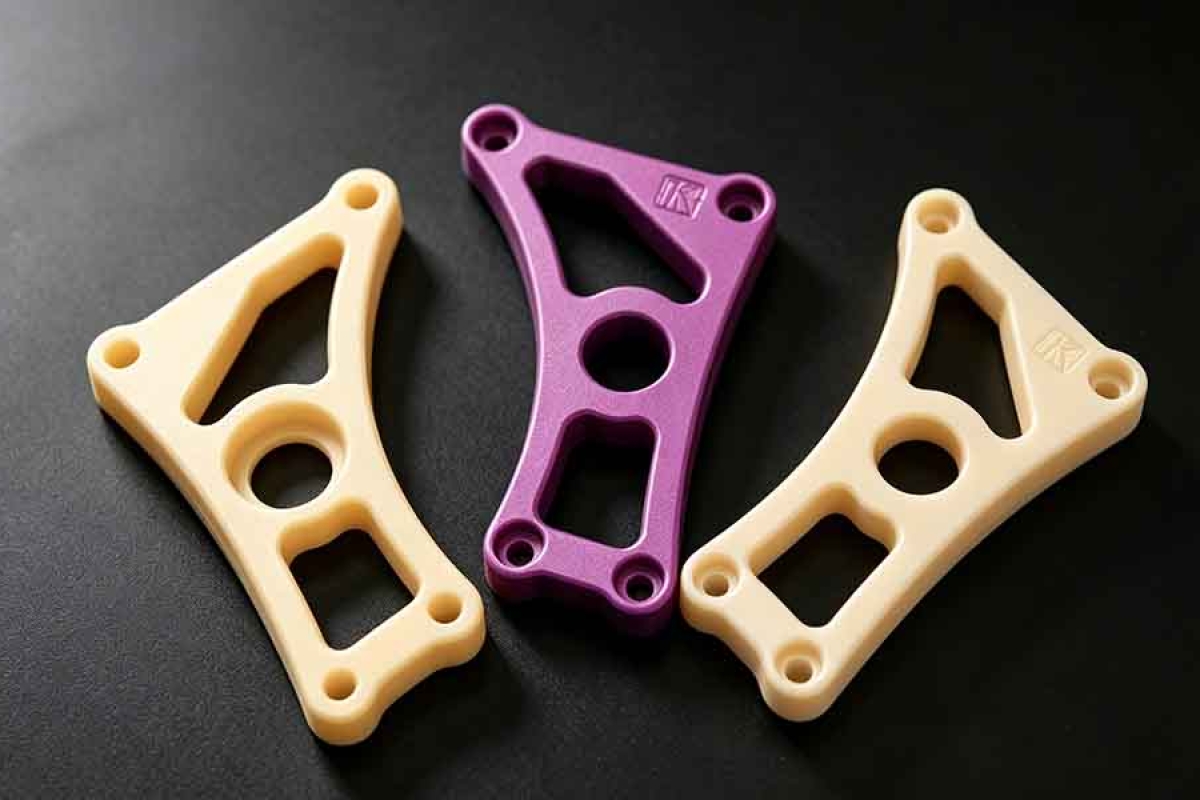
PAI CNC Machining: Properties, Machinability, Applications & Manufacturing Guide
PAI (Polyamide‑Imide) is a high‑performance engineering thermoplastic known for its exceptional combination of high‑temperature strength, dimensional stability, creep resistance, wear resistance, and chemical resistance. It is commonly selected for demanding applications where conventional engineering plastics such as POM, PA6 or standard nylon cannot maintain sufficient performance under elevated temperature, load, friction, or wear.
PAI is particularly suitable for precision CNC machined components, including high‑temperature bushings, seals, thrust washers, valve seats, electrical insulators, aerospace components, semiconductor equipment parts, and high‑load wear components.
Material terminology note: PAI is a polymer family, not one universal commercial grade. Common commercial PAI materials include Torlon® PAI grades. Different grades may be unfilled, internally lubricated, glass‑fiber reinforced, carbon‑fiber reinforced, or otherwise modified. Mechanical properties and machinability therefore vary substantially by grade. The values below are representative typical ranges and should be verified against the exact manufacturer's datasheet before production.
1. Basic Material Information
Standard Material Designations & Classification
Item | PAI |
|---|
Chemical name | Polyamide‑Imide |
Common abbreviation | PAI |
Material category | High‑performance engineering thermoplastic |
Polymer type | Amorphous high‑performance thermoplastic |
Common commercial family | Torlon® PAI |
Common forms for CNC machining | Rod, plate, sheet, tube, billet |
Typical manufacturing methods | CNC machining, compression molding, injection molding |
Relevant standard | ASTM D5204 and applicable product/test standards |
Common applications | Aerospace, semiconductor, automotive, precision machinery, electrical |
PAI does not have a universal metallic‑style UNS designation.
Commercial PAI grades should be identified by the manufacturer and exact grade, especially when the application depends on:
Temperature resistance
Wear rate
Friction coefficient
Electrical properties
Creep resistance
Chemical resistance
Reinforcement content
PAI vs. Torlon®
PAI is the material family; Torlon® is a commercial PAI product family.
This distinction matters when preparing engineering drawings and purchasing specifications. A drawing that simply states "PAI" may not adequately define the required performance.
Core Material Positioning
PAI is positioned near the upper end of engineering thermoplastics.
Compared with conventional plastics such as:
PAI offers substantially higher performance in:
Compared with PEEK, PAI can provide excellent high‑temperature mechanical performance and wear characteristics, but material selection depends heavily on the specific grade and application.
PAI is therefore typically chosen when performance requirements justify the significantly higher material and machining cost.
2. PAI Physical Properties
The following values are typical representative ranges for unfilled or selected PAI grades. Reinforced grades can have substantially different values.
Property | Typical PAI Range |
|---|
Density | ~1.38–1.45 g/cm³ |
Tensile strength | ~70–100 MPa |
Tensile modulus | ~3.0–4.5 GPa |
Elongation at break | ~5–15% |
Flexural modulus | ~3.0–5.0 GPa |
Hardness | Typically Rockwell M90–M100+ |
Water absorption | Generally low to moderate |
Thermal conductivity | ~0.2–0.3 W/m·K |
Glass transition temperature | ~275°C or higher, grade‑dependent |
Continuous‑use temperature | Commonly up to ~250°C for suitable grades |
Short‑term temperature capability | Can exceed 250°C for selected grades |
Important: PAI's high‑temperature capability is one of its major advantages, but actual continuous service temperature depends on grade, load, atmosphere, duration and mechanical requirements.
Density
PAI typically has a density around 1.38–1.45 g/cm³, depending on formulation.
Although denser than common plastics such as ABS and nylon, it remains substantially lighter than most metals.
This provides a useful combination of:
Tensile Strength & Stiffness
Typical PAI grades can provide tensile strength around 70–100 MPa, while reinforced grades may achieve considerably higher values.
Tensile modulus is commonly around 3–4.5 GPa for unfilled grades.
A major advantage is that PAI retains useful mechanical properties at temperatures where ordinary thermoplastics experience substantial softening.
Creep Resistance
Creep resistance is one of PAI's defining engineering advantages.
Under sustained mechanical loading, conventional plastics can gradually deform.
PAI exhibits much better resistance to:
This makes it useful for:
Wear Resistance
PAI provides excellent wear resistance, particularly in grades specifically formulated for tribological applications.
Depending on the formulation, PAI can be engineered for:
Low friction
High PV performance
Abrasion resistance
Dry‑running applications
Long service life
Some commercial grades incorporate lubricating additives such as graphite, PTFE or other modifiers.
For a wear‑critical component, the specific grade should be selected based on the actual load, sliding speed, counterface and lubrication condition.
Temperature Performance
PAI is one of the highest‑temperature‑capable thermoplastic families used for precision engineering components.
A glass transition temperature of approximately 275°C or above is typical for PAI chemistry.
Certain PAI grades can maintain useful mechanical performance at continuous operating temperatures around 250°C, subject to the exact application.
This makes PAI suitable for environments where:
POM would soften
Nylon would lose stiffness
ABS would become unsuitable
Standard plastics would experience excessive creep
Dimensional Stability
PAI provides excellent dimensional stability, particularly under elevated temperature.
Its low thermal deformation and creep resistance make it useful for precision components where maintaining geometry over long periods is important.
Nevertheless, PAI still has a coefficient of thermal expansion, so tight‑tolerance designs must account for operating temperature.
3. PAI Chemical Properties
Chemical Composition
PAI is a high‑performance aromatic polymer containing:
Amide groups
Imide groups
Aromatic structures
The exact molecular structure depends on the commercial formulation.
PAI compounds may contain:
The exact formulation should be specified using the commercial grade rather than relying only on the generic "PAI" designation.
Chemical Resistance
PAI generally offers good resistance to many:
Hydrocarbons
Fuels
Oils
Greases
Hydraulic fluids
Many organic solvents
This makes PAI attractive for demanding industrial and aerospace environments.
However, chemical resistance is not universal.
Strong acids, strong bases and certain aggressive chemical environments can attack PAI, particularly at elevated temperature.
For chemical‑service components, compatibility should be evaluated against:
Chemical concentration
Temperature
Exposure time
Mechanical stress
Exact PAI grade
Corrosion Resistance
PAI does not rust or undergo metallic corrosion.
It is therefore useful in environments where replacing a metal component with a polymer can reduce corrosion‑related problems.
However, PAI should not be described as chemically inert.
UV & Weather Resistance
PAI generally provides better thermal stability than conventional engineering plastics, but long‑term outdoor UV performance remains grade‑dependent.
For outdoor applications, UV exposure should be included in the material‑selection analysis.
Hydrolysis Resistance
PAI generally provides useful resistance to hydrolysis compared with some engineering polymers, but long‑term exposure to high‑temperature water or steam requires grade‑specific validation.
This is particularly important for applications involving:
Welding & Bonding
PAI is generally more difficult to bond than ABS or PMMA.
Possible assembly methods include:
For high‑temperature components, mechanical fastening is often preferred because the joint must withstand the same operating environment as the PAI component itself.
4. PAI CNC Machinability Analysis
Machining Difficulty: Difficult
PAI is machinable, but it is considerably more demanding to CNC machine than POM, ABS or conventional nylon.
The challenge comes from its:
For precision PAI components, tool selection and machining strategy can have a major effect on final dimensional accuracy and surface quality.
Recommended Cutting Tools
For unfilled PAI:
For glass‑ or carbon‑fiber‑reinforced PAI:
Reinforced PAI can significantly accelerate tool wear.
Tool Condition
Tool sharpness is critical.
A worn tool can generate:
For high‑value PAI components, tool wear should be monitored as part of process control.
General CNC Cutting Parameter Guidance
Because PAI grades vary significantly, machining parameters should be established from the specific stock material and tool manufacturer's recommendations.
Reasonable starting considerations for unfilled PAI may include:
Parameter | Typical Starting Consideration |
|---|
Cutting speed | ~100–250 m/min |
Feed per tooth | ~0.03–0.15 mm/tooth |
Tool | Sharp carbide |
Coolant | Air blast or compatible coolant |
Cutting strategy | Controlled engagement |
Finishing | Light finishing passes |
These values are starting ranges only, not universal production specifications.
Reinforced grades generally require more conservative parameters and more wear‑resistant tooling.
CNC Milling PAI
PAI can be machined using:
3‑axis CNC milling
4‑axis CNC milling
5‑axis CNC machining
Typical operations include:
Pocketing
Contouring
Slotting
Drilling
Threading
Precision profiling
Complex 3D machining
For expensive PAI stock, roughing strategy should minimize unnecessary material waste.
Recommended Process Strategy
Rough machining
Stress/thermal stabilization where necessary
Semi‑finishing
Controlled finishing
Critical‑feature inspection
This approach can reduce dimensional movement on demanding components.
CNC Turning PAI
PAI is suitable for precision turned parts such as:
Bushings
Valve seats
Seals
Rings
Spacers
Insulating sleeves
Bearing components
Because PAI is expensive, CNC turning should be planned carefully to maximize material utilization.
Drilling PAI
PAI can be drilled, but high‑quality tooling and chip evacuation are important.
Potential problems include:
Heat accumulation
Tool wear
Hole oversize
Burrs
Dimensional drift
For critical holes, controlled finishing operations may be necessary.
Threading PAI
PAI can be directly tapped and threaded.
For highly loaded or repeatedly assembled interfaces, threaded inserts may be considered.
Because PAI is expensive and often used in high‑performance environments, the thread design should be evaluated for:
Load
Temperature
Assembly frequency
Creep
Chemical exposure
Common PAI CNC Machining Problems
1. Tool Wear
This is particularly important for reinforced PAI.
Cause: Glass fiber and carbon fiber are abrasive.
Solutions:
Use appropriate carbide or PCD tooling
Monitor cutting‑edge wear
Optimize cutting speed
Avoid excessive tool engagement
Replace tools based on defined wear criteria
2. Heat Accumulation
PAI has relatively low thermal conductivity.
Excessive heat can lead to:
Dimensional changes
Surface damage
Tool wear
Thermal stress
Air blast and efficient chip evacuation can help remove heat.
3. Dimensional Deviation
Potential causes include:
Thermal expansion
Tool wear
Internal material stress
Excessive cutting forces
Improper fixture design
Solutions include:
4. Burr Formation
PAI can produce burrs on:
Hole exits
Thin edges
Slots
Intersecting features
Sharp tools and optimized finishing operations are important.
5. Thin‑Wall Deformation
Although PAI is stiff compared with many plastics, thin sections can still deform during machining.
Recommended methods include:
CNC Tolerance Capability
For properly controlled PAI CNC machining, tolerances around ±0.02–0.05 mm may be achievable on selected features.
However, PAI's thermal expansion, part geometry, grade and machining process must be considered.
For critical applications, the drawing should use functional GD&T rather than applying an unnecessarily tight general tolerance.
Critical characteristics may include:
Concentricity
Flatness
Parallelism
True position
Bore diameter
Profile
Surface finish
Surface Finish
Precision CNC‑machined PAI can achieve good surface finish.
A typical machined surface may fall approximately within: Ra 0.8–3.2 μm
depending on:
Grade
Tool geometry
Cutting parameters
Machine rigidity
Finishing strategy
Tool wear
For tribological components, surface finish should be considered together with the mating material, contact pressure and sliding conditions.
5. Typical PAI Applications & Part Scenarios
Aerospace
PAI is suitable for selected aerospace components requiring:
Potential components include:
Actual aerospace applications require the appropriate qualified material and certification.
Semiconductor Manufacturing
PAI can be valuable in semiconductor equipment because of its combination of:
Potential applications include:
Where contamination or outgassing limits apply, the exact grade and manufacturing process must be qualified.
Automotive
PAI can be used in demanding automotive environments for:
The exact grade should be matched to operating temperature, fluid compatibility and load.
Industrial Machinery
Common applications include:
PAI can reduce the need for lubrication in certain properly designed tribological systems.
Electrical & Electronics
PAI's high‑temperature capability and electrical insulation properties make it useful for:
For electrical safety applications, the exact grade and required certification must be specified.
Pumps, Valves & Fluid Equipment
PAI may be used for:
Valve seats
Seal components
Wear rings
Bushings
Pump components
Its combination of chemical resistance, dimensional stability and wear performance can be advantageous in demanding fluid‑handling environments.
6. Our PAI CNC Machining Advantages
Professional High‑Performance Polymer Selection
PAI should be selected based on actual operating requirements rather than simply choosing the most expensive polymer.
We can evaluate PAI against alternatives such as:
based on:
Temperature
Load
Wear
Chemical exposure
Electrical requirements
Dimensional stability
Cost
Experienced PAI CNC Process Planning
Because PAI is expensive and technically demanding, process planning is particularly important.
We can optimize:
Tool selection
Cutting parameters
Roughing strategy
Finishing sequence
Workholding
Chip evacuation
Tool‑wear monitoring
This helps minimize scrap and protect high‑value engineering material.
Precision CNC Manufacturing
Critical PAI components can be produced with controlled:
Bore dimensions
Flatness
Parallelism
Concentricity
Position
Profile
Surface finish
GD&T requirements can be incorporated into the production and inspection plan.
Low‑Volume to Batch Production
PAI CNC machining is suitable for:
For higher quantities, dedicated fixtures and optimized toolpaths can improve repeatability and cost efficiency.
Surface & Secondary Processing
Depending on the exact PAI grade and application, secondary operations can include:
Post‑processing should be validated against the temperature and chemical requirements of the application.
Quality Inspection & Material Documentation
Quality assurance can include:
Dimensional inspection
GD&T verification
Critical‑feature measurement
Thread inspection
Surface‑finish verification
Visual inspection
Material certification/documentation where available
For high‑performance polymer components, material traceability can be particularly important.
PAI CNC Machining Material Selection Summary
Requirement | PAI Suitability |
|---|
CNC milling | Good |
CNC turning | Good |
Precision machining | Excellent with controlled process |
High‑temperature performance | Excellent |
Creep resistance | Excellent |
Wear resistance | Excellent |
Low friction | Excellent for suitable grades |
Dimensional stability | Excellent |
Chemical resistance | Excellent |
Impact resistance | Good |
Moisture resistance | Good |
Electrical insulation | Excellent |
Reinforced grades | Available |
Thin‑wall machining | Moderate–Difficult |
Tool wear | Higher than conventional plastics |
Material cost | High |
Machining cost | High |
PAI vs. PEEK vs. POM vs. Nylon
Property | PAI | PEEK | POM | Nylon |
|---|
Temperature capability | Excellent | Excellent | Moderate | Moderate |
Creep resistance | Excellent | Excellent | Good | Moderate |
Wear resistance | Excellent | Excellent | Excellent | Excellent |
Dimensional stability | Excellent | Excellent | Excellent | Moderate |
Moisture absorption | Low–Moderate | Low | Very low | High |
Chemical resistance | Excellent | Excellent | Good | Good |
Machinability | Moderate–Difficult | Moderate–Difficult | Excellent | Excellent |
Impact toughness | Good | Excellent | Good | Excellent |
Material cost | Very high | Very high | Moderate | Moderate |
High‑load/high‑temperature parts | Excellent | Excellent | Limited | Limited |
Precision wear components | Excellent | Excellent | Excellent | Good |
Final Engineering Recommendation
PAI is a premium CNC machining material for demanding mechanical components exposed to high temperature, sustained loads, friction, wear and dimensional requirements. Its combination of high‑temperature mechanical strength, creep resistance and tribological performance makes it particularly valuable in aerospace, semiconductor equipment, automotive systems, valves, pumps and precision industrial machinery.
The key purchasing requirement is to specify the exact PAI commercial grade, not simply "PAI." Unfilled, lubricated, glass‑filled and carbon‑filled grades can have substantially different mechanical, thermal, electrical and machining characteristics.
For precision PAI parts, the CNC process should also account for tool wear, thermal management, workholding, dimensional stabilization and high material cost. A DFM review before production can help identify thin‑wall risks, unsupported features, excessive tolerances and unnecessarily complex machining operations.
Contact us for a CNC machining quote and DFM consultation for custom PAI/Torlon® components, including high‑temperature material selection, precision CNC machining, wear‑component design review, GD&T analysis and batch‑production planning
Get an Instant Quotefor your custom PAI parts today.