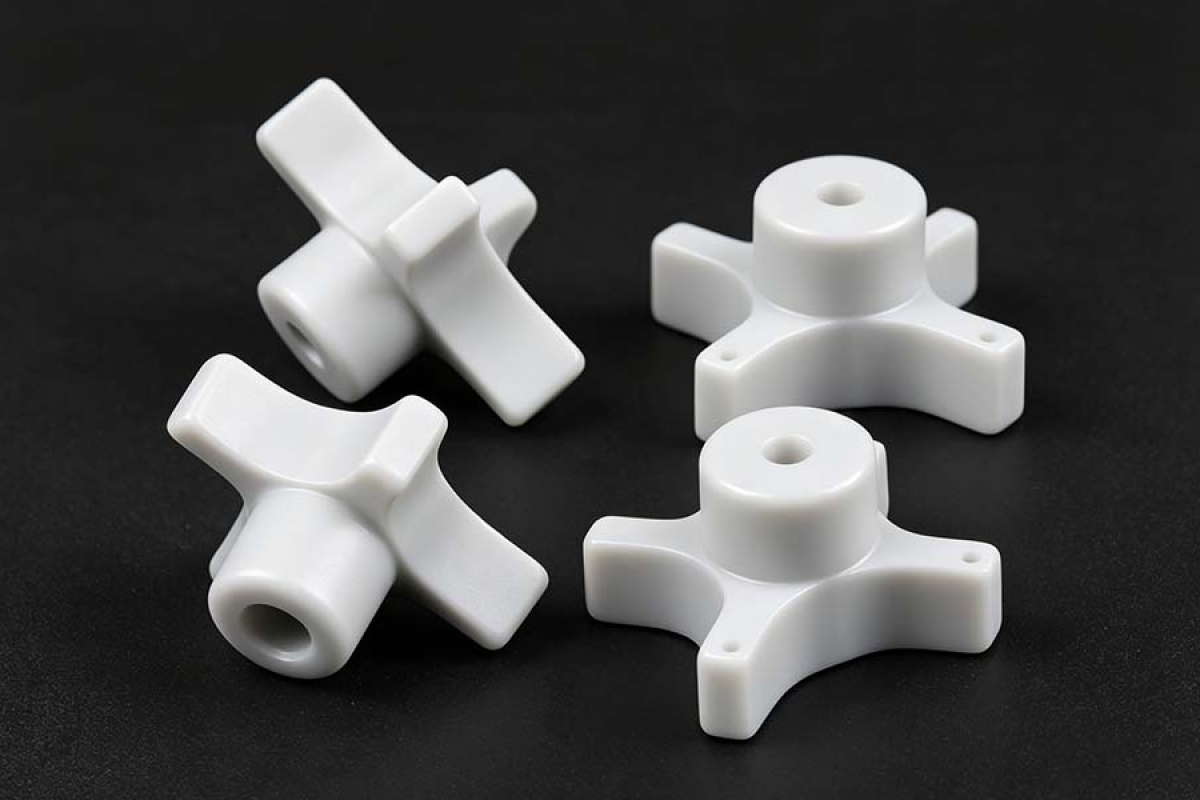
HDPE CNC Machining Guide | Evefab
HDPE CNC Machining: Properties, Machinability, Applications & Manufacturing Guide
HDPE (High-Density Polyethylene) is a semi-crystalline thermoplastic known for its low density, excellent chemical resistance, low moisture absorption, good impact strength, low friction, and excellent machinability. Compared with UHMW-PE, HDPE offers higher stiffness and easier machining at lower material cost, making it a practical choice for industrial components, fluid-handling parts, liners, tanks, guides, spacers, covers, and custom CNC-machined plastic parts.
For CNC machining, HDPE is generally considered easy to machine. However, its relatively low modulus, high thermal expansion, and tendency to deform under excessive clamping or cutting heat require appropriate process control when tight tolerances are specified.
1. Basic Material Information
Standard Material Designations & Classification
Item | HDPE |
Chemical name | High-Density Polyethylene |
Common abbreviation | HDPE / PE-HD |
Material family | Polyethylene |
Polymer type | Semi-crystalline thermoplastic |
Common standards | ASTM D4976, ASTM D3350 |
Common piping standard | ASTM D3035 / ASTM D3261, depending on application |
ISO designation | PE-HD / grade-dependent |
DIN designation | PE-HD |
Common stock forms | Sheet, plate, rod, tube, block |
Typical colors | Natural/translucent, black, white, custom colors |
CNC processes | Milling, turning, drilling, routing, tapping |
Typical applications | Tanks, liners, guides, spacers, bushings, fluid-handling parts |
HDPE is a polyethylene with a relatively high degree of crystallinity compared with lower-density polyethylene. Its molecular structure provides a useful balance of low density, chemical resistance, toughness, stiffness and superior machinability, which is why Evefab widely adopts HDPE for cost-effective custom plastic CNC machining solutions for industrial clients.
Common HDPE Material Types
HDPE is available in multiple professional formulations for differentiated industrial scenarios. As a professional CNC machining manufacturer, Evefab provides precise grade selection services for different working conditions:
Standard Industrial HDPE Mainly used for machine components, protective covers, equipment liners, positioning spacers and general industrial fabricated parts, suitable for conventional non-special working environments.
FDA / Food-Contact HDPE Compliant with food safety standards, specially customized for food processing equipment, including cutting surfaces, material containers, food-grade conveyor components. Evefab provides complete compliance certification documents to ensure product safety.
UV-Stabilized HDPE Mostly black modified formula with excellent anti-aging performance, suitable for outdoor equipment, marine components, agricultural machinery and outdoor storage tanks, solving the problem of ordinary HDPE aging and degradation under long-term ultraviolet radiation.
Antistatic / Conductive HDPE Modified for electrostatic control scenarios, used for electronic industry equipment parts and special industrial scenarios that need to eliminate static electricity accumulation.
2. HDPE Physical Properties
Property | Typical Value / Range |
Density | ~0.93–0.97 g/cm³ |
Tensile strength | ~20–35 MPa |
Tensile modulus | ~0.7–1.5 GPa |
Yield strength | ~20–30 MPa |
Elongation at break | ~100–1,000% |
Hardness | Approximately Shore D 60–70 |
Water absorption | Very low, typically <0> |
Thermal conductivity | ~0.4–0.5 W/m·K |
Melting range | ~125–135°C |
Continuous service temperature | Commonly ~60–80°C, application dependent |
Coefficient of thermal expansion | Relatively high |
Density
HDPE has a low density of 0.93–0.97 g/cm³, far lower than POM, PEEK, metal aluminum and steel. It is an ideal lightweight engineering plastic, which can effectively reduce the overall weight of equipment components and is widely used in lightweight industrial design projects undertaken by Evefab.
Tensile Strength & Stiffness
HDPE has moderate tensile strength and low rigidity compared with high-end engineering plastics. Its tensile modulus is 0.7–1.5 GPa, with good toughness and strong deformation resistance before fracture, but not suitable for ultra-rigid precision structural parts. For high-stiffness component customization, Evefab will recommend POM, PEEK or reinforced nylon according to actual load and temperature conditions.
Impact Resistance
HDPE has excellent impact toughness, far better than brittle plastics, and can maintain stable toughness in low-temperature environments. It is commonly processed by Evefab into equipment protective covers, storage containers, safety guards, industrial liners and material handling accessories.
Wear Resistance
HDPE has good general wear resistance for conventional friction scenarios. However, in high-frequency sliding and strong abrasive working environments, its performance is inferior to UHMW-PE, POM and PEEK. Evefab will prioritize UHMW-PE for severe wear working conditions to extend component service life.
Friction
With low friction coefficient, HDPE can be used to process guide parts, sliding surfaces, wear strips and low-load bushings. Its friction performance is affected by matching materials, contact pressure, sliding speed and surface finish, and Evefab will optimize processing technology according to actual working conditions to ensure friction stability.
Temperature Performance
The melting range of HDPE is 125–135°C, but the actual long-term continuous service temperature is only 60–80°C. With the increase of temperature, the dimensional stability and mechanical properties of the material will decline sharply. For high-temperature working scenarios, Evefab recommends high-temperature resistant materials such as PEEK, PPS and PEI.
Thermal Expansion
HDPE has a high thermal expansion coefficient, which is the core difficulty of precision CNC machining. Temperature changes will cause obvious dimensional deviation of parts. In precision processing projects, Evefab strictly controls machining temperature, part standing stabilization time and constant temperature inspection standards to ensure dimensional accuracy.
3. HDPE Chemical Properties
Chemical Composition
HDPE is composed of carbon and hydrogen elements with stable –CH₂–CH₂– repeating molecular structure. Commercial grades can be added with carbon black, antioxidants, UV stabilizers, pigments and processing additives to realize functional upgrades such as anti-aging and antistatic.
Chemical Resistance
HDPE's core advantage lies in excellent comprehensive chemical resistance, resisting most acids, alkalis, salts, detergents, alcohols and water-based industrial chemicals. It is the preferred material for chemical containers, fluid processing parts, storage tanks and anti-corrosion liners. Evefab strictly verifies chemical compatibility according to customer's medium concentration and service temperature to avoid material failure.
Water Absorption
HDPE has almost zero water absorption, and its dimensional and mechanical properties remain stable in humid, water immersion and wet processing environments. Compared with moisture-sensitive nylon materials, HDPE has obvious advantages and is very suitable for water treatment and wet industrial equipment.
Corrosion Resistance
HDPE will not rust or produce electrochemical corrosion like metals. It is widely used in marine environments, chemical plants, water treatment systems and outdoor equipment, and is a cost-effective anti-corrosion material solution adopted by Evefab for many industrial projects.
UV Resistance
Ordinary natural HDPE is prone to aging, yellowing and performance attenuation under long-term ultraviolet radiation. Black carbon black modified and professional UV-stabilized HDPE grades have excellent outdoor durability. Evefab will match special anti-UV grades for all outdoor component customization projects.
Electrical Properties
HDPE is an excellent insulating material with high resistivity and low dielectric loss, and its electrical performance is stable in humid environments. At the same time, Evefab can provide conductive and antistatic modified HDPE parts to meet the electrostatic protection needs of electronic and precision industrial equipment.
Welding and Bonding Compatibility
HDPE supports hot plate welding, hot gas welding, extrusion welding and butt fusion thermal connection processes with high connection strength. Due to low surface energy, ordinary adhesive bonding is difficult to form stable joints. For assembly parts requiring high strength, Evefab prefers mechanical fastening or professional surface activation bonding technology.
4. HDPE CNC Machinability Analysis
Machining Difficulty: Easy
HDPE is one of the most easily processed engineering thermoplastics, supporting CNC milling, turning, routing, drilling, sawing and tapping. The processing difficulty does not lie in cutting, but in precise dimensional control caused by thermal expansion and deformation characteristics, which is also the core process point that Evefab focuses on optimizing.
Recommended Cutting Tools
Evefab's professional processing standard configuration: sharp carbide tools, polished carbide cutters, single/double flute special plastic tools; sharp HSS tools are applicable for partial auxiliary processes. Dull tools are strictly prohibited to avoid friction heating, material melting, surface smearing and dimensional deviation.
General CNC Cutting Parameters
The following parameters are standard starting values for unfilled HDPE, and Evefab will dynamically optimize them according to tool specification, equipment rigidity, part structure and batch production requirements.
Operation | Typical Starting Range |
Milling cutting speed | ~200–600 m/min |
Turning cutting speed | ~150–500 m/min |
Feed per tooth | ~0.05–0.25 mm/tooth |
Drilling speed | Grade/tool dependent |
Tool | Sharp carbide / polished edge |
Coolant | Air blast or suitable coolant |
CNC Milling HDPE
HDPE is highly suitable for precision milling, including cavity grooving, contour processing, slotting, flat finishing, drilling, threading and 3D profiling. Evefab adopts clean cutting tool path planning to avoid tool friction and extrusion, ensuring smooth surface and stable size of milled parts.
CNC Turning HDPE
It can process high-precision cylindrical parts such as bushings, positioning spacers, rotating rollers, end caps, shaft sleeves and sealing components. Evefab uses sharp polished turning tools to ensure no burrs on the surface of rotary parts and high roundness accuracy.
Drilling HDPE
HDPE drilling operation is simple, but it is easy to produce edge burrs and hole diameter expansion deformation. For precision hole positions, Evefab adopts the process of pre-drilling undersize holes, natural cooling and stabilization, and secondary finish reaming to ensure hole position accuracy.
Tapping HDPE
HDPE tapping processing is convenient, but due to low material strength and creep characteristics, threads are easy to deform under load. For threaded connection parts, Evefab optimizes wall thickness and thread engagement length, and matches brass/stainless steel thread inserts for heavy-load scenarios to improve connection stability.
Common HDPE CNC Machining Problems
1. Material Melting Caused by excessive rotating speed, dull tools, low feed speed and blocked chip removal. Evefab solves the problem by configuring sharp tools, optimizing speed-feed ratio, enhancing air cooling and avoiding chip secondary cutting.
2. Part Deformation HDPE is soft and easy to deform under clamping pressure. Evefab uses soft jaw fixtures, vacuum adsorption positioning and segmented processing technology, reduces clamping force, and supports thin-wall parts in full area to eliminate deformation.
3. Thermal Dimensional Variation High thermal expansion leads to dimensional deviation after temperature change. Evefab maintains constant temperature processing environment, lets parts cool and stabilize before inspection, and calibrates detection temperature to ensure dimensional consistency.
4. Burrs Burrs are easy to appear at hole outlets, thin edges and groove intersections. Evefab uses high-precision sharp cutters and optimized feed parameters to minimize burr generation and reduce post-processing workload.
5. Stringy Chips Long continuous chips are easy to appear during turning, which will wrap tools and scratch parts. Evefab matches professional chip removal equipment and optimized tool paths to ensure smooth chip evacuation and processing safety.
CNC Tolerance Capability
With standardized process control by Evefab, the stable machining tolerance of HDPE parts can reach ±0.05–0.10 mm. Limited by the material's high thermal expansion and creep characteristics, full-range ultra-tight tolerance is not applicable. We selectively set high precision for key functional features to balance accuracy and cost.
Surface Finish
With polished precision tools and finishing technology, the surface roughness of HDPE machined parts can reach Ra 1.6–3.2 μm. Evefab's processing technology effectively eliminates melting marks and tool scratches to ensure smooth and flat part surface.
5. Typical HDPE Applications & Part Scenarios
Chemical Processing Equipment
Relying on excellent chemical corrosion resistance, HDPE is widely made into chemical storage tanks, tank liners, pipeline accessories, equipment covers, fluid processing parts and pump body components by Evefab, suitable for all kinds of corrosive chemical working environments.
Water Treatment
HDPE's zero water absorption and anti-corrosion performance make it the core material for water treatment equipment. Evefab customizes tank accessories, pipeline supports, anti-corrosion liners, guide parts and protective components for water treatment projects.
Conveyor & Material Handling
Evefab processes HDPE into conveyor guide rails, wear strips, sliding blocks, transfer plates and support spacers. It is suitable for conventional material handling scenarios; for high-abrasion working conditions, we will recommend UHMW-PE replacement.
Food Processing
Evefab uses FDA-certified food-grade HDPE to customize food processing equipment guards, conveyor parts, cutting plates and product contact components, which meet food safety standards and are clean and wear-resistant.
Marine Applications
HDPE is resistant to seawater corrosion and humid aging, with lightweight and high impact resistance. It is used for marine dock accessories, fender systems, guide parts and wear gaskets, and is a cost-effective marine plastic solution provided by Evefab.
Packaging Machinery
Lightweight, easy-to-process and chemically resistant HDPE is suitable for packaging machine guide parts, sliding plates, material handling components, safety guards and customized fixtures, helping customers reduce equipment maintenance costs.
Agriculture & Outdoor Equipment
UV-stabilized HDPE processed by Evefab is used for agricultural machinery wear pads, bushings, protective guards and equipment liners, adapting to long-term outdoor wind and sun exposure working environments.
Automation & Robotics
HDPE lightweight protective covers, cable guides, equipment guards and sliding components are widely used in automated production lines and robot equipment, suitable for scenarios that do not require ultra-high structural rigidity.
6. Our HDPE CNC Machining Advantages
Professional Material Selection Support
Evefab's engineering team provides one-stop material matching services, accurately selecting standard industrial grade, UV-stabilized outdoor grade, food safety grade, antistatic/conductive modified grade and special industrial grade HDPE according to working temperature, chemical medium, mechanical load, UV exposure and industry certification requirements.
Optimized CNC Machining Processes
Aiming at HDPE's thermal expansion and deformation characteristics, we independently optimize tool geometry, cutting speed, feed rate, heat control scheme, fixture positioning and chip removal system. Focus on stable dimensional accuracy of parts, not blind pursuit of processing speed.
Precision HDPE Machining
We support customized processing of various HDPE precision parts including custom plates, wear-resistant bushings, equipment liners, guide rails, protective covers and positioning spacers, and strictly implement GD&T geometric tolerance standards to control the accuracy of key features.
Complex CNC Geometry
Equipped with multi-axis CNC processing equipment, Evefab completes one-time molding of multi-layer grooves, curved profiles, precision slots, countersunk holes, threaded features and special-shaped contours. Multi-axis processing reduces clamping times and improves the overall consistency of complex parts.
Prototype to Batch Production
We cover the whole production cycle of single custom parts, functional prototypes, small-batch trial production and mass batch production. For large-batch orders, customized special fixtures and optimized tool paths are adopted to improve production efficiency and product repeatability.
Quality Inspection & Material Documentation
Full-process quality inspection system includes dimensional detection, GD&T verification, surface finish inspection and visual appearance inspection. Evefab can provide official material certificates and conformity certification documents to meet industry certification and delivery standards.
HDPE CNC Machining Material Selection Summary
Requirement | HDPE Suitability |
CNC milling | Excellent |
CNC turning | Excellent |
Drilling | Excellent |
Tapping | Good |
Chemical resistance | Excellent |
Moisture resistance | Excellent |
Impact resistance | Excellent |
Wear resistance | Good |
Friction | Low |
Lightweight construction | Excellent |
Stiffness | Moderate–Low |
Creep resistance | Moderate–Low |
Temperature resistance | Moderate–Low |
UV resistance | Grade-dependent |
Electrical insulation | Excellent |
Thin-wall machining | Moderate |
Precision dimensional stability | Moderate |
Chemical equipment | Excellent |
Water treatment | Excellent |
Conveyor components | Excellent |
Food-processing equipment | Excellent, grade-dependent |
Outdoor equipment | Good with UV-stabilized grade |
HDPE vs. UHMW-PE vs. POM vs. Nylon vs. PEEK
Property | HDPE | UHMW-PE | POM | Nylon | PEEK |
Density | Low | Very low | Moderate | Moderate | Moderate |
Stiffness | Moderate | Low | High | High | Very high |
Wear resistance | Good | Excellent | Excellent | Good–Excellent | Excellent |
Friction | Low | Very low | Low | Moderate | Low |
Impact resistance | Good | Excellent | Good | Good | Excellent |
Chemical resistance | Excellent | Excellent | Good | Moderate | Excellent |
Moisture absorption | Very low | Very low | Very low | High | Very low |
Temperature capability | Moderate–Low | Moderate–Low | Moderate | Good | Excellent |
Creep resistance | Limited | Limited–Moderate | Good | Moderate | Excellent |
CNC machinability | Excellent | Excellent | Excellent | Excellent | Good |
Material cost | Low | Low–Moderate | Moderate | Moderate | Very high |
Best application | Chemical/light-duty parts | Wear/sliding parts | Precision mechanical parts | Structural plastic parts | High-performance parts |
When Should Engineers Choose HDPE?
Choose HDPE when you need: Excellent chemical corrosion resistance, zero water absorption, lightweight performance, good impact toughness, easy CNC machining, low material cost and corrosion-free industrial components.
Choose UHMW-PE instead when: The equipment faces severe abrasive wear, long-term continuous sliding friction and ultra-low friction and high impact resistance are required.
Choose POM instead when: High dimensional stability, high structural rigidity and precision mechanical transmission parts such as gears and rollers are needed.
Choose Nylon when: Higher mechanical strength and rigidity are required, and moisture-induced dimensional deviation is acceptable.
Choose PEEK when: High-temperature working environment, high load-bearing requirements and strict creep resistance standards are required.
Final Engineering Recommendation
HDPE is a cost-effective, lightweight and anti-corrosion CNC machining plastic. Its comprehensive advantages of low density, excellent chemical resistance, ultra-low water absorption, good impact toughness and easy processing make it widely used in chemical processing, water treatment, food machinery, conveyor systems, marine equipment, packaging machinery and industrial automation fields.
The material's inherent limitations are moderate and low rigidity, high thermal expansion, creep deformation under long-term load and limited high-temperature resistance. For severe sliding wear scenarios, UHMW-PE is more suitable; for high-precision rigid structural parts, POM is a better choice.
In material procurement and engineering design, it is necessary to clarify HDPE grade, color, UV stabilization treatment, food safety certification, antistatic requirements, working temperature and chemical environment, instead of simply specifying ordinary HDPE materials.
Contact Evefab now to obtain professional HDPE CNC machining quotation and DFM design optimization consultation. We customize all kinds of HDPE precision plates, bushings, guide rails, equipment liners, spacers, anti-corrosion parts and conveyor components, providing one-stop solutions from prototype verification to batch mass production to meet your industrial precision manufacturing needs.
Get an Instant Quotefor your custom HDPE parts today.