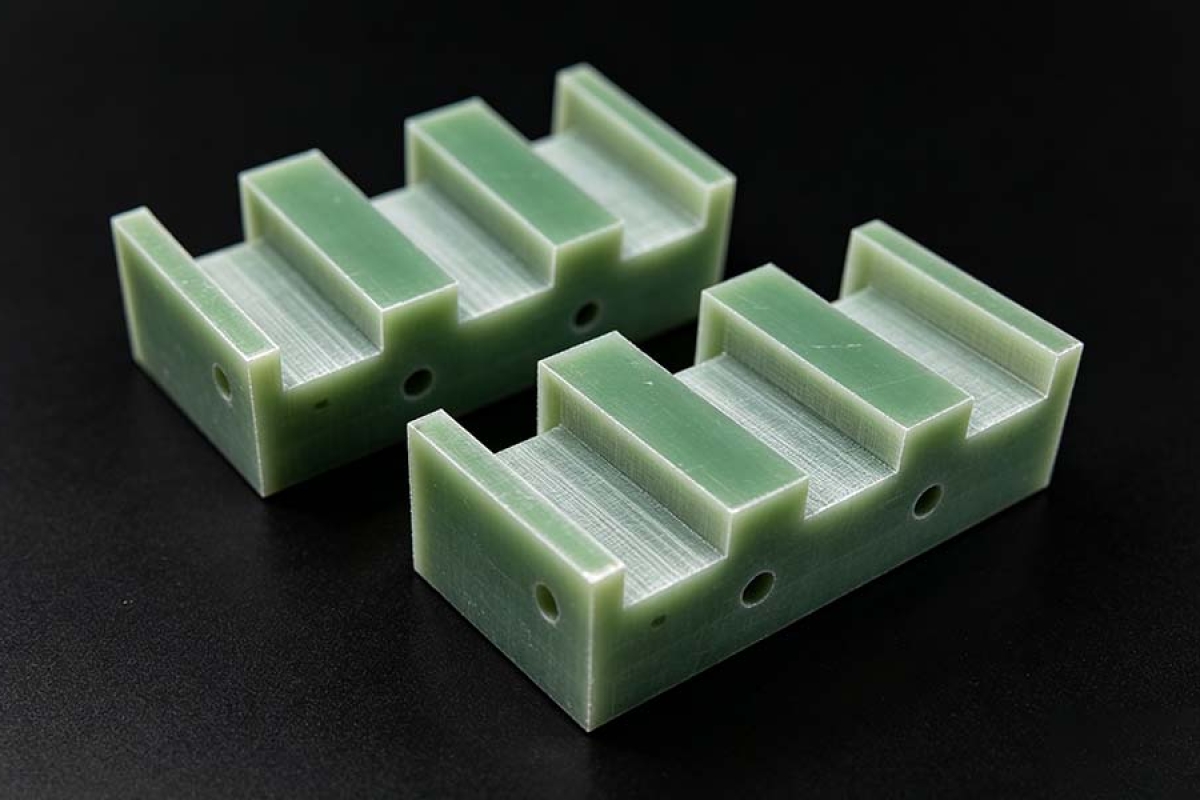
FR-4 is a glass-fiber-reinforced epoxy laminate widely used as an electrical insulation and structural material, particularly in printed circuit boards (PCBs), electrical fixtures, semiconductor equipment, test tooling, insulating components, and industrial electronics. As a professional precision machining manufacturer, Evefab provides customized FR-4 CNC machining services for diverse industrial high-insulation and structural scenarios.
Unlike conventional engineering plastics such as POM, PEEK, or nylon, FR-4 is a fiber-reinforced thermoset composite. Its perfect balance of superior electrical insulation, ultra-stable dimensional stability, high mechanical stiffness, excellent flame resistance and cost-effectiveness makes it a core material for electrically insulating CNC-machined components processed by Evefab.
In terms of CNC processing, FR-4 is rated moderate to difficult in machining difficulty. The embedded abrasive glass fibers easily cause tool wear, and fine glass-epoxy dust will be generated during processing. Evefab adopts standardized tool configuration, professional dust extraction systems and strict process control to ensure part precision, edge quality and production safety.
1. Basic Material Information
Standard Material Designations & Classification
Item | FR-4 |
Common name | FR-4 epoxy glass laminate |
Material family | Glass-fiber-reinforced thermoset composite |
Matrix | Epoxy resin |
Reinforcement | Woven glass fiber |
Common designation | FR-4 |
NEMA classification | FR-4 |
IEC material family | IEC 60893 / laminate specifications, grade-dependent |
UL recognition | Grade/manufacturer dependent |
Typical forms | Sheet, plate, laminate, PCB substrate |
CNC processes | Milling, routing, drilling, sawing |
Electrical performance | Excellent |
Flame resistance | Excellent, grade-dependent |
Typical applications | PCB, electrical insulation, fixtures, test tooling |
The core structure of FR-4 is composed of woven glass fiber reinforcement + epoxy resin matrix. The glass fiber layer provides high mechanical strength, structural stiffness, excellent dimensional stability and basic temperature resistance. The epoxy resin matrix undertakes electrical insulation, structural bonding, chemical corrosion resistance and flame-retardant functions. Evefab makes full use of the composite advantages of the two structures to process high-performance insulating structural parts.
FR-4 vs. G10
FR-4 and G10 are both classic glass-epoxy laminates with similar basic structures, and the core difference lies in flame retardancy. Evefab will select materials accurately according to customer flame-retardant certification requirements to avoid material mismatch.
Property | FR-4 | G10 |
Glass reinforcement | Yes | Yes |
Epoxy matrix | Yes | Yes |
Flame retardancy | Yes (UL94 V-0 mainstream) | Not necessarily |
Electrical insulation | Excellent | Excellent |
Mechanical strength | High | High |
Typical application | Electrical/electronic flame-retardant parts | Ordinary mechanical/electrical parts |
PCB applications | Common and mainstream | Less common |
Note: For scenarios requiring flame-retardant performance, FR-4 must be specified separately instead of defaulting G10 as an equivalent substitute.
2. FR-4 Physical Properties
Property | Typical Value / Range |
Density | ~1.8–2.0 g/cm³ |
Tensile strength | ~300–500 MPa, orientation-dependent |
Flexural strength | ~350–500 MPa, orientation-dependent |
Tensile/flexural modulus | ~18–25 GPa |
Water absorption | Typically low, grade-dependent |
Thermal conductivity | ~0.2–0.4 W/m·K |
Tg (Glass transition temperature) | Commonly ~130–180°C depending on grade |
Decomposition temperature | Substantially above Tg |
CTE | Low in-plane; substantially higher through-thickness |
Dielectric strength | Tens of kV/mm, grade-dependent |
Density
FR-4 has a density of 1.8–2.0 g/cm³, heavier than ordinary plastic materials such as HDPE, PP and POM, but far lighter than metal materials. It can realize lightweight structural design while ensuring rigidity, which is widely used by Evefab in electronic equipment structural insulation parts.
Mechanical Strength
FR-4 has extremely high structural strength among insulating materials, with a flexural strength of 350–500 MPa. Its mechanical properties are affected by glass weave structure, fiber orientation, resin content and laminate lamination process. Due to obvious anisotropy, Evefab will optimize part cutting direction according to stress characteristics to maximize structural stability.
Elastic Modulus
The elastic modulus of FR-4 reaches 18–25 GPa, much higher than ordinary unreinforced engineering plastics. It can maintain excellent structural rigidity without conductive performance, perfectly meeting the dual requirements of equipment structural support and electrical insulation.
Impact Resistance
FR-4 has stable static structural strength, but its impact toughness is general, lower than UHMW-PE, nylon and polycarbonate. It is prone to edge chipping and local cracking under strong impact. Evefab will optimize structural design for impact-prone parts to avoid structural failure.
Thermal Performance
Glass transition temperature (Tg) is the core thermal index of FR-4, with conventional grades at 130–180°C and high-Tg grades higher. It should be noted that Tg cannot be directly used as continuous service temperature. For high-temperature working scenarios, Evefab will screen high-temperature resistant FR-4 grades and verify material continuous temperature resistance parameters.
Dimensional Stability
Benefiting from glass fiber reinforcement, FR-4 has excellent in-plane dimensional stability, which is the key reason why it is widely used in precision test fixtures, PCB substrates and semiconductor tooling. Its thermal expansion coefficient is anisotropic: low in-plane expansion and obvious through-thickness expansion. Evefab fully considers this feature in precision part processing to control dimensional deviation caused by temperature change.
Electrical Properties
High-quality electrical insulation is the core advantage of FR-4, with high dielectric strength, volume resistivity and low dielectric loss. Its electrical performance is affected by frequency, temperature, humidity and material structure. For high-frequency electronic equipment, Evefab recommends customized low-loss FR-4 special grades to ensure stable electrical performance.
Flame Resistance
Most commercial FR-4 laminates meet UL 94 V-0 flame-retardant standard, which is indispensable for electrical and electronic equipment safety certification. Evefab strictly screens formal certified FR-4 materials for electrical equipment parts to ensure product safety compliance.
3. FR-4 Chemical Properties
Chemical Composition
FR-4 is a composite material composed of epoxy resin matrix and glass fiber reinforcement. The epoxy resin is mainly composed of carbon, hydrogen and oxygen elements; the glass fiber is based on silicon dioxide, supplemented by aluminum, calcium, magnesium, boron and other elements. The specific composition and ratio vary with different manufacturer formulas.
Chemical Resistance
FR-4 has good resistance to daily oils, hydrocarbons, dilute acid, dilute alkali and conventional organic solvents. However, high-concentration corrosive media and high-temperature environments will erode the epoxy resin matrix. For chemical contact scenarios, Evefab will verify material chemical compatibility one by one to ensure part service life.
Moisture Absorption
Compared with hydrophobic plastics such as HDPE, PP and PTFE, FR-4 has slightly higher moisture absorption. Moisture will reduce its electrical insulation performance and dimensional accuracy, which has a great impact on precision electronics and high-frequency equipment. Evefab controls processing and storage humidity for high-precision FR-4 parts to avoid moisture absorption deformation and performance attenuation.
Corrosion Resistance
As a non-metallic composite material, FR-4 will not rust or produce electrochemical corrosion. For copper-clad FR-4 substrates, Evefab will optimize surface protection processes to avoid copper layer oxidation and corrosion and ensure part stability.
Thermal Degradation
FR-4 is a thermoset material with no melting point. Excessive high temperature will cause resin softening, thermal degradation and surface charring. Therefore, in CNC processing, Evefab strictly controls cutting heat to avoid local overheating damaging material performance.
Welding and Bonding
Due to thermoset characteristics, FR-4 cannot be thermally welded like thermoplastics such as PP and PE. The conventional assembly methods processed by Evefab include mechanical fastening (screws, bolts), special adhesive bonding and embedded inserts fixation, matching targeted surface pretreatment processes to improve assembly firmness.
4. FR-4 CNC Machinability Analysis
Machining Difficulty: Moderate–Difficult
FR-4 CNC machining is more difficult than ordinary plastics. The abrasive glass fiber inside the material is easy to wear tools, and improper processing will cause delamination, edge chipping and fiber exposure. With mature process accumulation, Evefab solves various FR-4 processing pain points and stably outputs high-precision and high-quality parts.
Recommended Cutting Tools
Aiming at the abrasion characteristics of FR-4, Evefab is equipped with professional special tools: high-hardness carbide end mills and drills for conventional processing; diamond-coated tools and PCD tools for mass production to greatly extend tool life, reduce tool wear and ensure consistent processing quality.
General CNC Cutting Parameter Guidance
FR-4 processing parameters need to be adjusted according to laminate thickness, glass weave, tool specification and equipment rigidity. The following are stable starting parameters adopted by Evefab for mass processing:
Parameter | Typical Starting Range |
Cutting speed | ~100–300 m/min |
Feed per tooth | ~0.03–0.12 mm/tooth |
Tool | Carbide / diamond-coated tool |
Cooling method | Dry machining + professional dust extraction |
Chip evacuation | Priority guaranteed |
Finishing process | Light finishing pass |
Why FR-4 Requires Special Tooling
The hardness of glass fiber is far higher than epoxy resin. Long-term cutting will cause serious wear on ordinary tool edges. Worn tools will directly lead to part delamination, fiber fraying, edge chipping, excessive dust and dimensional deviation. Evefab implements regular tool inspection and replacement mechanism in production to ensure processing stability.
FR-4 supports 3-axis, 4-axis and 5-axis CNC milling and routing processes, suitable for profiling, pocketing, slotting and contouring processing. Evefab mainly processes FR-4 into electrical insulating plates, test fixtures, mounting brackets, PCB tooling and semiconductor precision fixtures for electronic and semiconductor industries.
CNC Drilling FR-4
Precision drilling is a common processing procedure of FR-4, widely used in PCB and fixture parts. The core processing difficulties are glass fiber abrasion, hole mouth breakout and layer delamination. Evefab uses sharp carbide drills with low-speed stable feeding technology to ensure smooth hole wall and no delamination.
FR-4 turning process is relatively less used, mainly for processing rotary parts such as insulating rings, positioning spacers, cylindrical fixtures and insulating bushings. Evefab optimizes turning tools and cutting parameters to reduce tool wear and avoid surface fiber fraying.
Common FR-4 CNC Machining Problems & Solutions
1. Delamination Caused by dull tools, excessive feeding, insufficient workpiece support and unreasonable tool geometry. Evefab solves the problem by matching sharp professional tools, reducing cutting force, adding auxiliary support fixtures and optimizing feeding parameters.
2. Glass-Fiber Fraying Poor cutting conditions lead to exposed broken glass fibers on the part edge, affecting insulation performance and appearance quality. Evefab adopts finishing pass process and high-precision tools to ensure smooth and burr-free edges.
3. Edge Chipping Slotting, drilling and thin-wall processing are prone to edge chipping. Evefab reduces single tool engagement and optimizes cutter geometric angle to protect part edges.
4. Excessive Tool Wear Abrasive glass fibers cause rapid tool loss. Evefab uses wear-resistant carbide/diamond tools, monitors tool life in real time, avoids tool friction and idle running, and reduces production cost.
5. Dust Generation FR-4 processing will produce fine glass fiber and epoxy mixed dust. Evefab is equipped with professional dust extraction and filtration equipment, and implements standardized PPE management and workshop cleaning specifications to ensure production safety.
CNC Tolerance Capability
Under standardized processing technology of Evefab, the conventional stable tolerance of FR-4 parts is ±0.05–0.10 mm. Ultra-precision features can achieve tighter tolerances through process optimization. The final precision is affected by laminate thickness, fiber orientation, processing temperature and part structure.
Surface Finish
The conventional CNC processing surface roughness of FR-4 can reach Ra 1.6–3.2 μm. Evefab focuses on edge finish optimization, effectively avoiding glass fiber fracture and exposure, ensuring the insulation performance and appearance quality of electrical parts.
5. Typical FR-4 Applications & Part Scenarios
Electrical Insulation Components
FR-4 is the mainstream material for industrial electrical insulation parts. Evefab customizes insulating plates, electrical spacers, mounting brackets, terminal supports and isolation baffles, which rely on high dielectric strength to realize safe electrical isolation of equipment.
PCB Manufacturing
FR-4 is the dominant substrate material for rigid PCBs and multilayer PCBs, widely used in industrial and consumer electronic equipment. It should be noted that PCB manufacturing and FR-4 CNC machining are different processes, and Evefab provides independent customized processing for PCB tooling and auxiliary fixtures.
Electrical Test Fixtures
With high rigidity and excellent insulation performance, FR-4 is very suitable for electronic test scenarios. Evefab processes high-precision test plates, assembly fixtures, probe fixtures and insulating tooling for electronic testing industry customers.
Semiconductor Equipment
FR-4 is used for semiconductor equipment insulating fixtures, mounting plates, equipment protective covers and test tooling. For high-temperature semiconductor processes, Evefab recommends high-Tg FR-4 grades to adapt to high-temperature working environments.
Automation Equipment
Evefab processes customized FR-4 insulating brackets, sensor fixing seats, electrical isolation baffles and fixture plates for automation equipment, providing rigid structural support while avoiding electrical conduction interference.
Electrical Switchgear
FR-4 insulating supports, isolation plates and terminal fixing parts are widely used in power switchgear. Evefab designs and processes according to voltage grade, temperature and creepage distance standards to meet power equipment safety specifications.
Transformer & Motor Components
FR-4 insulating plates, spacing gaskets and winding support parts are core auxiliary parts of transformers and motors. Its stable insulation and dimensional stability ensure long-term safe operation of electrical equipment.
Aerospace & Defense Electronics
Certified high-standard FR-4 grades are used for aerospace electronic equipment insulating fixtures and structural parts. Evefab provides material certification and process quality documents to meet aerospace industry high-reliability requirements.
6. Our FR-4 CNC Machining Advantages
Professional Material Selection
Evefab professional engineering team provides accurate material matching services, distinguishing standard FR-4, high-Tg FR-4, low-loss FR-4, halogen-free FR-4 and high-performance glass-epoxy laminates, and recommending G10 materials for non-flame-retardant scenarios to balance performance and cost.
Optimized CNC Machining Process
Aiming at FR-4's structural characteristics and processing pain points, we formulate exclusive processes: reasonably avoid fiber stress direction, match tool specifications according to laminate thickness, optimize cutting speed and feeding parameters, strictly monitor tool life, and equip perfect dust extraction system to ensure processing quality and safety.
Precision FR-4 Components
We support customized production of all kinds of FR-4 parts: insulating plates, electrical fixtures, electronic test tooling, PCB auxiliary fixtures, mounting brackets, precision spacers and complex special-shaped parts, covering all industrial insulation structural parts scenarios.
Multi-Axis Machining
Equipped with complete 3/4/5-axis CNC processing equipment, Evefab selects appropriate processing schemes according to part complexity, reduces clamping times and benchmark errors, and improves the overall precision and consistency of complex parts.
Prototype to Batch Production
We provide one-stop services from engineering prototype verification, small-batch trial production to mass batch manufacturing. For recurring orders, we customize special fixtures and optimize process flows to improve production efficiency and product repeatability.
Quality Inspection & Documentation
Full-process quality inspection system includes dimensional full inspection, CMM three-dimensional precision detection, GD&T geometric tolerance verification, hole position precision detection, thickness detection and edge quality inspection. We can provide complete material certificates and conformity reports to meet industry certification requirements.
FR-4 CNC Machining Material Selection Summary
Requirement | FR-4 Suitability |
CNC milling | Good |
CNC routing | Excellent |
CNC drilling | Excellent |
CNC turning | Moderate |
Electrical insulation | Excellent |
Flame resistance | Excellent, grade-dependent |
Dimensional stability | Excellent |
Stiffness | Excellent |
Chemical resistance | Good–Excellent |
Moisture resistance | Moderate |
Impact resistance | Moderate |
Abrasion resistance | Good |
High-temperature capability | Good |
Thin-wall machining | Moderate |
Precision machining | Good |
PCB substrate | Excellent |
Electrical fixtures | Excellent |
Test tooling | Excellent |
Semiconductor fixtures | Excellent, grade-dependent |
Outdoor exposure | Grade/environment dependent |
FR-4 vs. G10 vs. PEEK vs. POM vs. Nylon
Property | FR-4 | G10 | PEEK | POM | Nylon |
Material type | Glass/epoxy composite | Glass/epoxy composite | High-performance polymer | Engineering polymer | Engineering polymer |
Glass reinforcement | Yes | Yes | Usually no | No | Usually no |
Stiffness | Very high | Very high | High | High | Moderate–High |
Electrical insulation | Excellent | Excellent | Excellent | Good | Good |
Flame resistance | Excellent, grade-dependent | Grade-dependent | Excellent | Moderate | Grade-dependent |
Temperature capability | High | High | Very high | Moderate | Good |
Chemical resistance | Good–Excellent | Good–Excellent | Excellent | Good | Moderate |
Moisture absorption | Moderate | Moderate | Very low | Very low | Higher |
CNC machinability | Moderate | Moderate | Good | Excellent | Excellent |
Tool wear | High | High | Moderate | Low | Low–Moderate |
Best application | Electrical/structural insulation | Mechanical insulation | High-temperature high-performance parts | Precision mechanical parts | Low-cost structural parts |
When Should Engineers Choose FR-4?
Choose FR-4 when you need: Excellent electrical insulation, ultra-high structural stiffness, stable dimensional accuracy, flame-retardant safety performance, cost-effective insulating structural materials, customized CNC electrical fixtures and PCB supporting tooling.
Choose G10 when: Glass-epoxy structural insulation is required, and flame-retardant certification is not mandatory.
Choose PEEK when: Ultra-high continuous temperature resistance and superior chemical corrosion resistance are required.
Choose POM when: High-precision mechanical machining and low friction performance are core requirements, and insulation performance requirements are general.
Choose Nylon when: Higher impact toughness and low-cost structural parts are needed.
Critical DFM Guidelines for CNC-Machined FR-4
Combined with years of processing experience, Evefab summarizes professional DFM design guidelines for FR-4 customized parts:
1. Avoid overly thin wall thickness Ultra-thin FR-4 structures are prone to chipping, delamination and fiber breakout during processing, which affects yield and structural strength.
2. Optimize internal corner structure Set reasonable internal fillets to reduce tool cutting stress, avoid tool jamming, and improve processing efficiency and edge quality.
3. Pay attention to fiber orientation The mechanical and thermal properties of FR-4 are anisotropic, and the cutting direction should be matched with the stress direction in design.
4. Strengthen edge auxiliary support Slots, through holes and thin plate edges need structural support to prevent edge collapse and delamination.
5. Clarify detailed material specifications Do not simply mark FR-4, specify manufacturer, grade, thickness, Tg value, flame-retardant grade, electrical parameters, color and copper content to ensure material consistency.
6. Reserve dust control scheme FR-4 processing produces fine glass fiber dust, and production needs to be equipped with professional dust extraction equipment to ensure environmental safety.
Final Engineering Recommendation
FR-4 is a cost-effective high-quality composite insulating material, which is very suitable for working scenarios that prioritize electrical insulation, structural stiffness, dimensional stability and flame-retardant performance. Its core advantages include excellent insulation performance, ultra-high rigidity, stable dimensional accuracy, good thermal performance, reliable flame retardancy, low cost and wide material availability.
The processing challenges of FR-4 are mainly abrasive glass fiber leading to tool wear, edge chipping, layer delamination and dust generation. Through professional carbide/diamond tool configuration, perfect dust extraction system and refined tool life management, Evefab stably solves various processing problems and ensures high-quality delivery of parts.
For high-precision and safety-critical FR-4 parts, it is necessary to clarify detailed material specifications rather than general-purpose FR-4 materials. Contact Evefab now to obtain free CNC machining quotation and DFM design optimization consultation. We customize all kinds of FR-4 precision parts such as insulating plates, test fixtures, semiconductor tooling and precision spacers, providing one-stop manufacturing solutions from prototype to batch production.
Get an Instant Quotefor your custom FR4 parts today