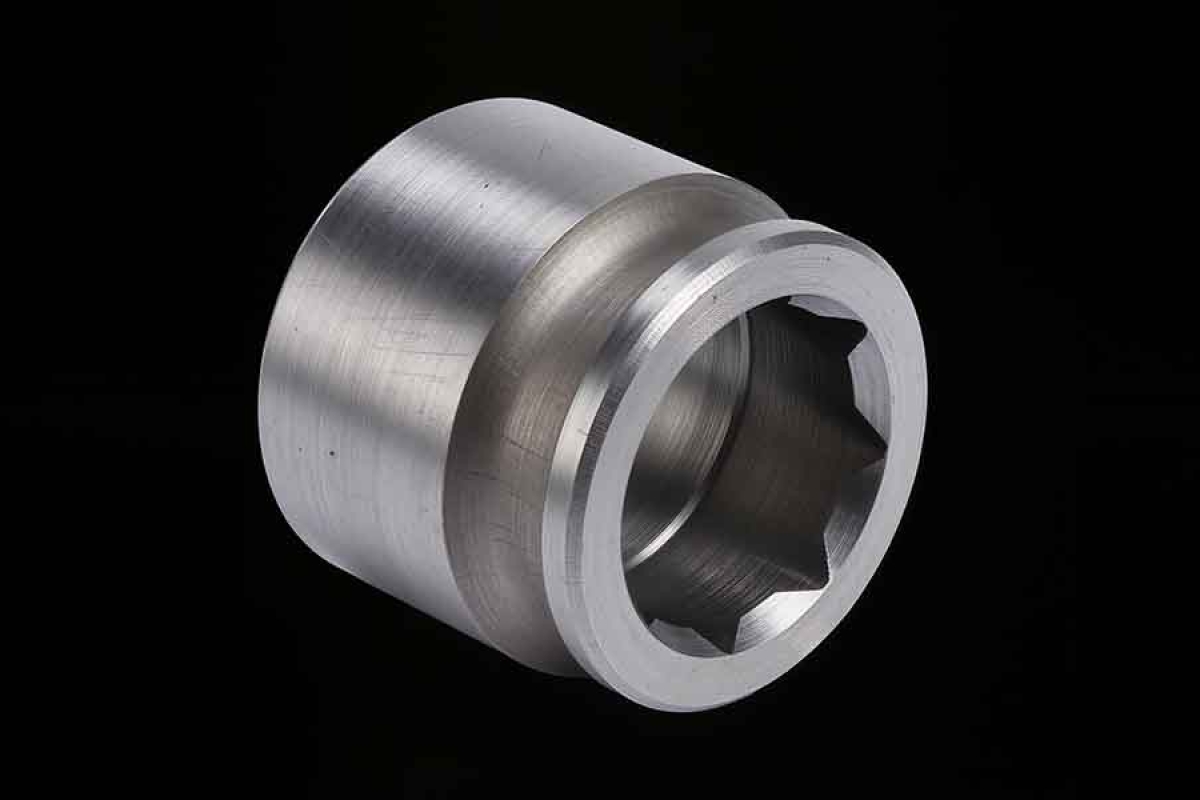
O1 tool steel, also widely recognized by its DIN designation 1.2510 and European grade 100MnCrW4, is a premium oil-hardening cold-work tool steel. It delivers a balanced combination of excellent wear resistance, reliable toughness, superior dimensional stability and favorable pre-heat-treatment machinability. In its soft annealed state, O1 steel is highly suitable for complex CNC machining, making it a mainstream material for precision tooling and wear-resistant industrial components.
Widely adopted in precision manufacturing, O1 tool steel is commonly used to produce dies, punches, precision gauges, cutting tools, jigs, fixtures and forming parts. Its core processing advantage lies in supporting high-precision CNC machining in the annealed condition, followed by heat treatment to achieve extreme hardness and long-term wear resistance.
Evefab provides one-stop customized O1 tool steel CNC machining services, covering prototype proofing, small-batch trial production and mass batch manufacturing. We offer full-process support including material certification verification, DFM process optimization, precision machining, professional heat treatment, surface finishing and complete quality inspection reports.
Specification Note: 1.2510 / 100MnCrW4 corresponds to standard O1 oil-hardening tool steel. However, grade equivalence must be verified against official material certificates and customer specifications, and nominal grade labels cannot be directly regarded as universal ASTM/DIN equivalent standards.
1. Basic Material Information
1.1 Material Identification
Item | Specification / Typical Information |
|---|
Material | O1 Tool Steel |
Common Designation | O1 / AISI O1 |
EN / DIN Material Number | 1.2510 |
European Standard Grade | 100MnCrW4 |
UNS Code | GCrW40 |
Material Category | Oil-hardening Cold-work Tool Steel |
Steel Type | High-carbon Alloy Tool Steel |
Delivery Condition | Annealed (soft state for machining) |
Heat Treatment Mode | Oil quenching hardening |
Annealed Machinability | Moderate to Excellent |
Hardened Machinability | Difficult (requires grinding/hard milling) |
Hardened Hardness | 58–64 HRC (adjustable via heat treatment) |
Typical Applications | Dies, punches, gauges, cutting blades, forming tools, wear-resistant parts |
O1 tool steel adopts a high-carbon manganese-chromium-tungsten alloy system. The synergistic effect of multiple alloy elements endows the material with stable hardenability and outstanding wear resistance. The standardized annealed delivery state is tailor-made for CNC precision processing, which is the core reason why O1 tool steel is widely used in precision tooling manufacturing.
1.2 Core Alloy Characteristics
The performance advantages of O1 / 1.2510 tool steel come from its precise alloy ratio, and the functions of each core element are as follows:
Carbon (C): High carbon content provides basic hardness and excellent wear resistance after heat treatment
Manganese (Mn): Optimizes material hardenability and improves structural strength and toughness
Chromium (Cr): Enhances quenching uniformity and further improves wear resistance and oxidation resistance
Tungsten (W): Forms high-hardness carbides to significantly improve high-temperature wear resistance
Silicon (Si): Plays a deoxidation role in smelting and improves material structural stability
The material is professionally designed for first machining, then hardening manufacturing logic. The soft annealed state supports complex CNC forming, and subsequent oil quenching treatment can instantly improve surface hardness and service durability, which perfectly matches the production needs of precision tooling. Evefab formulates exclusive processing routes based on this material characteristic to ensure processing accuracy and final performance.
2. Physical Properties of O1 Tool Steel
The following data are typical engineering reference values, not mandatory standard parameters. The actual physical and mechanical properties of O1 tool steel are affected by smelting process, forging/rolling state, heat treatment system and workpiece thickness.
Physical Property | Typical Value |
|---|
Density | ~7.8 g/cm³ |
Elastic Modulus | 200–210 GPa |
Poisson's Ratio | 0.29–0.30 |
Thermal Conductivity | 20–30 W/m·K |
Specific Heat Capacity | 460–500 J/kg·K |
Annealed Hardness | ≤230 HB |
Hardened Hardness | 58–64 HRC |
Thermal Expansion Coefficient | 11–12 × 10⁻⁶/K |
2.1 Annealed State Machining Advantage
O1 tool steel is uniformly delivered in an annealed soft state, which greatly reduces CNC machining difficulty. In the annealed state, manufacturers can complete all complex processing procedures including profile milling, deep hole drilling, cavity processing, thread cutting, turning and precision grinding.
Evefab Standard Manufacturing Process: Annealed raw material → CNC roughing → semi-finishing → stress relief treatment → professional oil quenching hardening → precision finishing grinding → full inspection and delivery
This process completely avoids the processing difficulties, serious tool wear and high cost of direct machining of hardened tool steel, and ensures the dimensional accuracy of complex tooling parts.
2.2 Dimensional Stability
After standardized heat treatment, O1 tool steel has excellent dimensional stability with small deformation. However, residual stress, uneven material removal, asymmetric structure and thin-wall design will still cause tiny dimensional changes during quenching.
For high-precision gauges, precision dies and inspection tooling, Evefab adopts a reserved grinding allowance process: pre-machining reserved allowance → heat treatment hardening → precision finish grinding, which completely eliminates heat treatment deformation and ensures micron-level dimensional accuracy.
2.3 Wear Resistance Performance
The biggest performance advantage of O1 tool steel is its excellent wear resistance after oil hardening. After reaching 58–64 HRC high hardness, it can resist long-term abrasive wear and adhesive wear, and is suitable for high-cycle repeated working scenarios.
It is widely used for blanking dies, punching tools, forming dies, industrial blades, wear plates and precision gauges. It should be noted that O1 tool steel is suitable for conventional wear working conditions, and extreme high-wear scenarios need to be replaced with high-alloy high-speed steel or powder metallurgy tool steel.
2.4 Toughness and Impact Resistance
O1 tool steel has balanced toughness and hardness. Higher hardness will slightly reduce toughness, so the heat treatment system needs to be optimized according to actual working conditions: pursue maximum hardness for wear-resistant parts, appropriately reduce hardness and improve toughness for impact-bearing punching parts, and balance stability and hardness for precision measuring tools. Evefab formulates targeted heat treatment schemes according to part usage scenarios to match optimal comprehensive performance.
3. Chemical Properties
3.1 Typical Chemical Composition
The standard chemical composition range of O1 / 1.2510 / 100MnCrW4 tool steel is as follows (the limit value is adjusted according to industry specifications and product forms):
Element | Mass Fraction Range |
|---|
Carbon (C) | 0.85–1.00% |
Silicon (Si) | 0.10–0.40% |
Manganese (Mn) | 0.90–1.20% |
Chromium (Cr) | 0.40–0.70% |
Tungsten (W) | 0.40–0.60% |
Phosphorus (P) | Low controlled level |
Sulfur (S) | Low controlled level |
Iron (Fe) | Balance |
3.2 Corrosion Resistance
O1 tool steel is ordinary alloy tool steel without stainless steel performance, and its corrosion resistance is far lower than 304, 316 and 17-4 PH stainless steel. It is easy to rust and oxidize in humid, salt spray, condensation and corrosive chemical environments.
Evefab provides targeted anti-corrosion solutions for O1 parts: rust-proof oil protection, surface blackening, professional coating and electroplating treatment, which effectively improve the environmental adaptability of tooling parts.
3.3 Oxidation Resistance
O1 is a typical cold-work tool steel with poor high-temperature oxidation resistance. Long-term high-temperature exposure will cause surface oxidation, scale formation and dimensional deviation. Therefore, it is only suitable for room-temperature and low-temperature cold stamping, cutting and forming working conditions, not for high-temperature hot-working scenarios.
3.4 Welding Performance
Due to high carbon content, O1 tool steel has poor welding performance. Unstandardized welding will produce brittle heat-affected zones, welding cracks and residual stress deformation. For precision tooling repair welding, strict preheating, filling material selection, inter-layer temperature control and post-weld stress relief treatment are required. In order to ensure part accuracy, Evefab avoids welding processing after final hardening as much as possible.
3.5 Surface Treatment Compatibility
O1 tool steel supports a variety of industrial precision surface treatments. According to part functional requirements, Evefab provides customized surface processes such as black oxide treatment, nitriding, PVD coating, DLC coating and hard chrome plating. We strictly control the coating thickness to ensure that the surface treatment does not affect the dimensional tolerance and matching accuracy of precision parts.
4. CNC Machinability Analysis of O1 Tool Steel
4.1 Machining Difficulty Rating
Annealed O1: Moderate to good machinability, suitable for conventional CNC milling, turning and drilling
Hardened O1 (58–64 HRC): Difficult to machine, conventional cutting is inefficient, priority to precision grinding and hard milling
The core processing principle of O1 tool steel manufacturing is: Complete all precision forming in annealed state, then harden and finish, which is the most efficient and high-quality processing scheme for precision tooling.
4.2 Recommended CNC Tooling Configuration
Tools for Annealed O1 Machining:
Preferred: Solid carbide end mills, carbide drills, coated carbide inserts
Auxiliary: HSS drills and taps for conventional low-load processing
Mass production: Wear-resistant coated carbide tooling to improve efficiency and tool life
Tools for Hardened O1 Machining:
Preferred: High-hardness coated carbide tools, cermet tools
Finishing: CBN tools for hardened precision grinding and finishing
4.3 Reference Cutting Parameters (Annealed O1)
The following parameters are industry standard starting values.Evefab will optimize and adjust according to tool model, machine rigidity, actual material hardness and production batch to ensure processing stability and efficiency.
Carbide Milling Parameters
Parameter | Typical Starting Range |
|---|
Cutting Speed | 80–160 m/min |
Feed Per Tooth | 0.03–0.10 mm/tooth |
Engagement Mode | Controlled radial cutting to reduce heat and load |
Carbide Turning Parameters
Parameter | Typical Starting Range |
|---|
Cutting Speed | 80–150 m/min |
Feed Rate | 0.08–0.25 mm/rev |
Roughing Depth of Cut | 1–3 mm |
Finishing Depth of Cut | 0.2–0.8 mm |
4.4 Common Machining Problems & Solutions
Built-Up Edge Adhesion
Causes: Low cutting speed, dull tool, insufficient cooling, unreasonable tool geometry Solutions: Use sharp new tools, optimize cutting speed, improve high-pressure cooling, select special coated carbide tools
Tool Chipping & Wear
Causes: Interrupted cutting, excessive cutting engagement, poor fixture rigidity, excessive feed Solutions: Improve clamping stability, reduce radial cutting amount, optimize feed parameters, standardize tool entry and exit
Dimensional Deviation
Causes: Tool wear, cutting heat accumulation, material residual stress, unstable clamping Solutions: Adopt staged processing, add intermediate inspection, monitor tool life in real time
Heat Treatment Deformation
This is the core risk of O1 tool steel processing. Evefab solves the problem by reserving grinding allowance, standardized oil quenching process and post-heat-treatment precision grinding to ensure dimensional consistency.
4.5 Machining Tolerance Capability
In annealed state, conventional CNC machining can stably achieve ±0.01–0.05 mm precision. For ultra-precision tooling with higher requirements, post-hardening precision grinding can achieve tighter tolerance control. Evefab formulates differentiated tolerance schemes according to part functional requirements to balance precision and production cost.
4.6 Surface Roughness Standard
Processing Procedure | Typical Ra Roughness |
|---|
Rough Milling | 3.2–6.3 μm |
Semi-finishing Milling | 1.6–3.2 μm |
Finish Milling | 0.8–1.6 μm |
Precision Grinding (Hardened) | 0.2–0.8 μm |
4.7 Compatible Processing Technologies
O1 annealed tool steel supports all conventional precision processing technologies:
3/4/5-axis CNC milling, CNC turning, turn-mill composite processing
Precision drilling, reaming, thread milling and tapping
Sawing, precision grinding
Wire EDM and sinker EDM (suitable for complex narrow grooves and deep cavity processing after hardening)
4.8 Complex Geometry Machining
In annealed state, O1 tool steel can be processed into various complex curved surfaces, multi-angle cavities and special-shaped structures. Evefab adopts 5-axis linkage processing technology for complex forming dies and precision fixtures, reducing clamping times and positioning errors, and matching the optimal process route of roughing → semi-finishing → heat treatment → precision finishing.
5. Typical Application Scenarios
5.1 Cold-Work Punches & Dies
It is the most mainstream application of O1 tool steel, suitable for blanking dies, piercing dies, forming dies and shear blades. It realizes high-precision forming before hardening and long-term wear resistance after hardening, and is widely used in stamping and cold forming industries.
5.2 Precision Inspection Gauges
Used for go/no-go gauges, detection pins, gauge blocks and customized inspection fixtures. Its excellent dimensional stability and wear resistance ensure long-term accuracy of measuring tools, avoiding dimensional deviation caused by long-term use and friction.
5.3 Industrial Cutting Tools
Suitable for industrial blades, chisels, reamers and customized cutting tools. High-carbon alloy composition ensures high hardness and sharpness after heat treatment, meeting the cutting and shearing needs of industrial production.
5.4 Jigs & Fixtures
Used for positioning pins, wear-resistant inserts, clamping parts and precision fixture components. Hardened O1 tool steel has far longer service life than ordinary mild steel, which can effectively reduce fixture replacement frequency and production cost.
5.5 Automotive Manufacturing Tooling
Widely used in automotive stamping punches, cutting dies, forming parts and production fixtures. It is suitable for high-cycle repeated cold working scenarios and is a cost-effective tool steel for automotive production lines.
5.6 Automation Industrial Equipment
Applied to equipment guide parts, wear blocks, bushings, precision shafts and mechanical limit components. It provides stable wear resistance for high-cycle automated equipment and ensures long-term stable operation of equipment.
6. Evefab O1 Tool Steel Machining Advantages
6.1 Professional Material Selection & Matching
Evefab's engineering team accurately distinguishes the performance differences between O1 (1.2510), D2, A2, S7 and H13 tool steels. We select the most suitable material according to part working conditions (wear resistance, impact resistance, temperature resistance, stability) to avoid material mismatch and performance waste, providing targeted material selection suggestions for customers.
6.2 Standardized Annealed State Processing
We strictly follow the optimal processing logic of "annealed machining first, hardening later", formulate scientific staged processing schemes, avoid excessive tool wear and processing deformation of hardened steel processing, and effectively improve production efficiency and part yield.
6.3 Precise Heat Treatment Customization
According to part structure, thickness and hardness requirements, we customize exclusive oil quenching and tempering systems, accurately control austenitizing temperature, holding time and quenching speed, ensure uniform hardness of parts and minimal heat treatment deformation, and meet different toughness and wear resistance matching requirements.
6.4 Post-Hardening Precision Grinding
For high-precision dies, gauges and matching parts, we reserve precise grinding allowance in advance, and eliminate heat treatment deformation and dimensional error through post-hardening precision grinding, realizing micron-level high-precision size control and excellent surface finish.
6.5 Full-Process Quality Inspection
Equipped with CMM three-dimensional detector, hardness tester, roughness meter and precision micrometer, we conduct full-dimensional, full-performance inspection of O1 parts, including dimensional accuracy, surface roughness, hardness value and material composition verification, to ensure that the delivered parts fully meet customer specifications.
6.6 Complete Document Traceability
For industrial, automotive and high-standard tooling projects, we provide complete MTR material test reports, heat treatment records, hardness detection reports and dimensional inspection reports, realizing full batch traceability and meeting the certification requirements of standardized manufacturing industries.
O1 Tool Steel Engineering Performance Summary
Performance Category | Evaluation Result |
|---|
Material Grade | O1 / 1.2510 / 100MnCrW4 |
Hardening Mode | Oil-hardening cold-work tool steel |
Annealed Machinability | Good, suitable for complex precision machining |
Hardened Machinability | Difficult, suitable for grinding/EDM finishing |
Hardened Hardness | 58–64 HRC |
Wear Resistance | Excellent after heat treatment |
Toughness | Moderate and balanced |
Corrosion Resistance | Low, need anti-rust protection |
Dimensional Stability | Excellent with standardized heat treatment |
Core Application | Cold-work dies, punches, precision gauges, fixtures, wear parts |
DFM Design Optimization Recommendations
Clearly mark material specifications: O1 / 1.2510 / 100MnCrW4 annealed state, and require official material certificates
Define clear target hardness range, avoid vague "hardened treatment" description
Reserve grinding allowance for key precision dimensions to offset heat treatment deformation
Reasonably set tolerances, use GD&T to mark key functional dimensions and reduce unnecessary high-precision costs
Optimize internal fillet structure to avoid sharp corners, reduce processing difficulty and stress concentration
Adopt staged processing scheme: roughing → semi-finishing → heat treatment → precision finishing
Design EDM process reserved space for deep narrow groove hardened features
O1 vs. A2 vs. D2 Tool Steel Performance Comparison
Performance Feature | O1 (1.2510) | A2 (1.2363) | D2 (1.2379) |
|---|
Hardening Method | Oil hardening | Air hardening | Air hardening |
Wear Resistance | High | High | Very High |
Toughness | Moderate | Good | Moderate-Low |
Dimensional Stability | Moderate | Excellent | Excellent |
Annealed Machinability | Excellent | Moderate | Poor |
Typical Application | General-purpose cold-work tooling | High-stability precision tooling | Ultra-high wear-resistant tooling |
Request Custom O1 Tool Steel CNC Machining Quote
Evefab focuses on high-precision O1 / 1.2510 tool steel customized processing, providing one-stop solutions including DFM optimization, CNC precision machining, professional heat treatment, surface finishing and full quality certification.
If you have 2D drawings, 3D CAD models, quantity requirements, hardness standards, tolerance and surface treatment needs for O1 tool steel parts, please contact us for free process consultation and accurate quotation!
Get an Instant Quotefor your custom Tool Steel O1 parts today.