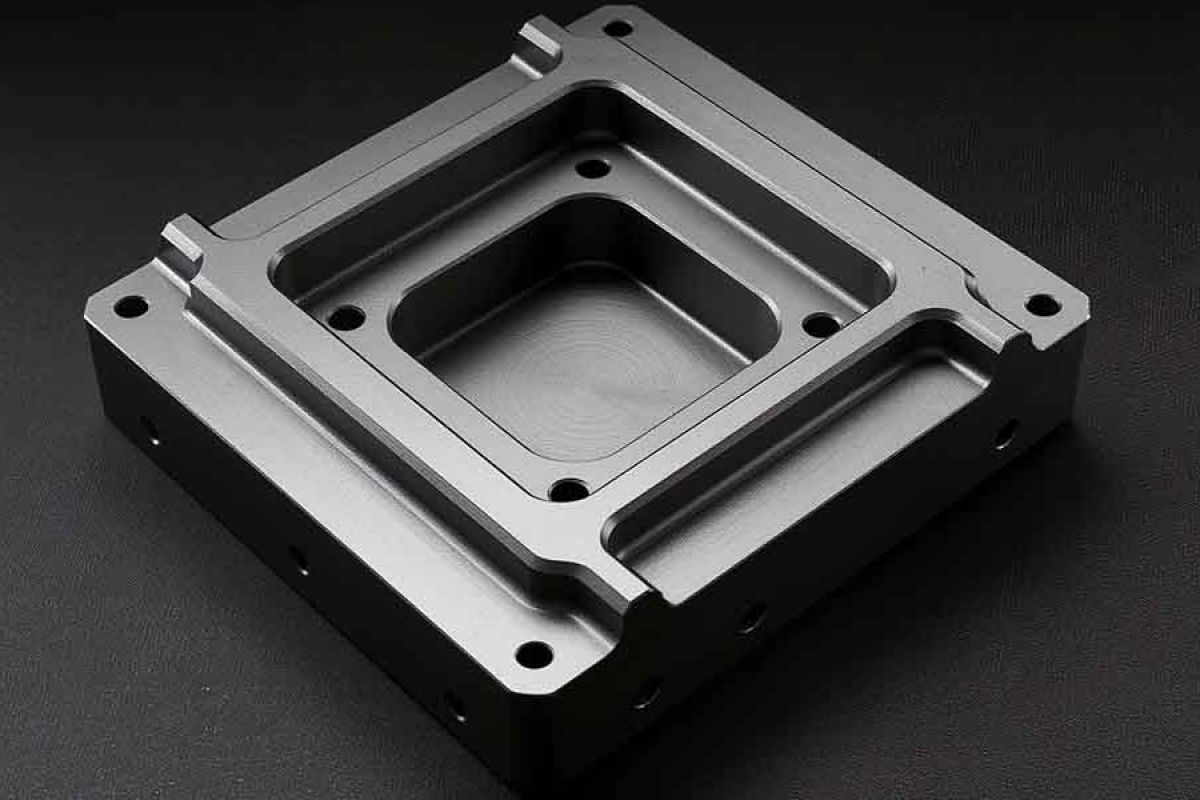
Titanium Grade 5, commonly known as Ti-6Al-4V, is the most widely used α+β titanium alloy for demanding engineering applications. It combines high specific strength, relatively low density, excellent corrosion resistance, fatigue performance, and good biocompatibility. These properties make it a preferred material for CNC machined aerospace parts, medical components, robotics, automotive components, semiconductor equipment, and high-performance industrial parts.
For precision manufacturing, however, Ti-6Al-4V is considerably more difficult to machine than aluminum or conventional stainless steels. Its low thermal conductivity concentrates cutting heat near the tool/workpiece interface, while its strength and chemical affinity with cutting tools can accelerate tool wear. Stable fixturing, sharp tooling, controlled cutting parameters, effective coolant delivery, and careful chip evacuation are therefore essential.
Evefab provides one-stop custom Ti-6Al-4V CNC machining services, covering prototype development, low-volume trial production and mass batch manufacturing. We support full-process services including professional material certification, high-precision dimensional inspection, customized surface finishing and DFM process optimization consultation.
1. Basic Material Information
1.1 Titanium Grade 5 Identification
Item | Information |
|---|
Material | Titanium Grade 5 |
Common designation | Ti-6Al-4V / Ti 6Al 4V / Ti-6-4 |
UNS | R56400 |
Material family | Alpha-beta titanium alloy |
German material number | 3.7165 / 3.7164 (varies by product specification) |
Typical ASTM references | ASTM B265, ASTM B348, ASTM B381 (varies by product form) |
Aerospace references | AMS specifications (customized by product form) |
Medical reference | ISO 5832-3 for wrought Ti-6Al-4V used for surgical implants |
Main alloying elements | Aluminum + Vanadium |
Titanium content | Balance |
CNC machinability | Difficult |
Typical density | ~4.43 g/cm³ |
Typical elastic modulus | ~114 GPa |
The UNS R56400 designation is widely associated with Ti-6Al-4V Grade 5. Material specifications must nevertheless be matched to the actual product form and application rather than assuming that every Ti-6Al-4V product complies with every ASTM specification. MatWeb identifies Ti-6Al-4V Grade 5 as UNS R56400 and references ASTM B265, ASME SB-265, AMS 4911 and DIN 3.7164/3.7165.
For medical applications, ISO 5832-3:2021 specifically covers wrought Ti-6Al-4V alloy for surgical implants. ISO also notes that mechanical properties of a finished-product sample are not necessarily identical to the specification values, which is why material condition and product form should always be verified from the supplied material certificate. Evefab strictly implements ISO medical-grade standards for implant part processing and provides complete material certification traceability.
1.2 Material Category
Ti-6Al-4V is an α+β titanium alloy. Its microstructure and properties are controlled by multiple factors, resulting in variable mechanical properties for materials with the same nominal composition:
Aluminum: Stabilizes the alpha phase
Vanadium: Stabilizes the beta phase
Heat treatment process
Forging or rolling processing history
Cooling conditions
Final material state
Therefore, two Ti-6Al-4V materials with the same chemical designation may have different mechanical properties due to differences in annealing, solution aging, forging and rolling processes. Evefab selects materials and formulates processing schemes according to actual application scenarios to ensure consistent part performance.
1.3 Market Positioning
Ti-6Al-4V is the core workhorse grade of high-performance titanium alloys. Recognized by the International Titanium Association as the most widely used titanium alloy, it is extensively applied in aerospace, turbine equipment and other high-demand engineering fields.
In the field of CNC manufacturing, it occupies a key intermediate position in titanium material systems:
Commercially pure titanium: Easy to machine but low in structural strength
Ti-6Al-4V Grade 5: Optimal balance of lightweight, high strength and corrosion resistance (cost-performance choice for high-precision machining)
High-end special titanium alloys: Higher temperature resistance and strength, but high cost and harsh processing requirements
2. Physical Properties of Titanium Grade 5
The following data are typical engineering reference values, not universal specification standards. Actual properties are affected by product form, heat treatment, section size and applicable industry specifications.
Property | Typical Value |
|---|
Density | ~4.43 g/cm³ |
Tensile strength | ~895–1,000 MPa |
Yield strength | ~825–910 MPa |
Elongation | ~10–14% |
Elastic modulus | ~114 GPa |
Poisson's ratio | ~0.34 |
Thermal conductivity | ~6.5–7 W/m·K |
Specific heat | ~560 J/kg·K |
Hardness | 30–36 HRC (variable with material state) |
Melting range | 1,600–1,660°C |
Electrical resistivity | ~1.7 × 10⁻⁶ Ω·m |
2.1 High Strength-to-Weight Ratio
The core advantage of Ti-6Al-4V is its excellent high strength-to-weight ratio. With a low density of 4.43 g/cm³, it is far lighter than steel while maintaining ultra-high mechanical strength. It is the preferred material for lightweight design scenarios that require both structural rigidity and weight reduction.
Typical application scenarios: Aerospace brackets, aircraft structural parts, drone components, robot joints, lightweight shafts, motorsport parts and medical implants.
2.2 Low Thermal Conductivity
Ti-6Al-4V has an extremely low thermal conductivity (6–7 W/m·K), far lower than aluminum and ordinary steel. This is the core difficulty of titanium CNC machining: cutting heat cannot be quickly dissipated, and a large amount of heat accumulates at the tool-workpiece contact interface.
Negative impacts of heat accumulation:
Sharp rise in tool cutting edge temperature
Accelerated tool wear and shortened service life
Risk of workpiece thermal damage
Tool and workpiece adhesion, poor chip removal
High sensitivity to unreasonable cutting parameters
Evefab adopts high-pressure cooling and customized heat dissipation process schemes to effectively solve the heat accumulation problem in titanium machining and stabilize processing quality.
2.3 Temperature Capability
Ti-6Al-4V can maintain stable mechanical properties in medium and high-temperature environments, so it is widely used in aerospace high-temperature working components. However, its strength will decrease significantly with excessive temperature rise, so it is not suitable for ultra-high temperature service scenarios.
In precision machining, Evefab evaluates material applicability based on continuous operating temperature, peak temperature, thermal cycle frequency, oxidation environment and fatigue life requirements to avoid material performance failure.
2.4 Wear and Impact Resistance
Ti-6Al-4V has excellent structural durability and fatigue resistance, but its inherent tribological performance is average. Long-term sliding contact is prone to adhesive wear, galling and fretting damage.
For parts with friction matching requirements, Evefab provides supporting processes such as surface anodizing, nitriding, hardening treatment and precision lubrication matching to improve surface wear resistance.
3. Chemical Properties of Ti-6Al-4V
3.1 Typical Chemical Composition
The standard chemical composition range of Ti-6Al-4V Grade 5 is as follows (the limit value is adjusted according to industry specifications):
Element | Typical / Specification-Level Range |
|---|
Aluminum (Al) | 5.5–6.75% |
Vanadium (V) | 3.5–4.5% |
Iron (Fe) | ≤ 0.40% |
Oxygen (O) | ≤ 0.20% |
Carbon (C) | ≤ 0.08% |
Nitrogen (N) | ≤ 0.05% |
Hydrogen (H) | ≤ 0.015% |
Titanium | Balance |
ISO 21339:2023 is the authoritative analytical standard for 6Al-4V titanium alloy, which stipulates the inductively coupled plasma atomic emission spectrometric method for detecting aluminum and vanadium content. The applicable detection range is 4.70%–7.00% for aluminum and 3.00%–5.00% for vanadium. Evefab strictly refers to ISO standards for material component inspection to ensure material compliance.
3.2 Corrosion Resistance
Ti-6Al-4V can rapidly form a dense and stable passive oxide film on the surface, with excellent corrosion resistance. It can work stably in atmospheric, humid, salt spray, chloride and most aqueous chemical environments, and is widely used in marine, chemical and medical equipment.
It should be noted that titanium alloy is not completely corrosion-resistant. It is prone to corrosion in strong reducing acid, high-concentration chemical media and crevice environments. Evefab will evaluate material compatibility according to the actual service environment of parts to avoid corrosion failure.
3.3 Oxidation Resistance
Ti-6Al-4V has good oxidation resistance at room temperature, but it will strongly react with oxygen, nitrogen and other gases at high temperatures. Therefore, strict protective measures are required during welding, heat treatment and high-temperature grinding to prevent surface contamination and performance degradation.
3.4 Welding Compatibility
Ti-6Al-4V has good weldability, and is commonly processed by TIG/GTAW, electron beam welding, laser welding and other precision welding processes. The key to welding quality is to isolate air and prevent hydrogen, oxygen and nitrogen contamination at high temperatures.Evefab matches professional inert gas shielding technology to ensure welding seam quality and structural stability.
3.5 Bonding and Surface Preparation
Ti-6Al-4V can be bonded with high-performance structural adhesives. The bonding quality depends on degreasing treatment, surface oxide layer control, adhesive selection and curing process. Evefab formulates standardized surface pretreatment and bonding processes according to part application requirements to ensure bonding firmness and durability.
4. CNC Machinability Analysis of Titanium Grade 5
4.1 Machining Difficulty: Difficult
Ti-6Al-4V is recognized as a difficult-to-machine material in the CNC industry. The main reasons for poor machinability are as follows:
High material strength and strong cutting resistance
Extremely low thermal conductivity, serious heat accumulation
Strong chemical affinity with cutting tools, easy adhesion and tool wear
Low elastic modulus, easy workpiece deflection and vibration chatter
Obvious work hardening effect, easy surface processing defects
Different from conventional aluminum and stainless steel machining, titanium alloy processing needs professional customized process strategies. Evefab has long been engaged in high-precision titanium alloy machining, and has mature process solutions to solve various processing pain points.
4.2 Recommended Cutting Tools
Cemented carbide tools are the first choice for Ti-6Al-4V CNC machining. Combined with Sandvik Coromant's professional titanium alloy machining guidance, the optimal tool configuration standards are summarized as follows:
Sharp cutting edge design to reduce cutting resistance and work hardening
Positive geometric angle to optimize chip removal effect
Special titanium alloy grade carbide substrate, wear-resistant and high temperature resistant
Short tool overhang configuration to improve tool rigidity and avoid vibration
Matching PVD coating or uncoated tool according to processing procedures
Applicable tool types: Solid carbide end mills, indexable carbide cutters, carbide drills, reamers and special turning inserts. Evefab equips dedicated titanium alloy tool sets and adopts PrimeTurning efficient turning technology to greatly improve processing efficiency and tool life.
4.3 Practical Starting Cutting Parameters
There is no universal fixed parameter for titanium alloy machining. The following are industry-standard starting reference values, whichEvefab will optimize and adjust according to machine performance, tool model, part structure and processing requirements:
Turning Parameters
Parameter | Typical Starting Range |
|---|
Cutting speed | 30–60 m/min |
Feed rate | 0.05–0.30 mm/rev |
Roughing depth of cut | 1–3 mm |
Finishing depth of cut | 0.2–0.8 mm |
Milling Parameters (Carbide End Mills)
Parameter | Typical Starting Approach |
|---|
Cutting speed | 40–80 m/min |
Feed per tooth | 0.03–0.10 mm/tooth |
Cooling mode | High-flow flood cooling / high-pressure cooling |
4.4 Core Causes and Solutions of Tool Wear
Heat concentration problem: Poor heat dissipation leads to high temperature tool wear. Solution: Match high-efficiency cooling system, control reasonable cutting speed, avoid excessive tool engagement.
Tool adhesion problem: Titanium alloy adheres to the cutting edge to form built-up edge and damage the tool. Solution: Use sharp new tools, select special coating grades, maintain stable chip thickness.
Processing chatter problem: Low rigidity leads to workpiece vibration and dimensional deviation. Solution: Shorten tool extension, improve fixture rigidity, optimize tool path.
Thin-wall deformation problem: Thin-walled parts are prone to elastic deformation under cutting force. Solution: Reserve supporting allowance for roughing, staged finishing, symmetric processing.
4.5 Compatible CNC Processes
Ti-6Al-4V is suitable for almost all precision CNC processing technologies. Evefab supports full-process customized processing:
3/4/5-axis CNC milling (suitable for complex structural parts)
CNC turning & turn-mill composite processing
Swiss-type precision finishing
Precision drilling, reaming, thread milling and tapping
Precision grinding and surface finishing
5-axis linkage machining is the optimal process for complex titanium alloy aerospace and medical parts, which can reduce multiple clamping and positioning errors, and realize one-time forming of complex curved surfaces.
4.6 Machining Tolerance Capability
The machining tolerance of titanium alloy parts depends on equipment accuracy, process scheme and part structure. Relying on high-precision CNC equipment and mature process control, Evefab can stably achieve ±0.01–0.05 mm conventional precision, and support customized ultra-tight tolerance processing for key features.
We reasonably formulate GD&T geometric tolerance standards according to part functional requirements to avoid unnecessary high-precision processing and effectively control production costs.
4.7 Surface Roughness Standard
Processing Procedure | Typical Ra Roughness Range |
|---|
Rough milling | 3.2–6.3 μm |
Semi-finishing | 1.6–3.2 μm |
Finish milling | 0.8–1.6 μm |
Fine finishing | 0.4–0.8 μm |
Evefab matches exclusive finishing processes for medical, aerospace and high-precision industrial parts to ensure stable and consistent surface roughness and meet industry application standards.
4.8 Thin-Walled Titanium Machining Technology
Thin-walled titanium alloy parts are the key difficult points in processing, which are prone to vibration, rebound deformation, burr and thermal accumulation defects. Evefab adopts a mature staged processing strategy: Roughing → Stress relief stabilization → Semi-finishing → Inspection → Precision finishing to ensure dimensional stability of thin-walled parts.
4.9 High-Efficiency Machining Optimization
Titanium alloy processing is not suitable for blind high-speed cutting. Evefab optimizes processing efficiency based on PrimeTurning efficient turning technology: optimizing tool path, controlling radial cutting amount, increasing reasonable feed rate, matching high-pressure cooling, and realizing high material removal rate while ensuring tool life and part accuracy.
5. Typical Application Scenarios of Ti-6Al-4V
5.1 Aerospace CNC Machining
Aerospace is the largest application field of Ti-6Al-4V. Relying on lightweight, high strength and corrosion resistance, it is widely used in aircraft brackets, structural fittings, engine parts, fasteners, actuators and lightweight structural components.Evefab strictly abides by AMS and aerospace industry specifications to process high-reliability aerospace titanium parts.
5.2 Medical CNC Machining
Ti-6Al-4V has excellent biocompatibility and is the mainstream material for surgical implants and medical devices. It is used for orthopedic fixation parts, surgical instruments, dental parts and implant components. Our processing strictly complies with ISO 5832-3:2021 medical-grade standards, and provides complete material certification and clean processing services.
5.3 Robotics Industry
It is widely used in high-performance robot parts such as robot joints, lightweight arms, connecting rods, end executors and precision shafts. It effectively reduces the moving mass of robots and improves dynamic response and operating accuracy.
5.4 Automotive & Motorsport
Used in high-end racing and new energy vehicle lightweight parts: suspension components, exhaust hardware, transmission parts and high-strength fasteners. It is used in high-performance scenarios where lightweight and structural strength are required.
5.5 Semiconductor & Automation Equipment
With corrosion resistance, high dimensional stability and clean performance, it is suitable for semiconductor equipment brackets, precision mounting parts and automation motion system components, meeting the high-cleanliness and high-precision requirements of industrial equipment.
6. Evefab Advantages for Titanium Grade 5 CNC Machining
6.1 Professional Material Selection & Certification Support
Evefab does not adopt generic material matching. According to customer drawings and application scenarios, we select standard materials that meet ASTM, AMS and ISO medical specifications, covering bar, plate, forging and other raw material forms. We provide complete MTR material test reports and batch traceability files to meet aerospace and medical industry certification requirements.
6.2 Customized Titanium-Specific Process Development
Aiming at the difficult processing characteristics of Ti-6Al-4V, our team independently develops exclusive processing schemes including tool matching, cutting parameter optimization, fixture design, cooling strategy and staged processing flow, realizing stable mass production of high-precision titanium parts.
6.3 High-Precision Tolerance Control
Equipped with CMM three-dimensional detector, height gauge, roughness tester and other precision testing equipment, we conduct full-dimensional inspection of parts, effectively solving common problems such as titanium alloy thermal dimensional drift, thin-wall deformation and tool wear deviation, ensuring 100% qualified dimensional accuracy.
6.4 Diversified Surface Finishing Services
According to part application requirements, we provide customized post-processing services such as anodizing, passivation, polishing, sandblasting and special coating, improving part corrosion resistance, wear resistance and appearance quality, meeting the differentiated needs of medical, aerospace and industrial fields.
6.5 Full-Cycle Production Capacity
We support the whole industrial chain service from prototype proofing, small-batch trial production to large-scale mass production. The standardized workflow of DFM optimization → material verification → CNC programming → first piece inspection → batch production → final delivery ensures stable product quality and short delivery cycle.
6.6 Complete Document Traceability
For high-standard engineering projects, we provide complete certification documents including material test reports, conformity certificates, dimensional inspection reports and first piece inspection documents, meeting the strict traceability requirements of aerospace, medical and high-end equipment industries.
Titanium Grade 5 CNC Machining Engineering Summary
Performance Category | Evaluation Result |
|---|
Strength-to-weight ratio | Excellent |
Corrosion resistance | Excellent |
Fatigue performance | Excellent |
Machinability | Difficult (need professional process customization) |
Thin-wall processing adaptability | Challenging (staged processing required) |
5-axis complex processing | Excellent adaptability |
Medical/aerospace application | Highly matched (compliant with ISO industry standards) |
Core Design & Processing Recommendations
Avoid overly narrow deep grooves and ultra-thin wall structures under allowable design conditions
Set reasonable internal fillet radii to reduce tool wear and processing dead angles
Avoid excessive tool overhang to prevent vibration and dimensional deviation
Formulate differentiated tolerance standards, avoid full-scale ultra-tight tolerance design and control costs
Adopt GD&T geometric dimensioning and tolerancing for key functional dimensions
Prioritize 5-axis processing for complex curved surface parts to improve forming accuracy
Reserve sufficient space for coolant circulation and chip removal
Clearly specify material standards, heat treatment state and certification requirements for high-standard parts
Communicate difficult feature processing schemes with Evefab engineers in advance to optimize DFM
Request Custom Ti-6Al-4V CNC Machining Quote
If you have Ti-6Al-4V / Titanium Grade 5 part drawings that need prototype proofing or batch production, please contact Evefab! We provide free DFM process optimization consultation, professional scheme evaluation and accurate quotation service.
You can send 2D/3D CAD files, material specifications, quantity requirements, tolerance standards and surface finishing requirements, and our professional engineering team will customize exclusive high-precision CNC machining solutions for you.
Get an Instant Quotefor your custom Titanium Grade 5 parts today.