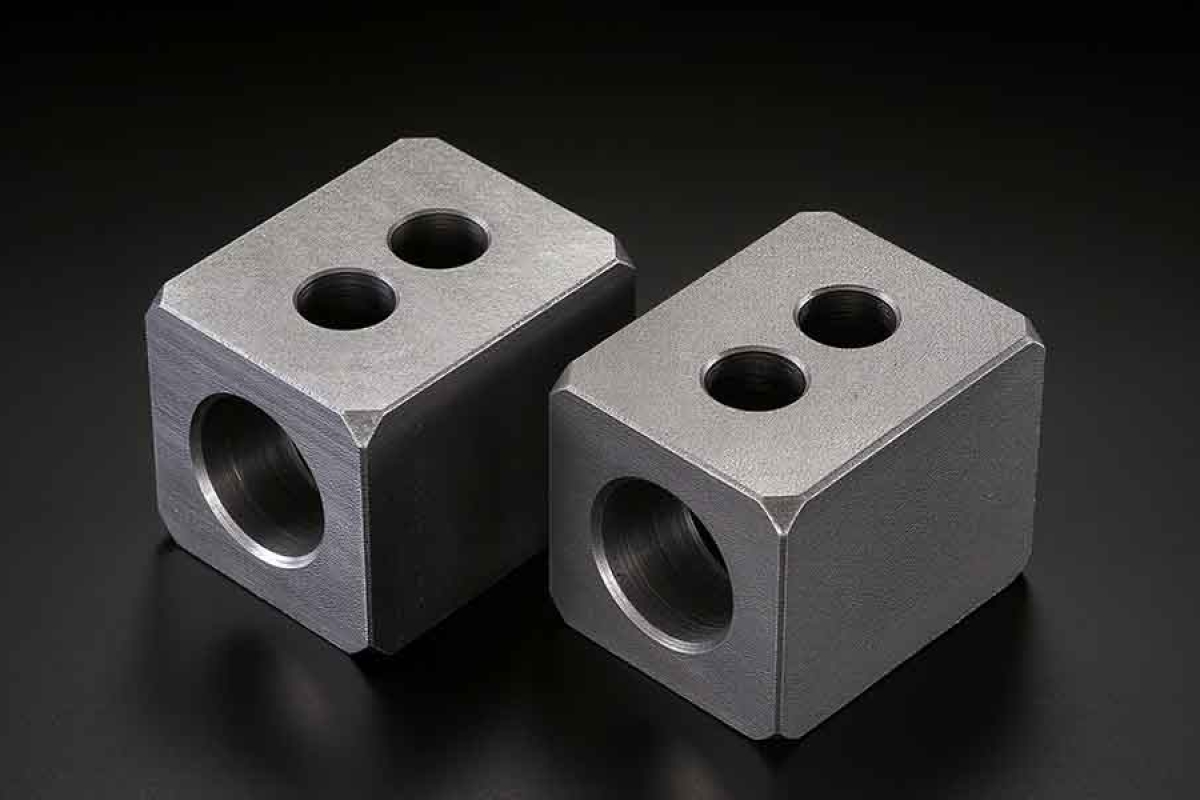
S275JR is a mainstream European non-alloy structural mild steel that balances strength, excellent weldability, reliable machinability and ultra-high cost performance. Compliant withEN 10025-2 standard, it corresponds to the European material number1.0044 and the old specification grade Fe430B. Widely used in general industrial structural parts, it is the preferred economical material for non-high-strength and non-corrosion-resistant CNC machining projects.
For precision CNC manufacturing, S275JR is ideal for producing brackets, machine frames, tooling fixtures, base plates, structural supports and conventional industrial parts. Different from professional free-cutting steel, it has moderate cutting performance, and the chip state and surface finish will slightly change with material composition and processing technology. Evefab optimizes the processing route according to the characteristics of S275JR steel to ensure stable machining accuracy and excellent finished surface quality for customers.
Specification Note: Fe430B is an outdated grade designation. In actual procurement and production, it is not completely equivalent to the modern S275JR standard. Evefab strictly implements EN 10025-2 standard and verifies materials through official material certificates to avoid grade mismatch.
1. Basic Material Information
1.1 S275JR Material Identification
Item | Detailed Specification |
|---|
Material Grade | S275JR |
Material Category | Non-alloy Structural Mild Steel |
Executive Standard | EN 10025-2 |
European Material No. | 1.0044 |
Old Designation | Fe430B |
Steel Type | Low-carbon Structural Steel |
CNC Machinability | Easy – Moderate |
Weldability | Excellent |
Heat Treatment Performance | Not suitable for high-hardness quenching |
Typical Applications | Machine frames, brackets, fixtures, base plates, structural supports, general industrial parts |
Supply Forms | Steel plate, sheet, profile steel and other structural raw materials |
EN 10025-2 is the core standard for hot-rolled non-alloy structural steel in Europe. The letter "S" represents structural steel, and "275" refers to the minimum yield strength of 275 MPa for thin-specification materials. Evefab strictly selects standard S275JR raw materials that meet the European standard to ensure consistent mechanical properties of processed parts.
1.2 Meaning of S275JR Grade Designation
The complete definition of the S275JR grade is clear and standardized, and each letter and number corresponds to fixed performance parameters:
S: Represents structural steel, specially used for industrial load-bearing and structural support parts
275: Nominal minimum yield strength (275 MPa), applicable to conventional thin and medium-thickness materials
JR: Impact test grade, indicating that the material meets the specified Charpy V-notch impact energy requirements at 20°C room temperature
It should be noted that the mechanical properties of S275JR will change slightly with material thickness and processing form. Therefore, Evefab will match the corresponding processing process and parameter standards according to the actual raw material specifications of each batch to avoid performance deviation.
1.3 Difference Between 1.0044 & Fe430B
1.0044 is the unified European material number corresponding to modern S275JR, while Fe430B is an obsolete old grade, which is only retained in legacy drawings and old technical documents.
Evefab Professional Suggestion: In formal production and procurement, do not equate Fe430B with S275JR completely. It is necessary to clearly mark S275JR (EN 10025-2, 1.0044) and verify the actual material composition and mechanical properties through the material test report to ensure compliance with modern industrial manufacturing standards.
2. Physical Properties of S275JR
The following data are typical engineering reference values. The actual certified parameters of S275JR depend on raw material thickness, rolling process and implementation standards, which are for CNC process design and part performance evaluation.
Physical Property | Typical Reference Value |
|---|
Density | ~7.85 g/cm³ |
Elastic Modulus | ~210 GPa |
Poisson's Ratio | ~0.30 |
Thermal Conductivity | 45–60 W/m·K |
Specific Heat Capacity | 450–500 J/kg·K |
Minimum Yield Strength | ≥275 MPa (thin specification) |
Tensile Strength | 410–560 MPa |
Elongation | ≥20% (variable by specification) |
Hardness | 120–180 HB (annealed state) |
Melting Temperature Range | 1425–1540°C |
Thermal Expansion Coefficient | 11–13 × 10⁻⁶/K |
2.1 Structural Strength Characteristics
S275JR is a medium-strength structural steel, not high-strength alloy steel. Its stable yield strength and tensile strength can fully meet the load-bearing and support requirements of conventional industrial parts, and is widely used in non-heavy-load structural scenarios.
Applicable parts: structural brackets, base plates, equipment frames, support parts, general tooling fixtures Alternative materials for high-strength requirements: S355 structural steel, 42CrMo4, 4140 quenched and tempered alloy steel
2.2 Density Feature
With a density of 7.85 g/cm³, S275JR is consistent with conventional carbon steel, much heavier than aluminum alloy and slightly lighter than titanium alloy. It is not suitable for lightweight component design, but has an absolute cost advantage for conventional structural parts, making it the first choice for cost-controlled industrial projects.
2.3 Elastic Modulus & Stiffness
The elastic modulus of S275JR is stable at 210 GPa, which is equivalent to most carbon steels and alloy steels. Although its yield strength is lower than high-strength steel, it has excellent structural stiffness, which can effectively avoid deformation and shaking of equipment frames and support parts during operation.
2.4 Operating Temperature Limitation
S275JR is a normal-temperature structural steel without high-temperature resistance. In high-temperature working environments, its strength will decrease significantly, and it is prone to thermal expansion deformation and surface oxidation. Therefore, it is only suitable for room-temperature conventional working conditions, and heat-resistant alloy steel is required for high-temperature equipment parts.
2.5 Wear Resistance Performance
S275JR has low to moderate wear resistance. It can adapt to conventional static contact and low-friction working conditions, but is not suitable for severe abrasive wear, sliding friction and high-contact-pressure working scenarios. For wear-resistant parts, Evefab recommends replacing with hardened tool steel or professional wear-resistant steel to extend service life.
3. Chemical Properties of S275JR
3.1 Typical Chemical Composition
The low-carbon composition of S275JR is the core reason for its excellent weldability. The standard chemical composition range compliant with EN 10025-2 is as follows:
Chemical Element | Content Range |
|---|
Carbon (C) | ≤0.21% |
Silicon (Si) | ≤0.35% |
Manganese (Mn) | ≤1.50% |
Phosphorus (P) | ≤0.035% |
Sulfur (S) | ≤0.035% |
Nitrogen (N) | Standard controlled content |
Iron (Fe) | Balance |
3.2 Corrosion Resistance
S275JR ordinary carbon structural steel has no natural anti-corrosion ability, far inferior to stainless steel. It is easy to produce surface rust, oxide skin and pitting corrosion in humid, atmospheric and aqueous environments.
Evefab Anti-Corrosion Solution: For S275JR parts used outdoors or in humid environments, we provide customized surface protection processes including powder coating, spray painting, zinc plating, hot-dip galvanizing, black oxide treatment and phosphating to effectively improve the environmental adaptability of parts.
3.3 Salt Spray & Marine Environment Adaptability
Bare S275JR cannot be used in marine, coastal and salt spray environments for a long time, and it will corrode rapidly. For marine equipment and coastal facilities, Evefab recommends two solutions: adopt professional anti-corrosion coating protection or replace with stainless steel materials.
3.4 Chemical Stability
S275JR has stable performance in conventional industrial environments, but cannot resist the erosion of strong acid, strong alkali, chloride solution and oxidizing chemicals. For parts in special chemical working environments, Evefab will evaluate material compatibility and recommend alternative anti-corrosion materials.
3.5 Welding Compatibility
This is the core advantage of S275JR. Low carbon content brings excellent welding performance, compatible with MIG/MAG, TIG, SMAW, submerged arc welding and automatic welding processes.
Evefab formulates targeted welding processes according to part thickness, joint structure and use standards, controls welding heat input and preheating temperature, effectively avoids welding deformation and cracks, and ensures the structural stability of welded parts.
4. S275JR CNC Machinability Analysis
4.1 Machining Difficulty Evaluation
S275JR Machining Level: Easy – Moderate
Compared with titanium alloy, hardened tool steel and high-temperature alloy steel, S275JR has low hardness, moderate strength and good thermal conductivity, with low machining difficulty and wide tool matching range. Although it is not professional free-cutting steel, Evefab optimizes cutting parameters and tool paths to ensure stable cutting quality and controllable burrs.
4.2 Recommended CNC Tooling Configuration
Suitable tools for S275JR mass production machining:
Milling: Coated carbide end mills, carbide inserts
Drilling: HSS drills, carbide drills
Finishing: Carbide reamers, thread mills
Threading: HSS taps / carbide taps
Coated carbide tools are the first choice for formal production, which can balance tool life, cutting efficiency and surface finish.
4.3 Reference CNC Cutting Parameters
The following parameters are standard starting values. Evefab will dynamically optimize according to machine rigidity, tool model, coolant condition and processing allowance to adapt to actual production conditions.
Carbide Milling Parameters
Processing Parameter | Typical Starting Range |
|---|
Cutting Speed | 120–250 m/min |
Feed Per Tooth | 0.04–0.15 mm/tooth |
Roughing Depth of Cut | 1–4 mm |
Finishing Depth of Cut | 0.2–1 mm |
Carbide Turning Parameters
Processing Parameter | Typical Starting Range |
|---|
Cutting Speed | 120–250 m/min |
Feed Rate | 0.10–0.30 mm/rev |
Roughing Depth of Cut | 1–4 mm |
Finishing Depth of Cut | 0.2–1 mm |
4.4 Common Machining Problems & Solutions
Burr Generation
It is easy to produce burrs during drilling, slot milling and edge cutting. Solutions: Use sharp new tools, optimize feed parameters, design reserved chamfers, standardize tool retraction, and add professional deburring process.
Built-Up Edge Adhesion
Low cutting speed, dull tools and insufficient coolant will cause material adhesion on the tool tip. Solutions: Appropriately increase cutting speed, match special coated tools, ensure sufficient chip thickness and stable coolant supply.
Processing Chatter
Large structural parts are prone to vibration and chatter due to long tool overhang and insufficient fixture rigidity. Solutions: Strengthen fixture clamping, reduce tool overhang, optimize spindle speed and radial cutting amount.
Dimensional Deviation
Residual stress of steel plate, clamping deformation and thermal expansion will cause dimensional error. Solutions: Adopt staged processing, reserve stress relief links, and carry out intermediate size inspection for large parts.
4.5 CNC Machining Tolerance Capability
S275JR has stable machining accuracy. Conventional CNC processing can stably achieve ±0.01–0.05 mm tolerance. Higher precision can be achieved through finish turning, finish milling, grinding and reaming processes.
Evefab Suggestion: For non-key structural surfaces, avoid over-specifying ultra-tight tolerances to save production costs while ensuring assembly accuracy.
4.6 Surface Roughness Standard
Processing Technology | Typical Ra Roughness |
|---|
Rough Milling | 3.2–6.3 μm |
Semi-finishing Milling | 1.6–3.2 μm |
Finish Milling / Turning | 0.8–1.6 μm |
Precision Grinding | 0.2–0.8 μm |
4.7 CNC Milling Processing
S275JR is fully compatible with 3/4/5-axis CNC milling, supporting face milling, cavity milling, slotting, contour processing and drilling. It has high material removal efficiency and low processing cost, and is very suitable for batch processing of large structural parts.
4.8 CNC Turning Processing
It can be turned into shafts, bushings, spacers, pins, flanges and other cylindrical parts. Evefab uses high-precision carbide turning inserts to ensure stable dimensional accuracy and smooth surface of rotary parts.
4.9 Drilling & Tapping Processing
Conventional HSS and carbide drills are applicable. For deep hole processing, adopt peck drilling and enhanced cooling chip removal. For threaded holes, match reasonable lubrication and chip removal schemes, and use thread milling process for large-diameter threads to avoid tap breakage.
5. Typical Application Scenarios
5.1 Industrial Machinery Parts
Mainly used for equipment mounting plates, machine brackets, structural supports, equipment bases, protective covers and mounting fixtures. Relying on excellent weldability and low cost, it is the preferred material for large industrial assembly structures.
5.2 CNC Tooling & Fixtures
Suitable for welding fixtures, machining fixtures, fixture bases, clamping brackets and positioning support blocks. For fixtures with high wear resistance requirements, Evefab will match hardened tool steel inserts to improve service life on the basis of S275JR base.
5.3 Automation Equipment Components
Used for robot bases, automation equipment frames, conveyor structural parts and equipment mounting brackets. It is suitable for fixed structural parts, and lightweight aluminum alloy is recommended for moving parts.
5.4 Automotive Manufacturing Tooling
Widely used in automobile production fixtures, welding tooling, equipment bases and assembly supports. It is mostly used for production auxiliary tooling, not for vehicle load-bearing transmission parts.
5.5 Construction & Structural Components
Used for structural connecting plates, support frames, mounting bases and engineering accessories, meeting the conventional load-bearing requirements of construction machinery and engineering structures.
5.6 General Engineering Parts
It is the best economical choice for parts requiring medium strength, convenient processing and low cost, replacing expensive alloy steel in conventional working conditions to effectively reduce project manufacturing cost.
6. Evefab S275JR Machining Core Advantages
6.1 Professional Material Selection Evaluation
Evefab engineering team comprehensively evaluates part working conditions (strength, corrosion resistance, processing difficulty, cost, weight), and accurately selects S275JR, S235JR, S355J2, C45, stainless steel and aluminum alloy materials to avoid material mismatch and cost waste.
6.2 Integrated Processing & Fabrication
We support one-stop services of cutting, welding, CNC machining, deburring and surface finishing. For large structural parts, we formulate economical processes of "cutting + welding + finish machining" to avoid full solid material processing and greatly reduce production cost.
6.3 Large-Size Part Custom Processing
Aiming at the characteristics of low cost and easy processing of S275JR, we are good at processing large base plates, equipment frames and large fixture structures. We optimize the processing sequence and clamping scheme to effectively solve the problems of plate deformation and residual stress of large parts.
6.4 Diversified Surface Finishing
According to customer usage scenarios, we provide customized anti-corrosion and surface treatment services: spray painting, powder coating, zinc plating, hot-dip galvanizing, black oxide and phosphating, which perfectly adapt to indoor, outdoor and conventional industrial environments.
6.5 Strict Precision Quality Inspection
Equipped with CMM three-dimensional detector, micrometer, roughness meter and other precision testing equipment, we conduct full inspection of part size, surface finish and assembly tolerance, focus on functional key dimensions, and ensure 100% qualified delivery of parts.
6.6 Complete Material Traceability Documents
For B2B industrial orders, we provide complete MTR material test reports, conformity certificates, dimensional inspection reports and surface treatment documents to realize full batch traceability and meet the certification requirements of automotive, mechanical and standardized manufacturing industries.
S275JR CNC Machining Performance Summary
Performance Dimension | Comprehensive Evaluation |
|---|
Grade Standard | S275JR / 1.0044 (EN 10025-2) |
Material Type | Low-carbon Non-alloy Structural Mild Steel |
Machinability | Easy – Moderate, suitable for batch processing |
Weldability | Excellent, compatible with multiple welding processes |
Corrosion Resistance | Low, need surface anti-corrosion treatment |
Wear Resistance | Low – Moderate, suitable for static structural parts |
CNC Processing Adaptability | Milling, turning, drilling, 5-axis processing are all applicable |
Core Advantage | Low cost, stable performance, easy processing and welding |
Typical Applications | Equipment frames, brackets, fixtures, structural support parts |
S275JR DFM Design Optimization Suggestions
Avoid over-tolerance design: Do not set ultra-tight tolerances for non-functional surfaces to retain the cost advantage of S275JR
Focus on key assembly dimensions: Use GD&T to mark high-precision requirements only for bearing seats, positioning holes and matching surfaces
Optimize large part technology: Adopt cutting and welding + finish machining process for large structural parts to reduce raw material cost
Reserve welding deformation allowance: Leave sufficient machining allowance for post-weld finish machining to eliminate deformation error
Match targeted anti-corrosion treatment: Select coating process according to indoor/outdoor and humidity environment to avoid rust failure
Reasonable material replacement: Replace with S355 high-strength structural steel for parts requiring higher load-bearing strength
S275JR VS Alternative Materials Performance Comparison
Performance | S275JR | S355J2 | C45 | 42CrMo4 |
|---|
Material Type | Structural Steel | Structural Steel | Medium-carbon Steel | Alloy Steel |
Yield Strength | 275 MPa | 355 MPa | Medium (hardenable) | High (after heat treatment) |
Weldability | Excellent | Excellent | Moderate | Poor |
Machinability | Good | Good | Good | Moderate |
Wear Resistance | Low-Moderate | Moderate | Moderate | High |
Cost | Low | Low-Moderate | Moderate | High |
Main Application | Conventional structural parts | Heavy-load structural parts | Conventional shaft parts | High-load precision parts |
Choose Evefab for S275JR CNC Machining
Evefab focuses on high-precision CNC customized processing of S275JR (1.0044) structural steel, integrating material selection evaluation, DFM process optimization, precision machining, welding assembly, surface finishing and full quality inspection.
We abandon single processing mode, and formulate personalized manufacturing routes according to part usage scenarios, size specifications and precision requirements, which is especially suitable for large machine frames, structural brackets, automation equipment fixtures and industrial assembly parts, helping customers balance quality, precision and manufacturing cost.
Get Free S275JR Machining Quotation
Provide your 2D drawings, 3D CAD models, processing quantity, tolerance standards and surface treatment requirements. Evefab will provide free DFM technical consultation, process optimization scheme and accurate CNC machining quotation for you!
Get an Instant Quotefor your custom Mild Steel S275JR parts today.