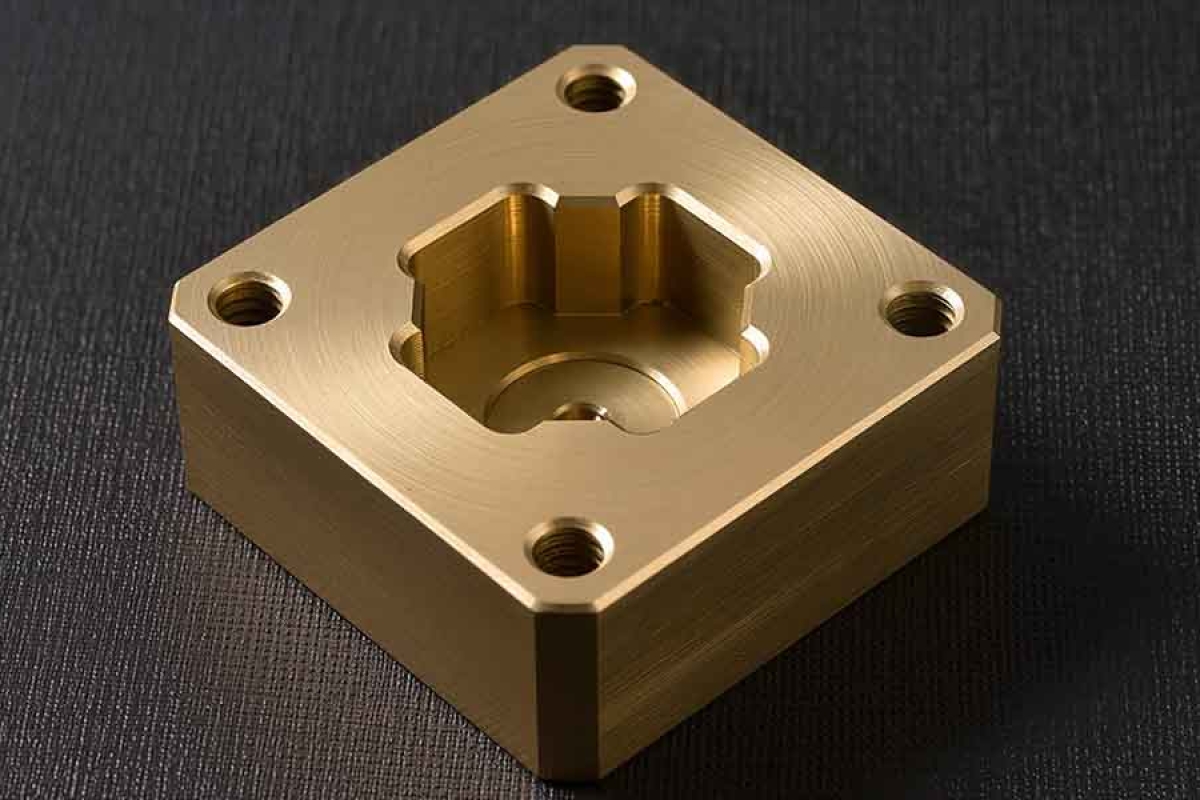
Important Material-Grade Correction: The industry often confuses two similar leaded brass grades. UNS C36000 (C360) strictly corresponds to CuZn39Pb3 / EN CW614N, while CuZn36Pb3 corresponds to EN CW603N as an independent alloy. According to official KME alloy specifications, the two grades differ greatly in chemical composition and processing performance and cannot be substituted mutually. If your drawing specifies CuZn36Pb3 (2.0375), it must be produced according to independent specifications instead of C360. As a professional precision CNC machining manufacturer, Evefab strictly distinguishes brass grades to avoid material mismatch and ensure part compliance and service stability.
1. Basic Material Information
UNS C36000 (commonly known as C360 free-cutting brass) is a classic leaded copper-zinc-lead alloy, specially developed for high-speed automatic turning, CNC mass production and precision mechanical parts. With a reasonable ratio of 60–63% copper, 2.5–3.0% lead and balanced zinc, the material has industry-top machinability. The lead element effectively breaks continuous chips, reduces cutting resistance and tool wear, making it the preferred material for high-efficiency batch precision machining.
1.1 International Standard Designation Comparison
C360 brass has unified corresponding designations in global mainstream standards. Evefab verifies material standards strictly according to customer drawings and procurement specifications to eliminate grade confusion:
Standard System | Corresponding Designation |
UNS | C36000 |
ASTM / CDA | C360 / C36000 (Free-Cutting Brass) |
EN / DIN | CW614N / CuZn39Pb3, DIN 2.0401 |
JIS | C3604 (equivalent free-cutting brass) |
Common Name | Free-Cutting Brass / Free-Machining Brass |
1.2 Material Core Parameters & Positioning
• Material Category: Copper-zinc-lead leaded free-cutting brass
• Chemical Composition: Cu 60.0–63.0%, Pb 2.5–3.0%, Zn balance, Fe ≤0.35%, total main components ≥99.5%
• Core Advantage: Machinability rating up to 100 (industry standard reference), excellent chip breaking, ultra-high machining efficiency
• Product Positioning: Manufacturing-oriented precision brass, focusing on high-volume CNC production, stable dimensional repeatability and low processing cost
C360 brass is the benchmark material for industrial high-speed turning and automatic screw machine production. Evefab takes advantage of its excellent processing characteristics to provide customers with low-cost, high-precision, large-batch brass part processing services.
2. Physical Properties of C360 Brass
The following data are authoritative typical engineering values from CDA official specifications. The actual performance of C360 brass is affected by material temper, section size and processing technology. Evefab matches optimal processing parameters and material status according to part functional requirements.
Physical Property | Typical Reference Value |
Density | ~8.5 g/cm³ |
Specific Gravity | 8.5 |
Electrical Conductivity | 26% IACS |
Thermal Conductivity | 116–117 W/m·K |
Melting Temperature Range | 885–899°C |
Elastic Modulus | 96–98 GPa |
Shear Modulus | 36–37 GPa |
Poisson's Ratio | 0.34 |
Specific Heat Capacity | 380 J/kg·K |
Thermal Expansion Coefficient | 20–21 × 10⁻⁶/K |
2.1 Mechanical Properties (Temper Dependent)
The strength, hardness and ductility of C360 brass vary significantly with cold working degree and annealing temper:
• Annealed State: Tensile strength ~400 MPa, yield strength ~310 MPa, elongation ~18%, hardness 50–70 HRB, good ductility
• Half-Hard Cold-Worked State: Higher tensile and yield strength, hardness 70–90 HRB, reduced ductility, suitable for structural parts requiring certain rigidity
For parts with strict mechanical performance requirements, Evefab will clearly define material temper in the processing scheme to ensure consistent mechanical properties of batch products.
2.2 Service Performance & Limitations
Wear Resistance: C360 has moderate wear resistance, suitable for conventional valve bodies, fasteners, bushings and mechanical connectors, but not applicable for high-load friction and severe abrasive working conditions.
High-Temperature Resistance: Although the melting point is close to 900°C, the tensile strength and dimensional stability of C360 will decrease significantly with rising temperature. Evefab recommends avoiding long-term high-temperature service for precision C360 parts.
3. Chemical Properties & Compliance Specifications
3.1 Standard Chemical Composition
The lead element in C360 brass is the core reason for its excellent machinability, which can break long continuous chips generated during brass processing and avoid tool adhesion and material smearing:
Element | Specification Range |
Copper (Cu) | 60.0–63.0% |
Lead (Pb) | 2.5–3.0% |
Zinc (Zn) | Balance |
Iron (Fe) | ≤0.35% |
Total Valid Components | ≥99.5% |
3.2 Corrosion Resistance & Application Restrictions
C360 brass has excellent atmospheric corrosion resistance and is widely used in plumbing, automotive, industrial fluid control and general hardware fields. However, it is not completely corrosion-resistant, and performance attenuation may occur in ammonia environment, strong acid, high-chloride and marine harsh environments.
In addition, zinc element in the alloy may cause dezincification in long-term aqueous environment, so C360 is not recommended for drinking water systems and long-term immersed marine equipment without anti-corrosion treatment.
3.3 Environmental Compliance & Regulatory Requirements
C360 brass contains 2.5–3.0% lead, which is listed as an SVHC controlled substance in EU REACH regulations and is restricted by RoHS 3, California Proposition 65 and other environmental directives. According to KME official compliance documents, leaded brass is allowed for industrial mechanical parts under specific exemptions, but not suitable for food contact, medical devices and pure drinking water equipment.
Evefab strictly complies with global environmental regulations, and will actively remind customers of material applicability risks and provide compliant material replacement schemes for regulated application scenarios.
3.4 Welding & Connection Performance
C360 brass has poor fusion welding performance, but excellent brazing and soldering performance:
• Soldering: Excellent | Brazing: Good
• Butt Welding: Fair | All arc welding, spot welding and seam welding: Not recommended
For C360 part assembly, Evefab prioritizes soldering, brazing or mechanical fastening instead of fusion welding to avoid material cracking and performance degradation.
4. C360 Brass CNC Machinability Analysis
Overall Machining Difficulty: Easy (Industry Benchmark Level)
C36000 has a machinability rating of 100, which is the industry standard reference for free-cutting copper alloys. Compared with pure copper such as C101, it has lower cutting resistance, cleaner chip breaking, longer tool life and far higher mass production efficiency, and is very suitable for automatic CNC turning and Swiss high-precision machining.
4.1 Recommended Tooling & Geometry
C360 has low processing requirements for tools, and multiple tool types can meet production needs:
• Conventional Production: High-speed steel tools, ordinary carbide tools
• High-Precision & Mass Production: Polished positive-rake carbide tools, special chip-breaking inserts
• Core Advantages: Effectively avoid chip adhesion and material smearing, stable processing quality and low tool loss
4.2 Reference CNC Cutting Parameters
The following parameters are universal starting values. Evefab dynamically optimizes spindle speed, feed rate and cutting depth according to tool specification, part structure and surface finish requirements:
Processing Operation | Typical Parameter Range |
Carbide Milling Speed | 150–350 m/min |
Carbide Turning Speed | 150–400 m/min |
Rough Milling Feed Per Tooth | 0.05–0.20 mm/tooth |
Finish Milling Feed Per Tooth | 0.02–0.10 mm/tooth |
Drilling Speed | 60–150 m/min |
4.3 Common Machining Problems & Evefab Professional Solutions
Edge Burrs
Slight burrs may appear at hole exits, thin edges and sharp corners.
Solution: Equip sharp new tools, optimize feed parameters, reserve process chamfers, and support automatic deburring and manual finishing processes.
Tool Wear & Dimensional Drift
Excessive speed or insufficient coolant will accelerate tool wear, resulting in dimensional deviation and poor thread quality.
Solution: Match special cutting fluid for brass, set tool wear compensation, and regularly verify tool accuracy in batch production.
Surface Scratches
Re-cutting of chips and unstable clamping will scratch the decorative brass surface.
Solution: Optimize chip removal system, fix fixture clamping force, and protect finished surfaces during processing and handling.
4.4 Machining Tolerance & Surface Finish Capability
Relying on mature C360 processing technology, Evefab stably achieves high-precision manufacturing standards:
• Conventional dimensional tolerance: ±0.05 mm
• Precision key feature tolerance: ±0.01–0.02 mm
• Conventional surface roughness: Ra 0.8–3.2 μm
• Ultra-fine finishing roughness: Ra ≤0.4 μm
For precision threaded parts and appearance parts, Evefab adopts GD&T geometric tolerance control to ensure assembly accuracy and appearance consistency of batch parts.
4.5 Machining Scenario Suitability
Machining Scenario | Suitability | Application Features |
CNC Turning / Automatic Screw Machining | Excellent | Core advantageous process, ultra-high batch efficiency |
Swiss Precision Machining | Excellent | Suitable for small-size precision shaft and pin parts |
CNC Milling / 5-Axis Complex Machining | Good | Stable processing of complex structural parts |
Thin-Wall & Deep Cavity Machining | Good | Low deformation, good dimensional stability |
High-Volume Mass Production | Excellent | Low cost and stable quality |
5. Typical Application Fields & Parts
5.1 Automotive Precision Parts
Relying on good corrosion resistance and ultra-high machinability, C360 is widely used in automotive fluid control systems: fluid connectors, sensor shells, thermostat parts, threaded adapters and automotive hardware fasteners.
5.2 Industrial Automation & Fluid Control
Suitable for pneumatic and hydraulic fittings, valve bodies, nozzles, couplings, sensor housings and mechanical connectors. It effectively reduces processing cycle time and production cost for batch automation parts.
5.3 Fastener & Threaded Parts
It is the preferred material for precision machined nuts, bolts, screws, studs and threaded inserts. Its excellent chip-breaking performance ensures high precision and no burrs of threads.
5.4 Electronic & Instrument Components
Used for instrument knobs, precision mechanical assemblies, electrical terminals, connector shells and decorative hardware parts. The natural metallic luster of brass ensures excellent appearance effect of finished parts.
5.5 Plumbing & General Hardware
Applicable to conventional plumbing fittings, valve accessories and industrial hardware. Note: Strictly verify lead-containing environmental protection standards before used in drinking water scenarios.
6. Evefab C360 Brass CNC Machining Core Advantages
6.1 Professional Brass Grade Distinction & Verification
Evefab engineering team accurately distinguishes easily confused brass grades such as C360/CuZn39Pb3, CuZn36Pb3/CW603N, C377 and C385, completely avoiding material substitution errors. We provide official MTR material test reports and full batch traceability records to meet customer compliance requirements.
6.2 High-Efficiency Batch Production Technology
Aiming at the high machinability of C360 brass, we customize exclusive high-speed processing schemes, optimize tool matching and chip breaking parameters, greatly shorten single-piece cycle time, reduce tool loss and production cost, and maintain stable dimensional consistency of tens of thousands of batch parts.
6.3 Full-Process Precision Machining Capacity
Support full-process services such as CNC turning, Swiss precision machining, 3/4/5-axis milling, tapping, knurling and finishing. Integrate turning and milling composite processing to reduce clamping errors and meet the processing requirements of small, complex and high-precision brass parts.
6.4 Professional DFM Cost Optimization
Evefab provides free DFM manufacturability review for C360 part drawings, optimizes unreasonable tolerance settings, corner structures and wall thickness designs, ensures product functionality, and effectively reduces unnecessary processing costs for customers.
6.5 Diversified Surface Finishing Services
According to application scenarios, we provide supporting secondary treatments such as deburring, polishing, wire drawing, nickel plating and chrome plating, to meet the dual requirements of industrial assembly and decorative appearance of C360 brass parts.
6.6 Full-Cycle Project Service
Support the whole process from prototype trial production, first-piece verification, small-batch testing to large-batch mass production, with unified process standards and stable quality, helping customers quickly complete product verification and mass delivery.
7. Material Grade Comparison: C360 vs CuZn36Pb3
It is the most critical engineering distinction in brass procurement and production. The two are non-interchangeable in specification and performance:
Comparison Dimension | C360 / C36000 | CuZn36Pb3 |
EN Standard Designation | CW614N | CW603N |
Chemical Grade | CuZn39Pb3 | CuZn36Pb3 |
Copper Content | 60–63% | 57–60% |
Core Advantage | Ultra-high machining efficiency, suitable for high-volume turning | Balanced machining and forming performance |
Material Interchangeability | Not interchangeable | Not interchangeable |
Engineering Summary & Recommendation
C36000 (CuZn39Pb3 / CW614N) free-cutting brass is the most cost-effective precision machining brass material in the industrial field. With its 100-level machinability, good corrosion resistance and moderate mechanical strength, it is widely used in automotive, automation, fluid control, fastener and instrument parts.
In actual procurement and production, it is necessary to strictly distinguish it from CuZn36Pb3/CW603N to avoid material mismatch. As a professional brass CNC machining manufacturer, Evefab relies on mature process technology, strict material verification and perfect quality control system to provide global customers with high-precision, low-cost and stable batch C360 brass part processing services.
Get Free C360 Brass CNC Machining Quotation
Provide your 2D/3D drawings, tolerance requirements, batch quantity and surface treatment standards. Evefab provides free DFM analysis, material grade verification, process optimization scheme and accurate quotation for C360 brass precision machining projects!
Get an Instant Quotefor your custom Brass C360 parts today.