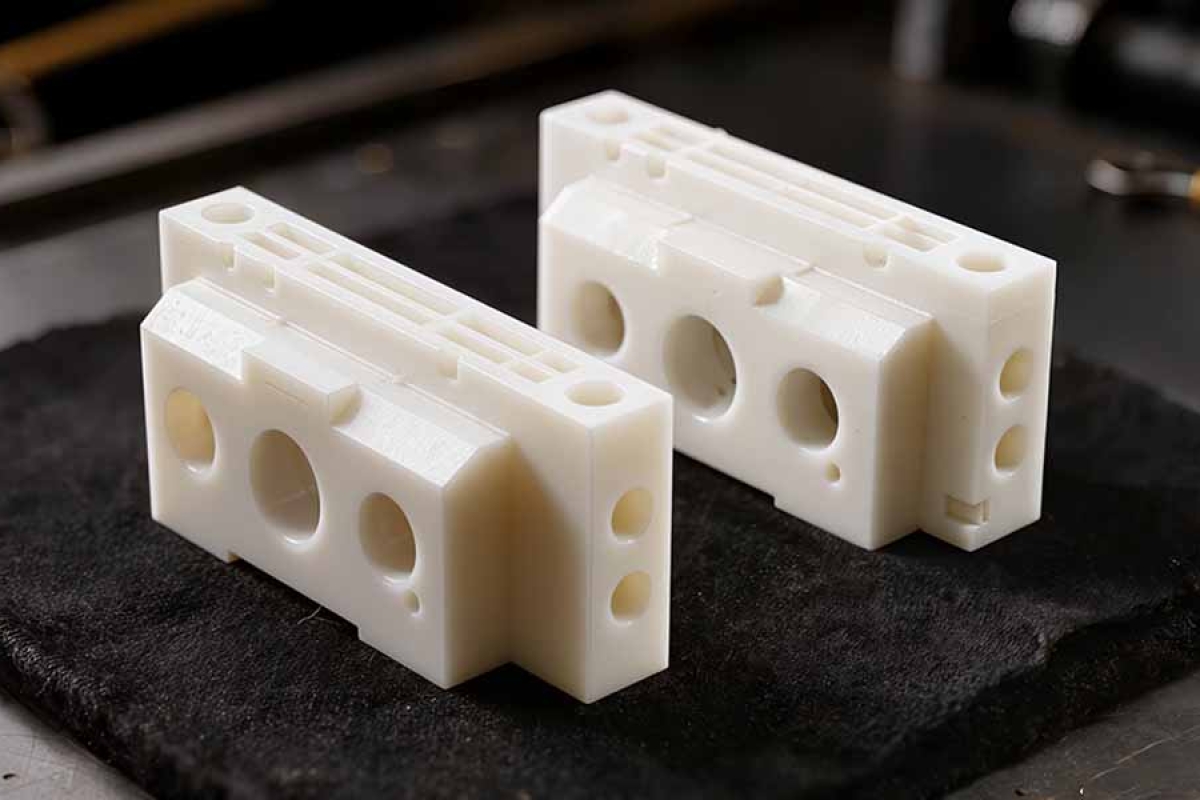
Qu'est-ce que le matériau POM?
POM (Polyoxyméthylène), communément connu sous le nom d'acétal, est un thermoplastique d'ingénierie de haute performance largement utilisé pour les pièces usinées CNC de précision. Delrin® est une marque commerciale bien connue d'homopolymère acétal, tandis que POM comprend également des grades de copolymères d'autres fabricants. Le matériau combine une faible frottement, une bonne résistance à l'usure, une stabilité dimensionnelle, une raideur et une excellente usinabilité, ce qui le rend particulièrement précieux pour les engrenages, les douilles, les rouleaux, les dispositifs de précision, les composants de guidage et les pièces mécaniques.
Note sur la terminologie des matériaux: «POM» et «Delrin» ne devraient pas être considérés automatiquement comme des spécifications identiques. POM est la famille des polymères; Delrin® est un nom commercial enregistré associé aux produits d'homopolymère acétal. Les propriétés réelles dépendent du grade spécifique et de la fiche de données du fournisseur.
1. Informations matérielles de base
Dénomination du matériel et Classification
Article | POM / Acétal |
Nom du matériau standard | Polyoxyméthylène |
Noms communs | POM, acétal, polyacétal |
Nom commercial | Delrin® pour des grades spécifiques de produits DuPont/Celanese |
Catégorie de matériaux | Ingénierie thermoplastique |
Structure du polymère | Thermoplastique semi-cristallin |
Formulaires communs | Feuille, plaque, tige, tube, billette |
Méthodes de fabrication communes | Usinage CNC, moulage par injection, extrusion |
Famille de matériaux ISO | POM |
Normes pertinentes | ISO 9988; ASTM D4181 et autres normes spécifiques à l'application/à l'essai |
Le POM est généralement divisé en deux grandes familles de matériaux :
POM-H (acétal homopolymère) — typically higher stiffness, strength and dimensional stability.
POM-C (copolymère acétal) — generally offers improved resistance to thermal and chemical degradation and is widely used for engineering components.
La qualité réelle doit être spécifiée en fonction de la fiche de données du fournisseur, car les additifs, le renforcement et la formulation peuvent changer considérablement les performances.
Positionnement du noyau
Le POM est l’un des plastiques d’ingénierie les plus importants pourcomposants mécaniques de précision.
Par rapport à l'ABS, POM offre généralement:
Meilleure résistance à l'usure
Friction inférieure
Une raideur plus élevée
Meilleure stabilité dimensionnelle
Meilleure usinabilité pour les composants mécaniques de précision
Par rapport au PEEK, le POM offre généralement:
Coût inférieur
Un usinage plus facile
Capacité de température inférieure
Performances chimiques et mécaniques plus faibles à des températures élevées
Cela rend le POM particulièrement attrayant pourPièces en plastique CNC de précision où le mouvement mécanique et la précision dimensionnelle sont importants.
2. Propriétés physiques du POM
Les valeurs suivantes représententgammes typiques pour les grades POM commerciaux non remplisCe ne sont pas des limites de spécification universelles. Les qualités d'homopolymère et de copolymère peuvent différer considérablement.
Propriété | Gamme POM typique |
Densité | ~1.40–1.43 g/cm³ |
Résistance à la traction | ~ 60 à 75 MPa |
Module de traction | ~2.5–3.5 GPa |
Elongation à la rupture | ~10–40% |
Module de flexion | ~2.5–3.5 GPa |
Dureté | Typiquement Rockwell M80-M95 |
Absorption d'eau | Généralement < 0 > |
Conductivité thermique | ~ 0,3 W/m·K |
Température de fusion | ~160–180°C |
Température de transition du verre | Environ -60°C |
Température de service continue | Généralement autour de 90-105°C |
Coefficient de frottement | Faible; grade et contreface dépendant |
Densité
Le POM a une densité d'environ1.40–1.43 g/cm³.
Il est considérablement plus léger que l'aluminium tout en étant considérablement plus dense et plus raide que de nombreux plastiques de base.
Cela offre une combinaison utile de:
POM non rempli typique fournit une résistance à la traction dans la plage approximative de60 à 75 MPaavec un module de traction communément autour2.5–3.5 GPa.
Cela rend le POM adapté aux composants chargés mécaniquement qui seraient trop exigeants pour les plastiques plus doux tels que le polyéthylène.
Cependant, le POM ne devrait pas être considéré comme un remplacement direct des métaux dans les applications fortement chargées ou à haute température.
Résistance aux chocs
Le POM a une bonne résistance et peut tolérer les charges mécaniques répétées mieux que de nombreux plastiques fragiles.
Son impact réel dépend de :
Classe
Température
Géométrie de la partie
Épaisseur de mur
Historique du traitement
Présence de renforcement
Résistance à l'usure
La résistance à l'usure est l'un des avantages d'ingénierie les plus importants du POM.
Le POM est souvent choisi pour les composants mobiles en raison de sa combinaison de:
Faible friction
Bonne résistance à l'abrasion
Bonne résistance à la fatigue
Bonne stabilité dimensionnelle
Il est couramment utilisé dans:
Bushings
rouleaux
engrenages
Blocs de guidage
Components coulissants
Cages à roulements
Pour des applications tribologiques extrêmement exigeantes, des grades POM spécialisés contenant du PTFE, de la silicone ou d'autres modifieurs lubrifiants peuvent être plus appropriés.
Résistance à la température
Le POM fonctionne généralement bien dans les applications mécaniques à température modérée.
A typical continuous operating range is approximately −40°C to +90/100°C, depending strongly on grade, load and environment.
Short-term exposure may be possible at higher temperatures, but continuous service conditions should be evaluated against the manufacturer's specification.
POM is therefore generally unsuitable for applications involving sustained temperatures approaching its melting range.
Absorption d'humidité
POM has relatively low moisture absorption compared with many polyamides.
This is an important advantage for precision components because dimensional changes caused by ambient humidity are generally smaller than with materials such as PA6.
Nevertheless, moisture and temperature still need to be considered when extremely tight tolerances are required.
3. POM Chemical Properties
Composition chimique
POM is based primarily on repeating oxymethylene (-CH₂-O-) units.
Unlike metallic materials, POM does not have an ASTM/UNS elemental alloy composition.
The exact formulation varies by manufacturer and grade.
Commercial POM may contain:
Therefore, the specific material datasheet should always be used when a component has critical chemical or mechanical requirements.
Résistance chimique
POM generally provides good resistance to many:
Hydrocarbons
Oils
Combustibles
Les alcools
acides faibles
Alcalines faibles
Many organic solvents
This chemical resistance contributes to its use in mechanical and fluid-handling components.
However, POM has important chemical limitations.
Strong acids and strong oxidizing agents can cause degradation.
POM should be evaluated carefully when exposed to:
Résistance à la corrosion
POM does not corrode or rust like metallic materials.
This makes it attractive for applications where metal corrosion would be problematic.
However, "corrosion-free" does not mean chemically inert. Chemical attack can still cause:
Résistance aux UV
Standard POM is not naturally optimized for long-term outdoor UV exposure.
Prolonged sunlight can cause:
For outdoor applications, a UV-stabilized grade should be considered.
Welding & Bonding Compatibility
POM is relatively difficult to bond using conventional adhesives compared with ABS.
This is largely related to its low surface energy and chemical resistance.
Possible joining methods include:
For precision assemblies, mechanical joining is often preferred.|
4. POM CNC Machinability Analysis
Difficulté d'usinage: Facile
POM is one of the most machinable engineering plastics for CNC manufacturing.
Its excellent machinability is a major reason why POM is frequently selected for precision plastic components.
Compared with many softer thermoplastics, POM produces relatively predictable chips and can achieve good surface quality when properly machined.
Outils de coupe recommandés
Recommended tools include:
The most important factor is maintaining a sharp cutting edge.
Dull tools can create:
Excessive heat
Frottement de surface
Drift dimensionnel
Poor surface finish
Burrs
Guidance générale des paramètres de coupe CNC
Typical starting ranges for unfilled POM can be approximately:
Paramètre | Gamme de départ typique |
Vitesse de coupe | ~200–500 m/min |
Alimentation par dent | ~ 0,05-0,20 mm/dent |
Liquide de refroidissement | Dry/air blast or suitable coolant |
Tool material | Carbide preferred |
Cutting approach | Sharp, positive cutting geometry |
Évacuation de la puce | Important |
These are starting ranges rather than fixed production parameters. The optimum cutting conditions depend on tool diameter, flute count, machine spindle speed, workpiece geometry and grade.
CNC Milling POM
POM is highly suitable for:
Pocket milling
Contouring
Slotting
Perforage
Threading
3D surface machining
Precision profiling
For complex geometries, 3-axis, 4-axis and 5-axis CNC machining can all be used.
For high-quality surfaces, a dedicated finishing pass is generally preferable to relying entirely on the roughing toolpath.
CNC Turning POM
POM is particularly suitable for CNC turning.
Common turned components include:
Bushings
rouleaux
Spacers
Shafts
Sleeves
Sealing components
Precision rings
Sharp turning tools and adequate chip clearance are important for maintaining dimensional accuracy.
Drilling POM
POM can be drilled efficiently.
Potential issues include:
For deep holes, peck drilling or optimized chip evacuation can be beneficial.
Tapping & Threading
POM can be directly tapped and threaded.
For low-load applications, machined plastic threads can work well.
For frequent assembly/disassembly or higher loads, consider:
The choice depends on load, assembly frequency and environmental conditions.
Common POM CNC Machining Problems
1. Dimensional Expansion or Contraction
POM can change dimension with temperature.
During machining, excessive heat can cause the component to measure differently immediately after machining than after it has thermally stabilized.
Solutions:
Keep cutting heat under control
Use sharp tools
Avoid excessive rubbing
Allow parts to thermally stabilize before final inspection
Maintain controlled inspection temperature
2. Burrs
Burrs can occur around:
Holes
Slots
Sharp external edges
Intersecting features
Sharp tooling and optimized finishing passes can significantly reduce burr formation.
3. Déformation de la paroi mince
Although POM is relatively stiff for a thermoplastic, thin sections can still deform under clamping force.
Recommended approaches include:
4. Heat Buildup
POM has relatively low thermal conductivity.
If cutting heat is not removed efficiently, localized temperature increases can affect:
Précision dimensionnelle
Finition de surface
Tool life
Edge quality
Air blast and efficient chip evacuation are often effective.
5. Stringy or Recut Chips
Improper cutting conditions can produce undesirable chips.
Solutions include:
Optimizing feed rate
Increasing chip evacuation
Using suitable flute geometry
Avoiding excessive rubbing
Capacité de tolérance CNC
POM is particularly suitable for precision machining.
Under controlled conditions, CNC machining can achieve approximately ±0.02–0.05 mm on selected features.
However, this should not be interpreted as a universal tolerance capability.
For very tight tolerances, engineers should account for:
Part dimensions
Thermal expansion
Material grade
Stock stress
Fixture method
Machining sequence
Inspection temperature
·
For functional designs, GD&T should be used to identify which dimensions actually require tight control rather than applying unnecessarily tight tolerances across the entire drawing.
Finition de surface
CNC-machined POM can achieve good surface quality.
A typical machined surface may fall approximately within:
Ra 0.8–3.2 μm
depending on:
Tool geometry
Vitesse de coupe
Feed
Stratégie de finition
Machine condition
Géométrie de la partie
For functional sliding surfaces, consistency and dimensional control can be more important than simply minimizing Ra.
5. Typical POM Applications & Part Scenarios
Automatisation industrielle
POM is extensively used for:
Blocs de guidage
rouleaux
Bushings
Composants du convoyeur
Positioning components
Sliding plates
Custom fixtures
Its low friction and wear resistance make it especially suitable for moving mechanisms.
robotique
CNC-machined POM can be used for:
Bushings
Spacers
rouleaux
Cable-routing components
Low-load gears
Guide components
End-effector components
For high-load robot joints, metal or reinforced engineering plastics may be more appropriate.
Precision Machinery
POM is frequently used in:
Roulements
Bushings
engrenages
Cam followers
Guide rails
rouleaux
Mechanical couplings
Its combination of machinability and dimensional stability makes it a strong candidate for precision mechanical components.
Automobile
Potential applications include:
Fuel-system components
Bushings
Gear components
Clips
rouleaux
Guide components
Interior mechanisms
The exact grade must be selected according to temperature, fuel and chemical exposure.
Électrique & électronique
POM can be used for:
Insulating components
Connector components
Precision spacers
Switch mechanisms
Mechanical supports
However, electrical applications requiring flame-retardant certification should use an appropriately certified grade rather than generic POM.
Medical & Laboratory Equipment
Suitable applications may include:
Medical applications require appropriate material certification and consideration of cleaning, sterilization and regulatory requirements.
Semiconductor & Automation Equipment
POM can be used for selected:
Mechanical guides
Positioning fixtures
Handling components
Insulating mechanical parts
Low-friction mechanisms
For environments requiring exceptionally low outgassing, high-temperature resistance or specific chemical compatibility, specialized materials may be preferable.
6. Our POM CNC Machining Advantages
Material Selection Support
We can help select between:
POM-H
POM-C
Standard acetal
Modified/lubricated POM
Glass-filled POM
Other engineering plastic alternatives
Material selection can be based on:
Load
Friction
Wear
Température
Chemical exposure
Dimensional requirements
Production volume
Mature CNC Process Control
POM is highly machinable, but precision results still depend on process engineering.
Our process planning considers:
This is particularly important for precision gears, bushings and thin-wall components.
High-Precision CNC Machining
For critical POM components, we can control:
Bore diameter
Shaft diameter
Concentricité
Planitude
Parallelism
Position
Profile
Thread dimensions
GD&T requirements can be incorporated directly into the manufacturing and inspection process.
Prototype à production en lots
POM CNC machining can support:
One-off engineering parts
Prototype components
Low-volume production
Pilot runs
Repeated batch production
Higher-volume CNC manufacturing
For larger quantities, machining strategy and nesting can be optimized to improve material utilization and reduce cycle time.
Surface & Post-Machining Services
Depending on application requirements, post-processing can include:
Precision deburring
Edge breaking
Polissage
Nettoyage
Laser marking
Part identification
Assemblée
Because POM has low surface energy and good chemical resistance, finishing processes should be selected specifically for the material.
Inspection et qualité Documentation matérielle
Inspection can include:
Dimensional inspection
GD&T verification
Bore and thread inspection
Surface-finish inspection
Visual inspection
Critical-feature inspection
Material documentation where available
For production orders, inspection requirements can be established according to the customer's drawing and quality specifications.
POM CNC Machining Material Selection Summary
Exigence | POM Suitability |
Fraisage CNC | Excellent |
tournage CNC | Excellent |
Perforage | Excellent |
Thread machining | Excellent |
usinage de précision | Excellent |
Gear machining | Excellent |
Bushing machining | Excellent |
Low-friction components | Excellent |
Résistance à l'usure | Excellent |
Stabilité dimensionnelle | Excellent |
Résistance à l'humidité | Très bien |
Résistance chimique | Très bien |
High-temperature applications | Limité–Modéré |
Résistance aux UV | Limited for standard grades |
Collage adhésif | Difficile |
Applications légères | Très bien |
High-load structural components | Moyenne |
Efficacité des coûts | Très bien |
POM vs. ABS for CNC Machining
Caractéristique | POM | ABS |
Machinabilité | Excellent | Excellent |
Rigidité | Plus haut | Moyenne |
Résistance à l'usure | Plus haut | Moyenne |
Friction | inférieure | Plus haut |
Stabilité dimensionnelle | Excellent | Très bien |
Résistance aux chocs | Très bien | Excellent |
Résistance chimique | Très bien | Moyenne |
Absorption d'humidité | Très bas | Faible |
Cosmetic appearance | Très bien | Excellent |
Collage adhésif | Difficile | Easier |
Typical mechanical parts | Excellent | Très bien |
Housings/enclosures | Très bien | Excellent |
engrenages/boîtiers | Excellent | Limité |
Relative material cost | Moyenne | Faible |
Recommandation d'ingénierie finale
POM/Delrin is one of the strongest choices for CNC machined plastic components that require precision, low friction, wear resistance and dimensional stability. It is particularly well suited to gears, bushings, rollers, spacers, guide components and other moving mechanical parts.
For procurement engineers and designers, the most important specification is not simply "Delrin." The drawing or purchase specification should identify the required POM grade, mechanical requirements, operating temperature, chemical environment, dimensional tolerances and any applicable certifications.
Contact us for a CNC machining quote and DFM consultation for POM/Delrin parts, including material-grade selection, precision machining, tolerance review and batch-production planning.
Demander un devis Instantanépour vos pièces POM-C personnalisées aujourd'hui.